Table of contents
Create a culture that means business™
Schedule a demo with an Achievers solution expert today.


 Copy URL
Improving the employee experience (EX) isn’t about perks anymore. It’s about building systems that scale across regions, roles, and working models. And when HR leaders search for how to improve employee experience, they’re really looking for one thing: a way to drive connection, performance, and retention without adding yet another initiative to everyone’s already‑full plate.
According to the Engagement and Retention Report, 29% of highly connected employees are looking for work, compared to 68% of those who feel disconnected. When even your most connected people are eyeing the exit, the message is clear: experience gaps become business risks fast.
The good news? You don’t need more programs. You need a framework that works at scale. This is your roadmap for building a workplace where people feel seen, supported, and set up to succeed.
Ready to turn employee experience into a competitive advantage? Let’s get into it.
What is employee experience?
Employee experience is the overall way work feels shaped by every interaction, system, process, and relationship an employee encounters from their first impression to their final day. It’s the everyday reality employees walk into: the clarity they get, the support they feel, and the signals that tell them whether they matter.
And while that definition is simple, the impact is anything but. A well‑designed, enhanced experience becomes the difference between people who stay engaged and people who quietly start updating their resumes.
Why is employee experience important?
The employee experience is essential in any workplace because it drives the outcomes every organization depends on, from engagement and retention to well‑being, performance, customer satisfaction, and ultimately, revenue. And it’s not theoretical. It’s backed by research from Achievers Workforce Institute‘s (AWI) State of Recognition Reports.
Here’s why improving the experience matters, and why recognition is at the center:
Boosts engagement
Engagement grows when people feel connected, supported, and recognized for their work. Consistent EX practices — like clear communication, timely feedback, and meaningful recognition — help employees stay motivated and connected to their purpose at work. When these signals are missing, engagement follows the same path: down.
Improves retention
Retention is driven by whether people feel valued, not by how many pizza parties or happy hours you throw during the year. Recognition is essential to this part of the experience. Employees who receive weekly meaningful recognition are 6x more likely to envision a long-term future at their company. Turns out, the secret to retention isn’t complicated: show people their work matters, and they start picturing themselves sticking around. No complicated models required.
Strengthens well-being
Well‑being thrives when people feel respected, supported, and confident in what they’re contributing to the business — that means more than self-care apps or wellness webinars. Recognition, clarity, and manager support are the keys to reducing job burnout and creating the psychological safety employees need to do their best work. In fact, 91% say they’d put in more effort if they felt valued — a reminder that well‑being and motivation go hand in hand.
Elevates performance
When employees know what’s expected, see how their work matters, and are regularly recognized for their progress, they operate at a higher level. Weekly meaningful recognition makes employees 2.6x more likely to report peak productivity. That’s proof that performance rises when people feel seen.
Increases customer satisfaction
Customer experience (CX) mirrors employee experience. When employees feel supported and confident, they communicate better, solve faster, and deliver smoother interactions. You can’t fix CX without first fixing EX — but once you do, customers can tell.
Increases revenue impact
Better engagement, stronger cultures, lower turnover, higher productivity and performance — this is the math that moves revenue. Employee experience doesn’t just influence the bottom line; it reinforces it every day. When people feel connected and capable, the business gains an undeniable competitive edge.
11 tips to improve employee experience at scale
Improving employee experience at scale starts with structure — clear stages, consistent practices, and shared expectations across every part of the journey. Once those foundations are in place, you can build the kind of experience that actually travels: repeatable, human, and impossible for employees to miss.
Here are 11 ways to improve the employee experience at scale:
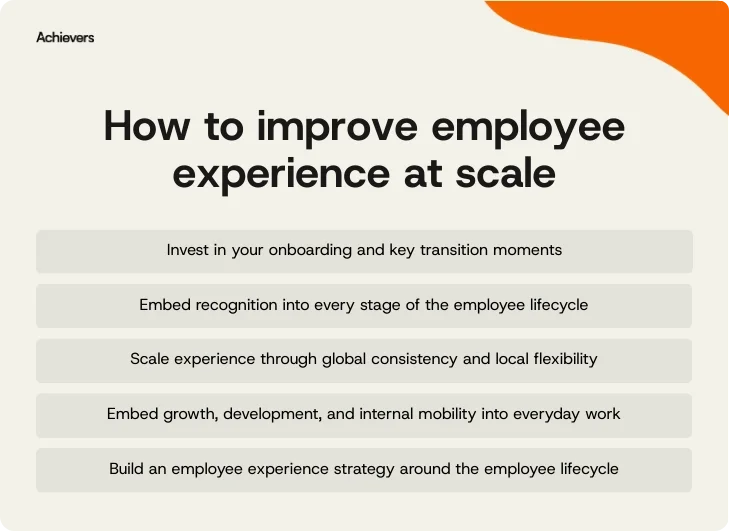
1. Invest in your onboarding and key transition moments
Strong onboarding sets the tone for everything that comes after — and right now, it’s where many organizations lose people before they’ve even settled in.
That’s why onboarding can’t end after week one. Stretch it into a full year, reinforce expectations clearly, and use every transition — new role, new manager, new team — as a chance to build confidence instead of confusion. When you get these moments right, employees feel like they joined a company that actually knows what to do with them.
What to do: Map out the moments that matter, then decide what support, clarity, or recognition employees should receive at each one so no one slips through the cracks.
2. Embed recognition into every stage of the employee lifecycle
Recognition isn’t a phase. New hires rely on it to feel anchored. Mid‑career employees use it to stay motivated. Long‑tenured employees need it to avoid feeling invisible.
Threading recognition into every stage doesn’t require a dozen new programs. It just means making appreciation a daily habit. When recognition shows up consistently, employees stop guessing whether their work matters — and start acting like it does.
What to do: Use a recognition platform to automate and prompt key moments — from week‑one welcomes to milestone check‑ins — so recognition becomes frequent, meaningful, and easy for managers and peers to deliver, no matter where or when it needs to happen.
3. Scale experience through global consistency and local flexibility
A great employee experience feels dependable, no matter where someone works, and still personal enough to reflect local culture, team norms, and daily realities. An employee experience platform makes that balance possible at scale, connecting recognition, feedback, and rewards across regions without losing local relevance.
Getting that balance right builds trust: the experience feels fair and human. Consistency creates stability; flexibility creates relevance. Together, they ensure every employee gets the same quality experience, delivered in a way that actually lands.
What to do: Set clear global standards for what “good experience” looks like, then give regions or teams room to adapt rituals, language, and recognition practices so they resonate locally.
4. Embed growth, development, and internal mobility into everyday work
Managers have a bigger impact on the employee experience than any policy, perk, or program — but most aren’t set up to lead with consistency. They’re juggling expectations, navigating change, and trying to support teams without enough visibility into what people need.
A recognition platform can help fill that gap. Smart nudges, prompts, and analytics give leaders the reminders and context they need to recognize often, communicate clearly, and catch small wins before they disappear.
What to do: Equip managers with a platform that surfaces who hasn’t been recognized, when key milestones are coming up, and where engagement is slipping, so they can act before problems grow legs.
5. Build an employee experience strategy around the employee lifecycle
A great experience requires listening — really listening. But employees quickly lose faith when feedback goes into a void, or when surveys don’t translate into anything meaningful.
Regular pulses, quick polls, and structured check‑ins give employees a voice. Pairing those signals with recognition moments shows employees their feedback isn’t just collected — it’s actually valued.
What to do: Use feedback tools to gather real‑time insights, then turn those insights into visible action and recognition moments, so employees see their input shaping real change.
6. Turn employee feedback into continuous improvement
Unclear expectations are one of the biggest contributors to disengagement and one of the easiest to fix. According to the State of Recognition data, 92% of employees feel unclear about what’s expected of them, which means most people are doing work while guessing whether they’re doing the right work.
Clarity paired with recognition removes confusion, boosts confidence, and dramatically improves performance.
What to do: Create simple expectation checklists for each role or stage, and use social recognition software to highlight when employees meet or exceed them — reinforcing clarity in real-time.
7. Protect well-being and prevent burnout with supportive tools and processes
Employee well-being isn’t just a perk. It’s a performance driver. But globally, well-being has been moving in the wrong direction. According to Gallup’s State of the Global Workforce Report, employee well-being has been declining since its peak at 35%. When people don’t feel supported, even the most well‑designed programs can fall flat.
Recognition plays a key role here. When employees feel seen and valued, it strengthens confidence, reduces stress, and creates that subtle-but-critical sense of “I’m not doing this alone.”
What to do: Use recognition to reinforce healthy team habits — calling out collaboration, resilience, and boundary-setting — and pair it with well-being check-ins so employees get support and appreciation, not one or the other.
8. Celebrate life events and milestones to make work more meaningful
Strong connection doesn’t just appear because people share a Slack channel or show up to the same meeting. It comes from everyday signals like recognition, communication, and follow-through that help employees feel part of something bigger than their to-do list.
Recognition makes those moments visible. A quick thank-you message helps employees feel included, especially in hybrid and distributed environments where connection can fade fast.
What to do: Encourage teams to share wins publicly through peer-to-peer recognition so people see each other’s impact, not just their own workloads.
9. Build diversity, equity, inclusion, and belonging into every experience
Values don’t shape culture unless employees see them in action. When leaders and peers call out behaviors tied to values, employees get a clear picture of what “good” looks like and how their work contributes to the bigger strategy.
This is where recognition becomes your teaching tool, reinforcing what matters and helping teams align their decisions, priorities, and efforts.
What to do: Define a set of value-based company core values inside your platform (i.e., “innovation,” “teamwork,” “creativity”), making it easy for employees and managers to tag recognitions to the behaviors you want more of.
10. Choose tools that connect recognition, feedback, and insights in one system
When recognition happens in private channels or dispersed tools, its impact shrinks. Visibility matters. It helps employees understand what good work looks like, builds team pride, and reinforces culture in a way that one-on-one praise simply can’t.
Recognition that’s brought into the open — across teams, locations, and integrated across workplace software — gives everyone a shared feed of wins. The small ones, the big ones, and the ones that would’ve gone unnoticed if someone hadn’t stopped to say something.
What to do: Create a public, company-wide feed so people can see wins across the organization and feel connected to something bigger than their own workload.
11. Create a supportive work environment and company culture focused on trust, leadership, and work-life balance
You can’t improve the employee experience if you can’t see it. Too many organizations skip straight to solutions without real data about where engagement is slipping, where recognition is low, or where well-being needs attention.
Analytics change that. When recognition, feedback, and engagement data live in one place, leaders can spot patterns early and respond quickly — long before issues turn into turnover.
What to do: Track recognition frequency, participation, and sentiment, then use those insights to guide manager coaching, strengthen culture, and double down on what’s actually working.
How to measure employee experience and where to act
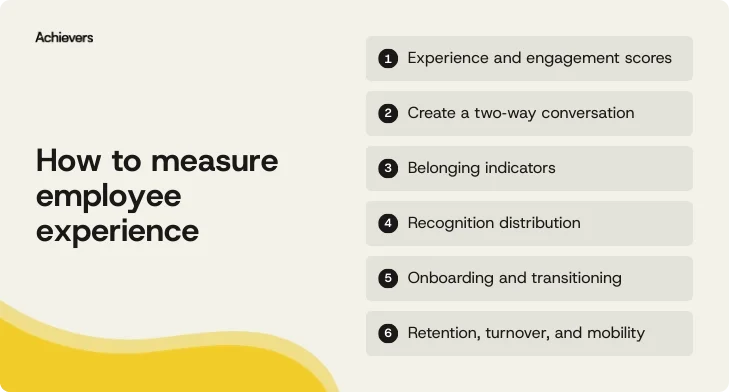
What metrics matter most for employee experience?
Experience and engagement scores
Experience and engagement scores show how employees actually feel about work — not just whether they show up. Track them regularly to see if your recognition, culture, and manager efforts are landing or just living in PowerPoint slides.
Manager effectiveness
Manager effectiveness is where most of the experience is made or broken. Measure things like trust, clarity, recognition frequency, and quality of 1:1s so you can support managers who need help and scale the habits of those who are getting it right.
Belonging indicators
Belonging metrics show whether employees feel included, valued, and connected — and pulse surveys are your fastest way to monitor those signals in real time. Consistent check‑ins help you spot early dips in connection before they lead to disengagement or turnover.
Recognition distribution
Recognition distribution shows whether appreciation is reaching everyone — not just the loudest contributors or the usual top performers. Pair your platform data with a manager checklist to ensure recognition is frequent, inclusive, and connected to the behaviors that matter most.
Onboarding and transition quality
Onboarding and transition metrics show how well you handle the most fragile parts of the employee journey, including first days, new roles, new managers, and restructures. Low scores here are a sign that employees are starting their story with confusion instead of confidence.
Retention, turnover, and mobility
Retention, turnover, and internal mobility data connect experience to real business outcomes. When you link who’s staying, leaving, and moving internally with their engagement, recognition, and manager scores, you see exactly where to invest — and where to intervene.
How to evaluate impact
Employee surveys and experience metrics
Surveys — especially satisfaction surveys and experience checks — give you a direct read on how employees feel about work. Short, frequent listening moments help you spot patterns early and show employees their feedback actually leads somewhere.
Journey mapping
Journey mapping helps you see the employee experience as a whole story rather than scattered touchpoints. When you line up feedback, recognition, and performance data across the lifecycle, the friction points (and the wins) become impossible to miss.
Combine quantitative and qualitative insights
Numbers tell you what is happening; comments tell you why. Blending both gives you a full, honest picture of the moments shaping your culture, and the ones quietly chipping away at it.
Compare benchmarks over time and against targets
Benchmarks turn data into direction. Tracking results across quarters, teams, and internal or external targets helps you see whether your efforts are actually improving experience or just maintaining the status quo.
Where to go from here: Building an experience that scales
Improving employee experience isn’t about grand gestures — it’s about getting the everyday moments right. When organizations build clarity, connection, and recognition into the flow of work, employees feel supported, managers feel equipped, and culture becomes something people experience, not something they read about in a handbook.
But in complex times, even the strongest cultures need reinforcement. Belonging doesn’t happen by accident — it’s shaped through intentional experiences, inclusive recognition, and leaders who know how to meet employees where they are.
Read to build that kind of workplace?
How to improve employee experience FAQs
Key insights
- Improving employee experience at scale starts with getting the everyday moments right — onboarding, recognition, clarity, and connection.
- Recognition is the thread that ties the entire experience together, strengthening engagement, well‑being, and performance across every stage of the employee lifecycle.
- When organizations combine consistent manager habits with data‑driven insights, they turn experience gaps into opportunities and build a workplace where people feel seen, supported, and set up to stay.