Table of contents
Create a culture that means business™
Schedule a demo with an Achievers solution expert today.


 Copy URL
What actually causes job burnout? (Hint: It’s not just workload).
In today’s workplace, burnout gets tossed around to describe everything from a bad Monday to inbox overload. But for HR and business leaders, treating burnout like a temporary energy dip is a costly mistake. Real burnout at work isn’t about being tired, it’s about being done.
Burnout is a systemic issue. Left unchecked, it quietly drains engagement, pushes top performers out the door, and slowly suffocates innovation. And no, the solution isn’t another meditation app.
When one employee checks out, the ripple effects are immediate: productivity drops, morale wobbles, and culture starts to fray at the edges. If you’re responsible for building a resilient, high-performing organisation, understanding why burnout actually happens is step one. Fixing it requires looking beyond surface symptoms and addressing the structural and cultural choices that created it in the first place.
This isn’t about “wellness theater.” It’s about protecting your most valuable asset: your people.
Stress vs. burnout: Key differences and signs of both
The World Health Organization (WHO) defines burnout as an “occupational phenomenon” with three specific dimensions.
- Feelings of energy depletion or exhaustion.
- Increased mental distance from one’s job, or feelings of negativism or cynicism related to one’s job.
- Reduced professional efficacy.
It’s a syndrome resulting from chronic workplace stress that has not been successfully managed. Let’s dig in a bit more to the difference between burnout and stress.
Stress gets a bad rap, but in high-performance environments, it’s not only normal — it’s expected. Stress is usually about too much: too many deadlines, too many decisions, too many Slack pings. The key difference? Stressed employees still believe relief is possible. “Once this project ships, I’ll breathe.”
Burnout is different. Burnout is about not enough — not enough energy, clarity, recognition, control, or purpose. It’s what happens when stress becomes chronic and hope quietly exits the building.
A stressed employee is flailing but still swimming.
A burned-out employee has stopped trying to stay afloat.
From an organisational standpoint, burnout is far more dangerous. It fuels disengagement, “quiet quitting,” and eventually, very loud resignations.
The 8 drivers of burnout (and why workload is only one piece)
Yes, workload matters — but burnout rarely shows up because of a single factor. It usually appears when multiple breakdowns stack on top of each other. Here are the most common ones leaders need to watch.
1. Unsustainable workload (or: when competence gets punished)
This one’s obvious, and often mishandled. Burnout isn’t just about long hours; it’s about cognitive load and recovery.
In many organisations, high performers are rewarded with…more work. They get the biggest projects, the tightest deadlines, and zero relief from their existing responsibilities. Eventually, success starts to feel like a trap.
Add an always-on digital culture, Slack, Teams, email at all hours, and recovery disappears entirely. When people never fully disconnect, they never fully recharge. Over time, even work they love becomes exhausting.
2. Lack of control: accountability without authority
People need autonomy. When employees are responsible for outcomes but have no say in how the work gets done, cynicism shows up fast.
This often looks like micromanagement, endless approvals, or strategy changes handed down without context. Employees feel like passengers in a car they’re expected to drive — but aren’t allowed to steer.
Restoring control doesn’t mean chaos. It means setting clear outcomes, trusting professionals to do their jobs, and giving teams the tools and flexibility to manage their work intelligently.
3. Effort without recognition (the fastest way to kill motivation)
Work is transactional but meaning is emotional.
Compensation matters, of course. But the real burnout accelerator is invisible effort. When people push through obstacles, help teammates, or go above and beyond — and the response is silence — work starts to feel pointless.
A results-only culture without recognition creates defensive employees. They stop aiming for excellence and start aiming for “don’t get blamed.”
Frequent, specific recognition isn’t fluff. It’s fuel.
4. The slow erosion of community
Work is a social experience, even on Zoom.
When community breaks down, burnout speeds up. Isolation, unresolved conflict, and lack of support make every challenge feel heavier. Hybrid and remote work have only raised the stakes here. Without intentional employee connection, work becomes purely transactional.
In unhealthy environments, people spend more energy protecting themselves than collaborating. They don’t ask for help. They don’t speak up. Psychological safety evaporates.
Strong communities don’t happen accidentally anymore. They have to be designed.
5. Perceived unfairness (the trust killer)
Nothing drains engagement faster than the belief that the game is rigged.
When promotions feel opaque, rewards inconsistent, or policies selectively enforced, trust erodes. And unfairness doesn’t have to be dramatic — it often shows up in small moments. Who gets visibility? Whose ideas get airtime? Who gets the benefit of the doubt?
Once employees believe effort and outcomes aren’t connected, they disengage emotionally. They stop partnering with the organisation and start protecting themselves from it.
Transparency isn’t optional here — it’s foundational.
6. Values conflict: when the brand story doesn’t match reality
This one cuts the deepest.
Burnout accelerates when employees are asked to act in ways that contradict their own values, or the company’s stated ones. Saying “we value work-life balance” while celebrating midnight emails creates cognitive whiplash.
When people are forced to compromise their integrity or professional pride, emotional detachment becomes a survival mechanism. Caring starts to hurt, so they stop.
Purpose isn’t a perk. It’s a retention strategy.
7. Role ambiguity
A quiet contributor to burnout that’s often missed by leaders is role ambiguity. When expectations are unclear, or constantly changing, employees live in a state of low-grade anxiety. They spend more time figuring out what success at work means than achieving it. In matrixed organisations, this is especially dangerous.
Clarity is calming. Confusion is exhausting.
8. Stagnation
Burnout doesn’t always come from too much work. Sometimes it comes from too little growth.
High performers need momentum. When development stalls and career paths disappear, boredom sets in — and boredom is draining. It signals that the organisation isn’t invested in the employee’s future.
Why recognition is a burnout countermeasure (not a “nice-to-have”)
Recognition doesn’t replace structural fixes — but it accelerates recovery across several burnout drivers at once.
- It closes the effort-reward gap by making contributions visible
- It rebuilds community through peer-to-peer appreciation
- It reinforces core values by spotlighting behaviours that actually matter
When recognition is timely, specific, and embedded in daily workflows, it sends a powerful message: “You matter. Your work matters. We see you.” That message goes a long way.
Preventing job burnout: Moving from awareness to action
The impact of managers on an employees workplace experience and resilience is undeniable. According to research from the Achievers Workforce Institute (AWI) and data from the Engagement and Retention Report: APAC edition, which surveyed over 500 employees across the region, shows us that employees in Singapore are feeling burnout and may be approaching their breaking point — just 18% see a long career at their current company and 43% plan to look for a new job in 2026. Reasons to go include being overlooked on a major project (23%), leaving a toxic boss (38%), or if workload increased without support (39%).
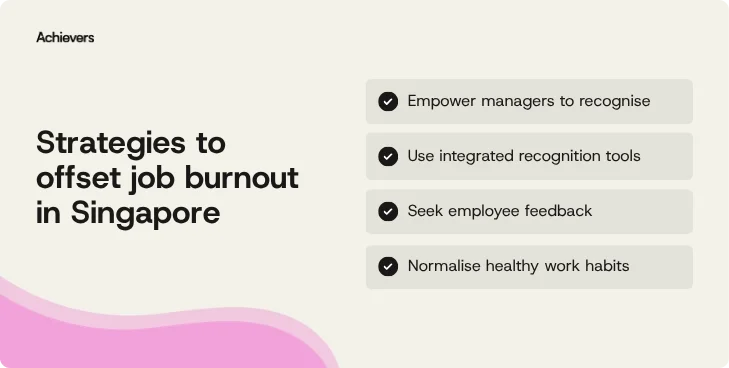
Setting both managers and employees up for success is crucial for stemming off burnout. Here are some strategies on how to get started:
1. Measure what actually matters
Ask employees about workload sustainability, recognition, clarity, and fairness. Look at results by team, not just company-wide averages.
2. Equip managers, don’t overwhelm them
Managers are your first line of defense — and often your most exhausted group. Give them data, authority, and simple tools to recognise and support their teams in real time.
3. Normalise healthy behaviour from the top
If leadership treats burnout as a badge of honor, no program will fix it. Boundaries have to be modeled, not memo’d.
4. Match culture goals with the right tools
If appreciation matters, make it easy. If voice matters, make it safe. Your tech stack signals what you truly care about.
Addressing the causes of job burnout
Burnout isn’t inevitable in high-performing organisations, or those striving to be. Burnout the result of how work is designed, managed, and rewarded.
Organisations that thrive understand this: people aren’t machines to be run until failure. They’re contributors to be supported, recognised, and aligned with purpose.
At Achievers, we’re experts in making work, work better. We know that when employees feel seen, trusted, and valued, they don’t just stick around; they bring their best ideas, their energy, and their loyalty.
And that’s not just good culture. That’s good business.

Causes of job burnout FAQs
Key insights
- Burnout often shows up not when people care too little, but when they care deeply for too long without support or acknowledgment.
- The fastest way to lose top talent isn’t asking for more effort — it’s failing to explain why the effort matters and how success is defined.
- Culture isn’t shaped by mission statements; it’s shaped by what leaders reward, ignore, and tolerate every single day.
| Topic | Stress | Burnout |
|---|---|---|
| Definition | Feeling under pressure when things start piling up | Feeling completely worn out when stress has gone on too long |
| Example | Being nervous or overwhelmed before a big meeting or presentation | Feeling numb and unmotivated after months of non-stop work |
| Causes | Too much to do, tight deadlines, everyday pressures | Long-term stress with little rest or support |
| Length | Usually short-term and goes away once things calm down | Builds up slows and sticks around |
| Energy levels | May feel tense but with energy to push through | Feeling drained and exhausted most of the time |
| Motivation | Still want to get things done | Hard to care or feel motivated anymore |
| Recovery | Improves with rest or taking a break | Takes more time and often real lifestyle changes |