Key insights
- Today's top talent wants an employer that delivers on purpose, growth, and recognition — not just a paycheck.
- Everyday employee experiences, from onboarding to manager support, have a bigger impact on retention than employer branding alone.
- Frequent, meaningful recognition is one of the strongest drivers of engagement, connection, and long-term retention.
Attracting top talent — and getting them to stick around — isn’t getting any easier. According to Gallup, 52% of U.S. employees are either casually browsing or full-on job hunting right now. Yep, that means half your team might be quietly updating their résumés and are open to an exit.
In a market this tight (with expectations this high), companies can’t just “see what happens.” People want more than a paycheck. They’re looking for purpose, growth, and a culture that actually backs up what it says. Enter your employee value proposition (EVP) — not the shiny, marketing-approved version on your careers page, but the one employees experience every single day.
When your EVP is strong, magic happens. Your employer brand gets a boost, the right candidates raise their hands, and your best people stick around longer. But here’s the catch: it’s not just what your EVP is — it’s how you tell the story. Show off your company culture, values, and real employee experiences everywhere candidates are looking: your careers page, social channels, and review sites. Trust us, they’re paying attention.
So… ready to put your EVP to work?
13 key strategies to attract top talent
So how do you attract top talent — and keep them from wandering? It starts with the everyday moments that shape your culture. From onboarding to recognition to manager support, every interaction plays a part in whether someone stays for the long haul or starts updating their LinkedIn.
Here are 13 real-world ways to attract and retain top talent in 2025 — and build a workplace they’ll want to grow with.
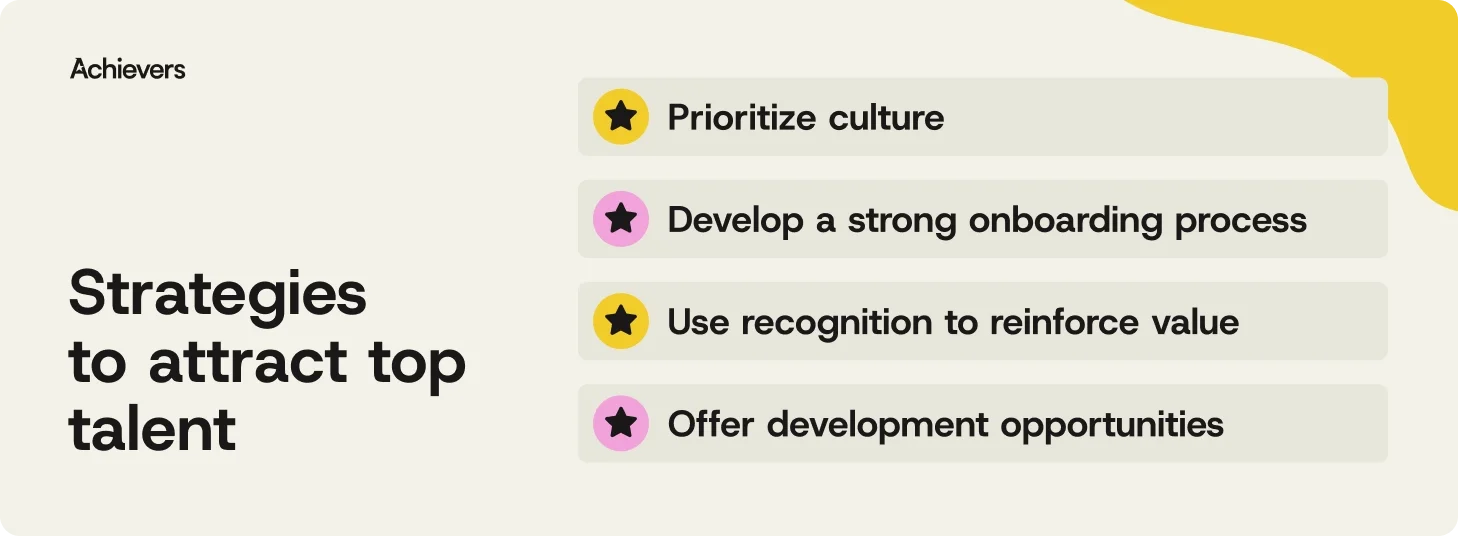
1. Prioritize culture — not just credentials
Skills can be trained. Alignment with your company’s core values? That’s harder to coach. A strong culture fit helps people thrive — and stick around.
- Weave culture into the hiring process: Go beyond job requirements — include what success looks like at your company and how your team works together.
- Be honest about your workplace environment: Candidates can handle the truth (and they’ll appreciate not being surprised later).
- Invest in a culture worth keeping: Inclusion, trust, psychological safety — these aren’t “extras.” They’re what top talent looks for before they sign on. And for today’s workforce, DEI isn’t optional — it’s expected. Candidates want to see that your company values diverse voices and creates space for everyone to contribute.
If your culture’s working, your best candidates will see themselves in it — and your best employees won’t want to leave it.
2. Develop a strong onboarding process
You don’t get a second chance to make a first impression. Onboarding should make new hires feel equipped, connected, and confident — not guessing what comes next.
- Design onboarding as a journey, not a checklist: Extend support and learning over the first 90 days — or even the full first year.
- Balance clarity with connection: New hires need structure, but they also need to meet people, find purpose, and build momentum.
- Ask what’s working and what’s not: Onboarding is a two-way experience. Regular feedback loops show you’re listening from day one.
Strong onboarding isn’t just about getting new hires up to speed — it’s about making sure they want to stay.
3. Use recognition to reinforce value
Appreciation might not be magic, but it gets pretty close. It’s what keeps people motivated, loyal, and showing up ready to make an impact.
- Move beyond manager-only recognition: Give everyone the tools to recognize great work in real time, no matter their role or location.
- Make it personal and visible: Public recognition tied to core values reinforces what good work looks like and why it matters.
- Reward frequently and fairly: Mix social shoutouts with meaningful, flexible rewards to keep momentum high and teams engaged.
When recognition is easy, inclusive, and consistent, it becomes part of your culture — not just a line item.
4. Offer opportunities for continuous learning
Stagnation is a dealbreaker for high performers. If people don’t see a path forward, they’ll start building one somewhere else.
- Treat employee development like a benefit, not a bonus: Upskilling and reskilling should be a core part of the employee experience, not something squeezed in “if there’s time.”
- Offer real opportunities, not just resources: Create space for mentorship, cross-functional projects, and certifications — and make sure managers champion them.
- Let employees drive their own growth: Ask what they want to learn, then remove the red tape that slows them down.
When learning is part of the job, your best people won’t feel the need to look elsewhere.
5. Support employee wellness
You can’t attract top talent if you burn them out once they arrive. Wellness isn’t just about preventing churn — it’s about helping people perform at their best.
- Start with flexibility: Whether it’s where, when, or how they work, give people more control over their day-to-day.
- Go beyond awareness campaigns: Mental health apps and EAPs are great — but only if they’re visible, accessible, and normalized.
- Build a culture that respects boundaries: Model healthy behavior from the top, and employees will follow your lead (instead of faking availability).
People do their best work when they’re not running on fumes. Prioritize wellness, and performance follows.
6. Help employees find meaning in their work
Top talent isn’t motivated by busywork. They want to know their efforts matter — to the team, the company, and the mission.
- Connect the dots: Show how individual contributions drive team wins, customer outcomes, or company impact.
- Tie recognition to purpose: A “thank you” hits harder when it highlights the real-world effect of someone’s work.
- Give people room to take ownership: People find more purpose when they’re not just doing the work but helping define it.
When employees can see the ‘why,’ they’re more invested in the ‘how.’
7. Offer competitive compensation and benefits
Yes, employees want purpose and culture. But they’re also paying rent. Compensation may not be the only factor — but it’s still a big one.
- Benchmark regularly and transparently: Pay should reflect market reality — and you should be willing to talk about how it’s set.
- Think total rewards, not just salary: Health benefits, workplace equity, bonuses, time off — these all shape how employees see their value.
- Avoid the bait and switch: Overpromising and under-delivering on compensation will cost you trust faster than any exit interview can fix.
You can’t pay people in purpose. Competitive, fair pay is still table stakes for attracting (and keeping) top performers.
8. Cultivate great managers
People might join because of your brand — but they leave because of their manager. Leadership can make or break the employee experience.
- Train managers to lead people, not just projects: Invest in coaching, regular feedback, and people-first skills — not just performance reviews.
- Give them the tools to support their teams: Think recognition, feedback loops, and real-time insights into engagement and sentiment.
- Hold them accountable for culture: Great managers build trust, team alignment, and inclusion at work — and that should be part of how they’re measured.
Your culture lives or dies in the hands of your managers. Choose and support them wisely.
9. Encourage internal mobility
If employees can’t grow with you, they’ll grow without you. Internal mobility is one of the most effective, and underused, retention tools.
- Make career paths visible and accessible: Let employees know what’s possible, and remove the barriers to making moves.
- Normalize cross-functional growth: People evolve. So should their roles. Help employees explore different tracks without penalizing them for it.
- Recognize and reward internal moves: When someone levels up or pivots, celebrate it publicly.
Help your employees grow where they are, and you’ll spend a lot less time replacing them.
10. Create a culture of feedback
Top talent wants to grow — and that means knowing where they stand. But feedback only works when it’s part of the culture, not a quarterly event.
- Make feedback regular and two-way: Employees should receive real input on their work — and be encouraged to give feedback, too.
- Train managers to deliver genuine feedback: Honest, timely conversations build trust and drive growth.
- Connect feedback to action: Employees are more likely to speak up when they see their input leads to real change.
A culture of feedback keeps communication honest, development ongoing, and trust intact.
11. Build connection across teams
People don’t just want a job — they want to feel part of something. And in today’s hybrid and distributed world, employee connection takes more than casual coffee chats.
- Design moments for connection: Don’t leave it to chance. Whether it’s cross-team projects, interest groups, or virtual hangouts, make space for people to engage.
- Recognize contributions publicly and often: Frequent recognition builds visibility across the organization and gives people a reason to celebrate each other.
- Use tech to bridge the gaps: A modern platform can help teams share appreciation, updates, and wins — wherever they’re working.
Connected teams don’t just collaborate better. They stay longer, too.
12. Invest in employee recognition
Recognition might seem simple, but platforms like Achievers have shown just how powerful it can be when it’s done right. When recognition is frequent, meaningful, and tied to values, it becomes one of your strongest tools for attracting and keeping top talent.
- Make recognition part of the everyday experience: According to Achievers Workforce Institute (AWI), employees who are meaningfully recognized at least monthly are 80% more likely to recommend their company as a great place to work. That kind of advocacy doesn’t just reflect engagement — it helps strengthen your employer brand from the inside out.
- Empower everyone to recognize: The most impactful programs aren’t top-down. They give everyone a role in celebrating wins and reinforcing what matters. When recognition is easy and accessible, usage goes up. In fact, companies using platforms like Achievers see twice the activity compared to others.
- Back it with meaningful rewards: Not every thank-you needs a reward — but when it does, it should feel personal. A wide range of flexible, locally relevant options from platforms like Achievers ensures that recognition actually resonates, whether employees are in Toronto, Tokyo, or working from home.
Recognition is one of the most effective ways to attract top talent — and Achievers was built to help you do it right.
13. Tap into employee referrals
Your current team might be your best untapped recruiting tool. When employees recommend someone, it’s usually because they believe that person will add value and make a lasting impact.
- Offer simple, visible incentives: Make it easy to refer someone, and worthwhile when it works out.
- Keep the process clear: Let employees know how referrals are reviewed — and don’t leave them in the dark once a name is submitted.
- Recognize successful referrals: A quick shoutout (and a solid reward) goes a long way in encouraging more of the same.
Referrals aren’t just faster and more cost-effective, they bring in people who already have a head start on your culture.
How to attract and retain top talent FAQs
Attracting and retaining top talent in 2026 is challenging because today’s workforce is more mobile, selective, and open to change. With over half of U.S. employees actively or passively job hunting, companies must compete on more than pay. Purpose, growth, culture, and everyday employee experiences now play a major role in whether top talent joins—and stays.
An employee value proposition plays a critical role in attracting top talent because it shapes how employees and candidates experience your organization day to day. A strong EVP goes beyond marketing language and reflects real culture, values, and growth opportunities. When communicated consistently, an EVP helps attract the right candidates and encourages employees to stay longer.
Recognition helps attract and retain top talent by making employees feel appreciated, connected, and valued for their contributions. Frequent, meaningful recognition reinforces company values and shows employees their work matters. According to engagement research, employees who feel recognized are far more likely to find work meaningful, stay engaged, and recommend their company as a great place to work.
Culture fit is more important than skills when hiring top talent because skills can be taught, but values alignment is harder to develop. Employees who connect with a company’s culture are more engaged, collaborative, and likely to stay. Hiring for culture helps build trust, inclusion, and psychological safety—key factors that today’s talent expects from an employer.
Companies can attract top talent while improving retention by focusing on everyday employee experiences, not just recruitment efforts. Strong onboarding, supportive managers, meaningful recognition, growth opportunities, wellness, and clear purpose all influence whether employees stay. When organizations consistently deliver on these moments, they become places people want to join—and continue growing with long term.
Attract and retain the talent that keeps your business moving
To attract top talent, you have to give them a reason to choose you, and a reason to stay. That’s where recognition comes in.
Achievers helps you turn values into actions — and actions into results. With tools that make appreciation easy, frequent, and actually meaningful, you can build the kind of culture people want to be part of. One that stands out to job seekers and stands up to retention risks.
Because attracting great people is hard enough. Keeping them? That takes recognition that actually works.