Table of contents
Create a culture that means business™
Schedule a demo with an Achievers solution expert today.


 Copy URL
Workplace equity should be the norm in organizations. Everyone deserves fair access to opportunity, recognition, and a real sense of belonging. But the numbers are still catching up. Research from Deloitte’s Women @ Work 2026 Report found that out of 7,500 women surveyed across 15 countries, only 10% make up C-suite and board members.
Equity can’t live in a mission statement; it has to show up in who gets recognized, who gets promoted, and who feels like they truly belong.
What is equity in the workplace?
Workplace equity means making sure every employee has fair access to opportunities, resources, and recognition so they can fully contribute and grow. It’s not about treating everyone the same; it’s about removing systemic barriers, addressing individual needs, and creating a culture where success feels possible for everyone, not just a select few.
Why is equity important in the workplace?
Fairness shouldn’t feel like a bonus. When people trust that they’ll be heard, recognized, and given a real chance to grow, they’re more likely to stay engaged and show up with purpose.
Here’s what happens when equity is part of the everyday:
- Higher engagement: When employees feel genuinely supported, engagement goes up, along with energy, purpose, and maybe even job satisfaction.
- Stronger collaboration: Equitable workplaces make space for more voices, which means more collaboration, better decisions, and less side-eye.
- Better performance: When people have the right tools and support, they’re set up to succeed, and they do.
- Talent attraction: A culture built on fairness and belonging retains talent, and it also attracts it. Research from Achievers Workforce Institute found that 17% of employees surveyed in 2026 would return to a previous company for better appreciation.
- Healthier workplaces: Equity supports more than performance. It supports people and that’s what builds a company culture worth staying for.
Equity vs. equality in the workplace
Equity at work focuses on the support employees receive from their managers and the organization to account for individual challenges, systemic barriers, or unique circumstances. Equity ensures staff have fair access to the tools and resources they need to succeed.
Equality at work means treating all employees the same and allocating the same amount of resources, with the assumption that everyone faces the same circumstances and is beginning from the same starting point.
What are the principles of equity in the workplace?
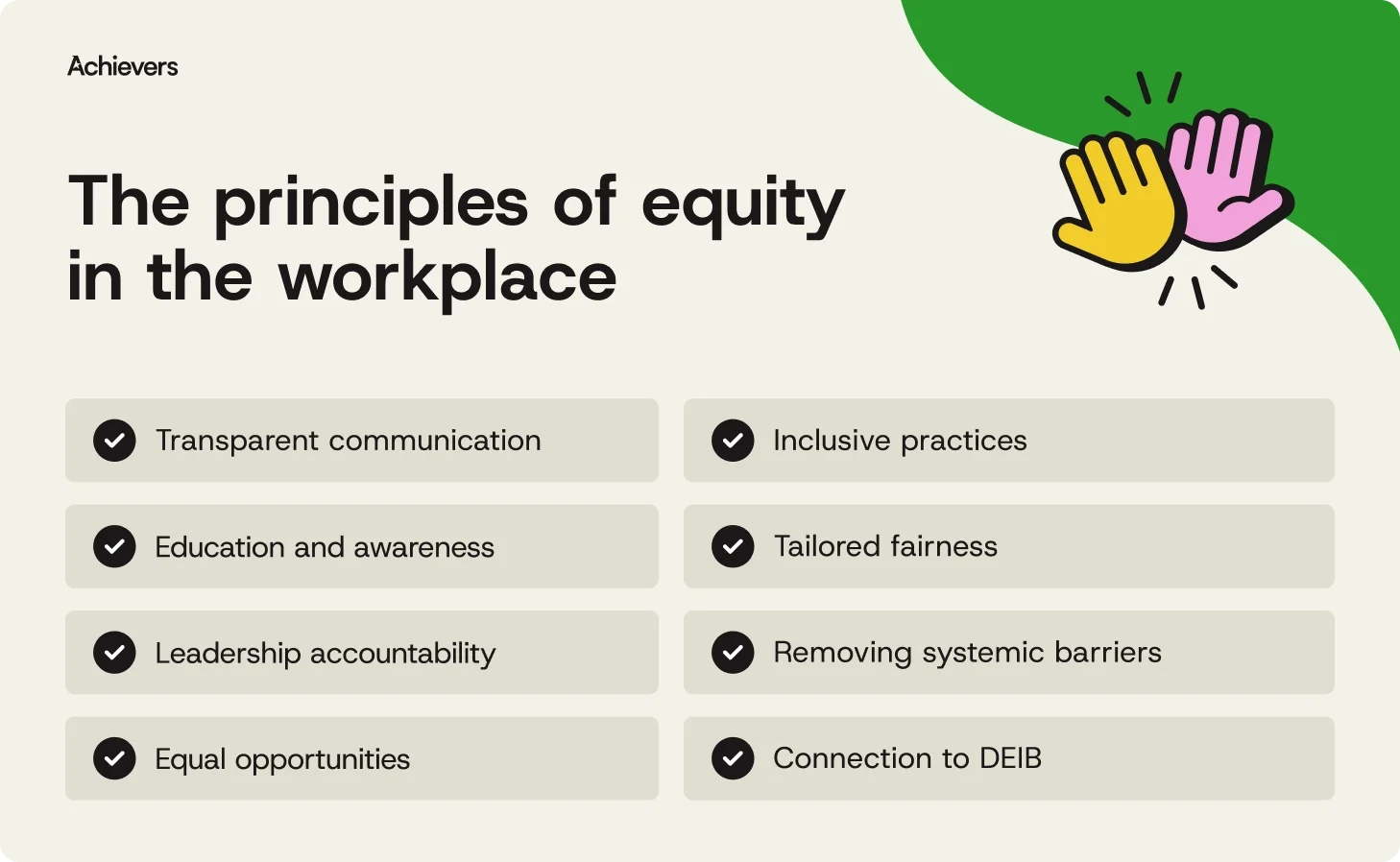
- Transparent communication: Trust grows when people understand how decisions are made — not through whispers, but through clear, open dialogue.
- Education and awareness: Building equity starts with seeing the gaps. Ongoing education, bias training, and honest conversations help people become part of the solution.
- Leadership accountability: Equity needs action, not slogans. Leaders should set goals, track progress, and stay connected through tools that surface real-time feedback and recognition.
- Equal opportunities: Everyone deserves a fair shot at growth and leadership. People who see promotion equity in their workplace are more than twice as likely to say they can see themselves having a long career at the company.
- Inclusive practices: Equity should show up in every touchpoint, from hiring to performance reviews and frequent recognition.
- Tailored fairness: Equity is about giving people what they need to succeed. That might look different for each person, and that’s the point.
- Removing systemic barriers: Equity means tackling the systems that quietly hold people back, from biased job descriptions to one-size-fits-all policies, and doing the work to break them down.
- Connection to DEIB: Equity is what turns good intentions into real outcomes by making sure everyone has the tools, support, and recognition they need to thrive.
How to improve workplace equity
To improve workplace equity:
- Diversity mentorship programs: Connect senior leaders with employees from underrepresented groups to support growth and break down career roadblocks. It’s about access, visibility, and opening doors that have been closed for too long.
- Employee Resource Groups (ERGs): ERGs give employees a place to connect, share, and advocate. They can also influence policy, shape culture, and build real community.
- Diversity training: Meaningful DEIB training should spark self-awareness, challenge assumptions, and give people the tools to lead more inclusively at every level.
- Celebrate cultural holidays: Inclusion shows up in the details. Recognizing cultural and religious holidays, and giving people the space to celebrate them, is a small act that sends a big message: you belong here.
- Promote accessibility: If people can’t fully participate, they can’t fully belong. Make sure your spaces, physical and digital, work for everyone, whether that means screen readers, ramps, or simply more thoughtful design.
- Examine onboarding: Onboarding is your culture’s first impression. Make sure it’s welcoming, inclusive, and doesn’t assume everyone comes in knowing the unspoken rules of the office.
- Update hiring practices: Using clear criteria, diverse panels, and consistent interviews helps reduce bias and keeps the playing field level. Don’t wait for problems to show up before reviewing your process. Check in often to make sure it’s still working for everyone.
- Recognize unconscious bias: Help your people name bias, check it, and move toward more objective, fair decisions, especially when it comes to hiring and promotions.
- Promote DEIB from the top: Make equity a leadership priority by setting goals, tracking progress, and celebrating wins along the way.
Why recognition belongs in your workplace equity strategy
Recognition belongs in your workplace equity strategy because it helps make employee effort and impact visible across the business, ensuring everyone is equally seen and appreciated for their contributions.
Recognition programs like Achievers make appreciation feel natural instead of forced. They fit right into the tools your team already uses, offer rewards people actually want, and even help avoid the awkward “good job!” emails. And when recognition feels authentic, it makes people feel like their work matters.
Best practices for workplace equity
1. Make leaders accountable for equity outcomes
Making leaders accountable for outcomes helps turn equity goals into everyday business decisions. Leaders should regularly review workforce trends, employee feedback, and development opportunities to understand where barriers may exist and where additional support is needed.
2. Make equity measurable
Making equity measurable starts with understanding where access, advancement, and visibility gaps exist. Review hiring, promotion, retention, employee feedback, and recognition data regularly to identify patterns and track progress over time. Recognition data can be especially useful because it shows who’s being seen, supported, and celebrated across the organization.
3. Expand access to hiring opportunities
Expanding access to hiring opportunities helps organizations build stronger and more representative talent pipelines. Working with professional associations, community organizations, and diverse talent networks increases the number of candidates you’ll reach and helps avoid relying on the same referral channels and recruiting sources.
4. Standardize hiring decisions
Standardizing hiring decisions reduces inconsistency and creates a fairer candidate experience. Structured interviews, skills-based assessments, and standardized evaluation criteria help ensure hiring decisions are based on qualifications and job-related skills.
5. Create transparent career pathways
Creating transparent career pathways helps employees understand how advancement decisions are made. Clear promotion criteria, growth opportunities, and accessible development plans reduce ambiguity and help employees trust the process.
6. Create clear promotion standards
Creating clear promotion standards helps employees feel confident that advancement decisions are fair. Consistent evaluation criteria and promotion frameworks help reduce uncertainty and support more objective decision-making.
7. Build accessibility into everyday work
Building accessibility into everyday work helps ensure all employees can fully participate. Accessible, integrated technology, inclusive communication practices, and thoughtfully designed workspaces support a wider range of employee needs and experiences.
8. Reinforce inclusive behaviors
Reinforcing inclusive behaviors helps turn awareness into everyday actions. Training can build knowledge, but lasting change happens when organizations consistently recognize, coach, and reward behaviors that contribute to inclusion, belonging, and equitable decision-making.
How to measure equity in the workplace: A checklist
To measure equity in the workplace:
- Look at pay equity: Break down compensation data across roles, experience levels, and demographics. People doing similar work should be paid fairly.
- Track promotion rates: Take a close look at who’s moving up. If certain groups are consistently underrepresented in leadership, it’s a sign your advancement pathways need rethinking.
- Run feedback surveys: Ask employees how they’re experiencing your culture. Do they feel included? Valued? Do they believe they have a fair shot at growth? The answers offer insight you won’t get from spreadsheets alone.
- Audit your hiring practices: Check if your recruitment process is welcoming to a wide range of candidates, not just on paper, but in experience. Look at who’s applying, who’s advancing, and who’s getting offers.
- Analyze recognition patterns: Recognition data offers a unique lens into equity. Are certain teams or demographics being recognized more often, or not at all? Are you using a recognition platform to help uncover those trends so you can close visibility gaps before they turn into retention issues?
- Use insights to spot trends early: Tools like Achievers help uncover equity gaps through real-time recognition and engagement data, making it easier for leaders to respond with intention, not guesswork.
- Review and act on the data: Track trends over time, share the results openly, and use them to guide smarter, more inclusive decisions.
Auditing recognition data for fairness and equity
Auditing recognition data for fairness and equity means examining who receives recognition, who gives it, and which contributions are being celebrated across the organization. Recognition is one of the clearest real-time signals of what an organization values, so recognition gaps often surface before equity issues appear in engagement, retention, or promotion data.
A thorough audit should analyze participation patterns, recognition coverage, adoption gaps, and collaboration trends to understand whether visibility is distributed fairly across teams, roles, locations, and employee groups. Recognition data can reveal whether certain employees consistently receive recognition while others make meaningful contributions that go unnoticed.
Auditing also means looking at the quality and context of recognition. Recognition themes, skills, values, and contribution patterns can highlight for leaders which behaviors are being reinforced and whether recognition aligns with business priorities.
Turn equity into action with Achievers
True equity at work is built into everyday moments, from who gets recognized to who is able to grow in their role.
The goal is to be better; more aware, more inclusive, more human. That’s what turns equity from a line in your mission statement to something your people feel. And that’s exactly the kind of culture Achievers help companies build, one recognition, one insight, one intentional moment at a time.
Equity in the workplace FAQs
Key insights
- Workplace equity is a visibility problem as much as a policy problem. Employees can't access fair opportunities if their contributions aren't consistently seen, recognized, and connected to growth.
- Organizations build more equitable workplaces when they remove barriers to recognition, development, and belonging instead of relying on generic employee experiences that lack meaning and personalization.
- Recognition is one of the few equity levers that operates in real time. While pay reviews and promotions happen periodically, recognition shapes who feels valued, included, and supported every day.