Table of contents
Create a culture that means business™
Schedule a demo with an Achievers solution expert today.


 Copy URL
Deskless and offline workers are the people who keep work moving, from serving customers to keeping lines running on the factory floor. And they’re not a small group either. According to research, deskless workers make up 70 to 80% of the global workforce.
Yet many recognition programs are still built for desks, inboxes, and logins, which means frontline teams are often left out. When recognition doesn’t reach them, it’s harder for people to feel seen, understand what matters, or stay connected to the bigger picture.
This guide is the first step to changing that. You’ll learn what recognition looks like when it’s designed for non‑desk teams — from program ideas and reward strategies to practical ways to deliver recognition where (and how) people actually work.
Understanding non-desk and offline workers
Non-desk and offline workers are employees whose jobs aren’t assigned to a desk or a single workstation. They’re on retail floors, factory lines, hospital units, loading docks, job sites, and out in the field — often moving, collaborating, and solving problems in real time.
Their work realities shape how they experience engagement and retention. Shift schedules, shared devices, physical demands, and limited access to digital tools mean they have fewer built‑in moments for feedback, visibility, or connection. And when recognition does happen, it’s often informal, inconsistent, or easy to miss.
Key challenges and goals of recognition programs for non-desk and offline workers
Common challenges
There are many challenges non-desk employees face when it comes to recognition programs. For frontline teams, access is the first barrier. Many employees don’t have regular access to a work computer or corporate email, which immediately limits who can participate in recognition programs and how often recognition happens.
Work structures add another layer. Shift schedules, shared devices, and distributed locations make it harder to deliver recognition consistently, especially when teams rarely overlap or work asynchronously.
These realities often lead to recognition inequality, with desk-based employees receiving more of the acknowledgements and thank-you messages. Not because they’re contributing more, but because their offline colleagues don’t have the right tools or processes to be a part of the conversation.
Core goals HR leaders should prioritize
To ensure recognition reaches everyone, HR leaders need a program that allows 100% of the workforce to participate, regardless of role, location, or access to technology. With the right recognition platform, the next step is to prioritize in-the-moment appreciation. Recognition that happens close to the work itself is more meaningful and more likely to reinforce the right behaviors.
Visibility matters, too. Strong programs make frontline contributions visible across teams and the broader organization, helping employees feel seen and valued. Not only that, but according to the State of Recognition Report, 45% of employees surveyed believe recognition would make them more productive. When recognition is tied to what matters most, it shows people that their work counts, even when no one’s watching.
How to bridge the gap between corporate and floor staff
One of the biggest challenges facing organizations today is ensuring frontline employees feel as connected, informed, and valued as their corporate counterparts. When communication, recognition, and visibility flow primarily through desk-based channels, non-desk workers can feel excluded from the company culture.
According to Achievers Workforce Institute (AWI) research, only a small percentage of employees feel connected to the people and information they need to succeed, making connection a critical driver of employee engagement and retention.
Recognition helps bridge the gap between corporate and floor staff by creating shared visibility, reinforcing company values, and helping every employee understand how their work contributes to organizational success. When recognition is accessible to everyone — regardless of location, shift, or device access — it becomes a powerful tool for building belonging across the workforce. Frontline employees who feel seen and appreciated are more likely to stay engaged, productive, and connected to the larger organization.
To close the gap between corporate and frontline teams, organizations should:
- Make recognition accessible everywhere: Use mobile-friendly and offline-capable recognition tools that meet employees where they work
- Create visibility across roles: Celebrate frontline contributions alongside corporate achievements to reinforce that every role matters
- Equip managers to act as connectors: Frequent recognition helps managers build trust, strengthen relationships, and keep employees aligned with organizational priorities
- Encourage peer-to-peer recognition: Recognition across teams and functions helps break down silos and strengthen workplace connections
- Connect recognition to company values: Showing how frontline work supports broader business goals helps employees see their impact and purpose
When recognition becomes part of the daily employee experience, it does more than say “thank you.” It creates a bridge between the corporate office and the front line, helping employees feel connected to their colleagues, leaders, and purpose — regardless of where they work. AWI research shows that connection is one of the strongest drivers of engagement, belonging, and retention, making recognition a practical way to turn separate employee experiences into a shared culture.
Why recognition matters more for frontline and offline teams
Recognition as a driver of connection and belonging
Offline employees have fewer built‑in moments for feedback and connection. They’re less likely to be in meetings, fewer messages cross their inboxes, and great work can easily go unseen. Recognition helps close that gap. Being recognized by a peer, a manager, or the broader organization reinforces that sense of belonging and sends a clear message: you matter here. Over time, these moments of appreciation help non-desk team members feel part of something larger than a shift, a route, or a task list.
Reinforcing clarity, confidence, and contribution in hands-on roles
In hands‑on environments where priorities can change quickly, calling out specific actions helps employees understand what “good” looks like. Recognizing behaviors tied to safety, service, or teamwork builds confidence and reinforces how the effort of one person connects to the larger business goals.
Recognition programs for non-desk and offline workers
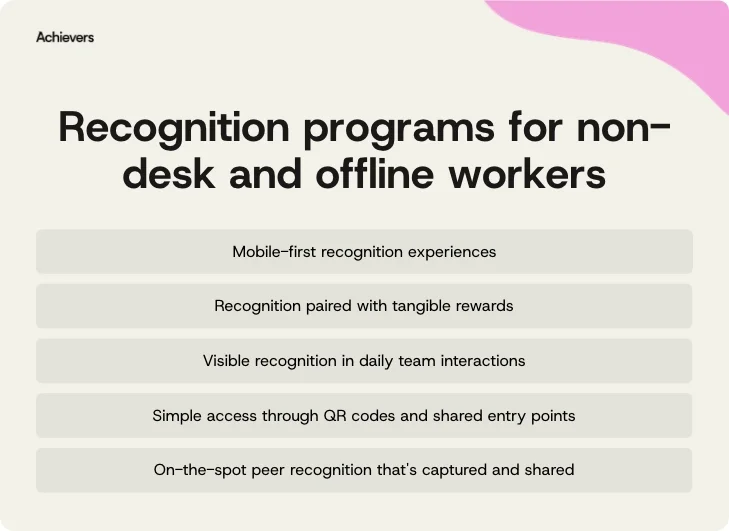
Mobile-first recognition experiences
What this solves: Lack of access.
Mobile-first recognition experiences make recognition accessible at the moment great work happens. If employees need a desktop computer, corporate email address, or shared terminal to participate, recognition becomes harder to give, receive, and repeat. For non-desk employees, access is often the difference between a recognition program that drives participation and one that gets ignored.
How HR leaders can design this:
- Enable appreciation through mobile-first recognition tools that work on smartphones, including personal devices
- Remove corporate email as a requirement for giving or receiving recognition
- Design recognition actions that can be completed during a shift change, break, or other natural moments in the workday
Recognition paired with tangible, easy-to-use rewards
What this solves: Delay and disconnect.
Recognition paired with tangible, easy-to-use rewards strengthens the connection between appreciation and action. When rewards are difficult to access, limited in choice, or irrelevant to employees’ lives, recognition loses momentum. The best reward experiences reduce effort and give employees meaningful choices that reflect their needs and preferences.
How HR leaders can design this:
- Pair recognition with access to a broad, global rewards marketplace, so employees can choose rewards that fit their interests and preferences
- Offer a mix of reward types, including physical items, digital gift cards, experiences, travel, wellness options, charitable giving, and company‑branded swag
- Offer local fulfillment options, so employees can redeem rewards wherever they work
- Use physical reward codes that managers can hand out in person, while still allowing employees to redeem digitally later
Visible recognition in daily team interactions
What this solves: Invisibility.
Visible recognition in daily team interactions helps employees understand which behaviors the organization values most. Public recognition turns individual appreciation into a learning opportunity by showing others what success looks like in practice. When recognition remains private, the cultural impact often stays limited to a single employee.
How HR leaders can design this:
- Build recognition into existing moments like shift huddles, safety briefings, or team meetings
- Encourage leaders to recognize work publicly so others see what good looks like
- Keep recognition specific, calling out actions tied to safety, service, or effort
Recognition embedded in shared physical spaces
What this solves: Missed connection.
Recognition embedded in shared physical spaces keeps appreciation visible for employees who spend little or no time in digital systems. Shared recognition spaces create ongoing exposure to team wins, helping employees feel connected to colleagues, goals, and organizational culture.
How HR leaders can design this:
- Use shared screens or kiosks in breakrooms to display recent recognition
- Create physical recognition boards for posting notes, shout-outs, and team accomplishments
- Refresh recognition regularly so displays reflect current achievements rather than outdated successes
Simple access through QR codes and shared entry points
What this solves: Friction.
Simple access through QR codes and shared entry points removes unnecessary barriers to participation. Recognition is more likely to happen when employees can give appreciation, receive recognition, or redeem rewards without remembering passwords or navigating multiple systems.
How HR leaders can design this:
- Place QR codes on posters, kiosks, and printed materials that link directly to recognition and rewards
- Use QR-enabled access to simplify sign-in and reward redemption
- Keep the experience straightforward so participation feels effortless
On-the-spot peer recognition that’s captured and shared
What this solves: Lost moments.
On-the-spot peer recognition that’s captured and shared ensures meaningful contributions are recognized when coworkers witness them firsthand. Many of the most valuable moments happen between peers during everyday work, and those moments often disappear when recognition depends on formal processes or delayed reporting. Capturing and sharing them helps reinforce the behaviors teams want repeated.
How HR leaders can design this:
- Encourage peers to recognize each other in the moment, verbally or in writing
- Reinforce that recognition doesn’t need to be formal to be meaningful
- Provide managers with a recognition checklist to help encourage frequent, personal appreciation across their team
- Capture and share peer recognition stories so they can reinforce culture across teams
How to design a meaningful recognition program for offline teams
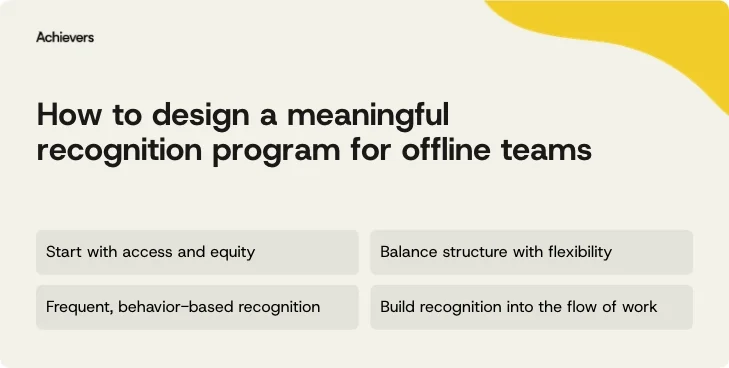
Start with access and equity
Frontline and offline employees are often the hardest to reach and the first to be unintentionally excluded. Designing for access and equity ensures recognition isn’t shaped by who has a desk or an inbox, but by who’s doing the work.
How to design for access and equity:
- Start by figuring out how different employee groups work — on the floor, in the field, across shifts — before choosing recognition channels
- Ensure recognition can be given and received without relying on desks, email, or meeting attendance
- Review participation data regularly to spot gaps by role, shift, or location and correct them early
Make recognition frequent and behavior-based
Recognition is most effective when it shows up while work is happening and reinforces the behaviors employees should repeat. Frequency builds clarity, and behavior‑based recognition builds confidence.
How to design for frequency and impact:
- Set expectations that recognition happens weekly or more, not just during milestones
- Focus recognition on behaviors — safety decisions, teamwork, service moments — not just results
- Encourage specificity so employees understand what was recognized and why it mattered
Balance structure with flexibility
Clear guardrails create fairness and alignment, while local flexibility ensures recognition fits the way different teams actually work. Too much of either breaks trust.
How to design for balance:
- Establish clear program guidelines around eligibility, frequency, and values alignment
- Allow teams and locations to personalize recognition so it reflects the realities of local teams
- Avoid one‑size‑fits‑all campaigns that ignore how different teams operate
Build recognition into the flow of work
When recognition is embedded into the tools and routines employees already use, it happens more naturally and more often. The easier recognition is to give, the more likely it is to stick.
How to reduce friction:
- Embed recognition into the tools and programs employees already use, with clear HRS and HCIM software integrations
- Build recognition into existing routines like shift handoffs, safety check-ins, or team updates
- Support managers with simple prompts or checklists so recognition stays consistent across teams
External recognition and its impact on non-desk employees
What external recognition is and why it matters
External recognition is appreciation that comes from outside the workplace, such as customers, patients, or clients. For non-desk teams, this type of recognition can be especially powerful because it connects their work directly to the people they serve. It turns effort into impact, showing their peers and leaders not just that they did a good job, but that their work genuinely made a difference.
How third‑party recognition reinforces pride and credibility
Recognition from customers or patients carries a different kind of weight. According to the Achievers Workforce Institute (AWI), 50% of healthcare workers say their most meaningful recognition was specific and non‑monetary. When appreciation comes from those directly affected by the work, it reinforces pride, credibility, and purpose in a way that internal recognition alone sometimes can’t.
Recognition platforms with programs for offline and non-desk teams
Achievers
Achievers is an all-in-one recognition and rewards platform, built to support organizations with large, distributed, and frontline workforces where recognition can’t rely on desks, email, or perfect timing. The platform is designed to make frequent, meaningful recognition accessible to every employee, whether they work on the floor, in the field, or across shifts.
What Achievers offers for offline and non‑desk teams:
- Mobile access plus offline options, including QR codes, kiosks, and physical recognition cards
- Enterprise‑grade integrations with tools like Workday, Outlook, Slack, and Microsoft, so recognition fits into daily workflows
- Support for frequent, behavior‑based recognition tied to safety, service, teamwork, and values
- A global rewards marketplace spanning nearly 190 countries, with local fulfillment, free shipping, and zero markups
- Manager dashboards and visual reports to track participation, spot recognition gaps, and ensure recognition is fair across roles and locations
- Dedicated customer success and research‑backed programs to maintain adoption over time
By removing access barriers, supporting frequent recognition, and giving HR leaders clear visibility across roles and locations, Achievers helps frontline and offline employees feel seen, valued, and connected to their work.
Guusto
Guusto is a recognition and rewards platform designed to support both office and frontline employees, with a focus on simplicity and flexible access for non‑desk teams. It’s often used by organizations looking to start small and scale recognition over time.
Key capabilities:
- Recognition delivered via SMS, QR codes, shared screens, and no‑login options
- Flexible reward options, including gift cards, charitable donations, and custom rewards
- Manager budgets, approvals, and cost‑center‑based spending limits
Kudos
Kudos is an employee recognition platform focused on structured recognition tied to company values, with an emphasis on internal culture measurement and formal recognition programs.
Key capabilities:
- Recognition messages are tied to company values and levels of impact to support culture alignment
- Awards and milestones, including nomination‑based awards, years‑of‑service milestones, and group eCards for key moments
- Analytics and reporting to help organizations understand participation and cultural trends
Motivosity
Motivosity is an employee recognition and engagement platform with a strong emphasis on social connection, peer‑to‑peer recognition, and internal communication across teams and locations.
Key capabilities:
- Peer‑to‑peer recognition delivered through a social‑style feed designed to encourage frequent appreciation
- Automated celebrations for milestones, service anniversaries, and nomination‑based awards
- Analytics and dashboards that surface participation trends, morale signals, and recognition activity
Make recognition a priority, no matter where teams work
Recognition programs succeed or fail based on who they reach. For non‑desk and offline teams, that means designing recognition that fits the realities of frontline work — moving shifts, shared spaces, limited screen time, and moments that matter most in real time.
The organizations that lead on retention, safety, and performance are the ones that recognize people where work actually happens, not where it’s easiest to design programs. Turns out, recognition works best when it shows up on the floor, not just on a PowerPoint slide.
Recognition programs for non-desk and offline employees FAQs
Key insights
- Recognition only works when it’s designed for how people actually work — not where it’s most convenient to run programs.
- For frontline teams, access, visibility, and timing matter more than scale or polish.
- When recognition is frequent, visible, and tied to real behaviors, it strengthens belonging and drives performance where it matters most.