Table of contents
Create a culture that means business™
Schedule a demo with an Achievers solution expert today.


 Copy URL
Remote work has changed how people show up, how teams connect, and how contributions get noticed. And the impact is hard to ignore. According to Gallup, 57% of fully remote workers are actively looking or passively watching for new job opportunities. But when they’re fully engaged, that number drops by 10%.
Remote work didn’t just change where people work, it changed how they experience being part of a team. A virtual team-building game or two can help boost morale, but without regular signals of appreciation, even high‑performing employees can start to feel invisible. That’s why recognizing remote employees can’t be left to chance.
The recognition challenges remote employees face today
Recognition is one of the most common and most misunderstood challenges facing remote employees today. When teams aren’t sharing the same physical space, the signals that help people feel seen and valued don’t always travel as far. What once happened naturally now requires intention.
- Lower visibility into effort and impact: In remote teams, much of the work happens quietly. Without in‑person cues or informal check‑ins, effort and progress are easier to overlook — especially for employees who aren’t the loudest or most visible in digital spaces.
- Fewer organic moments for appreciation: Remote work removes many of the spontaneous opportunities for recognition, like quick thank‑you messages or hallway feedback. Without intentional recognition practices, appreciation is often delayed or skipped altogether.
- Increased risk of isolation, disengagement, and burnout: Digital communication keeps work moving, but it can also take a toll. In fact, 69% of remote workers report increased burnout from digital communication tools, making consistent, human recognition even more critical for managers looking to keep engagement and wellbeing high.
- Recognition gaps are often structural: Most managers want to recognize great work. But without clear systems or habits in place, recognition becomes inconsistent, uneven, or tied to visibility instead of impact.
Why remote recognition needs a different approach than in-office recognition
In-office appreciation is often directly connected to proximity. Managers can see effort as it unfolds, offer feedback in the moment, and recognize contributions naturally throughout the day.
On the other hand, remote work removes those cues. Work happens across time zones, progress is shared digitally, and silence can easily replace feedback. Without an intentional approach, recognition can become reactive or disappear altogether. That’s why remote employee recognition can’t just mirror what worked in the office. It needs to be designed to replace that lost visibility, reduce proximity bias, and make appreciation clear, consistent, and human, no matter where teams are located.
What effective remote employee recognition looks like
At its core, effective remote employee recognition fills the gaps that distance creates. When people aren’t in the same place, recognition has to work a little harder to send the same message.
What remote employees need from recognition to stay engaged
- Timely acknowledgment: Recognition is most effective when it happens close to the moment of impact. In remote work, waiting too long can make appreciation feel like an afterthought. A timely callout reinforces that effort is noticed as it happens, not weeks later.
- Specific feedback that explains why their work mattered: A quick “great job” doesn’t go very far on its own. Remote employees need clarity around what they did well, why it mattered, and how it contributed to team or business goals.
- Visible appreciation that reinforces belonging: Recognition shouldn’t live only in private messages. When appreciation is visible in remote workplaces, it signals inclusion, strengthens connection, and helps employees see how their work fits into something bigger.
- Human recognition, not transactional rewards: Employee perks and points-based reward systems can support recognition, but they can’t replace it. What remote employees value most is recognition that feels personal, thoughtful, and grounded in genuine appreciation.
How managers influence recognition equity, frequency, and impact in remote teams
- Managers determine whether recognition happens at all: If recognition isn’t modeled or prioritized by managers, it tends to fade into the background. In remote environments especially, employees take cues from what their manager notices and what they don’t.
- Managers set the tone for consistency and fairness: Without clear habits, recognition can unintentionally go toward the most visible voices or recent wins. Managers play a key role in making sure recognition is distributed equitably, not just to those who speak up the most.
- Managers give recognition its meaning and weight: Peer recognition helps build connection and community, but manager recognition carries a different level of impact. It reinforces priorities, clarifies expectations, and signals what success really looks like.
- Managers fill the silence that remote work creates: When recognition doesn’t show up, employees don’t assume everything is fine; they assume their work isn’t being seen.
The manager’s guide to remote employee recognition: 5 key strategies
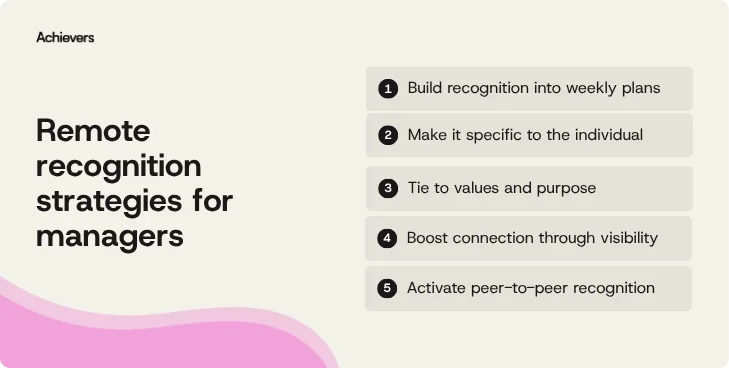
Strategy #1: Build recognition into weekly remote management plans
Building recognition into weekly remote management plans is the easiest way to make recognition consistent instead of accidental. Remote employees need regular signals that their work is seen and valued.
Why cadence matters more than scale
Cadence matters more than scale because employees remember consistent recognition long after they forget occasional recognition campaigns. Weekly recognition creates trust, reinforces priorities, and reduces the uncertainty that remote employees can experience when most work happens out of sight. Small moments delivered consistently often have a greater impact than recognition that only appears during major milestones.
How managers can recognize weekly without adding meetings
- Team meetings and standups: Use a few minutes to call out progress, collaboration, or problem‑solving from the past week. This helps remote employees see how their work fits into the bigger picture and reinforces what “good” looks like for the team.
- 1:1 check‑ins: Weekly or biweekly check‑ins are a natural place for more personal recognition. This is where managers can acknowledge effort, growth, or resilience, especially work that might not be visible to the rest of the team.
- Async recognition in collaboration tools: A thoughtful message in a shared channel, project thread, or collaboration tool can be just as meaningful as in-person recognition, and is often more inclusive for distributed teams working across time zones.
Strategy #2: Make recognition specific to the individual employee
Making recognition specific to the individual employee helps remote workers understand exactly why their contribution mattered. Generic praise confirms that work was noticed. Specific recognition explains what was valuable about the work, why it mattered, and what behaviors should continue. That clarity is especially important in remote environments, where employees have fewer opportunities to gather feedback through everyday interactions.
What specific recognition looks like for remote employees
Specific recognition explains the action, the impact, and the outcome. Employees should understand what they did, why it was important, and who benefited from it. Without that context, recognition becomes appreciation without direction.
How managers can make recognition more specific in remote teams
- Anchor recognition in real work: Tie appreciation to projects, challenges solved, or collaboration that happened, especially work that may not be seen by their colleagues.
- Replace general praise with context: Instead of “Thanks for the update,” try acknowledging what the update enabled or improved.
- Use simple prompts to add clarity: Many managers find it helpful to rely on a short recognition checklist or set of cues, like calling out what was done, why it mattered, and who it impacted. This can help make appreciation more meaningful without overthinking it.
- Reinforce priorities through recognition: What managers recognize sends a signal. Specific recognition helps reinforce what the team should continue doing and why it matters.
Strategy #3: Tie recognition to values and purpose and not just outcomes
Tying recognition to values and purpose helps employees understand what success looks like beyond performance metrics. Remote teams rarely see the day-to-day behaviors that shape culture. Recognition fills that gap by highlighting the actions, decisions, and habits the organization wants employees to repeat.
What to recognize beyond performance metrics
- Collaboration across time zones: Call out employees who make an effort to communicate clearly, support teammates in different regions, or adjust how they work to keep the team aligned.
- Problem-solving and adaptability: Recognize employees who navigate ambiguity, solve unexpected challenges, or adjust quickly as priorities shift, especially when that effort happens quietly.
- Knowledge sharing and support: Acknowledge those who document processes, mentor others, or step in to help without being asked. These contributions often go unnoticed, but they have a lasting impact on how teams work together.
Strategy #4: Use visibility to strengthen connection and belonging
Using visibility to strengthen connection and belonging helps employees see that their work matters beyond their individual tasks. Recognition that stays in private messages benefits one employee. Recognition that is visible across a team reinforces culture, creates shared understanding, and helps employees connect their contributions to a larger purpose.
How managers can balance public and private recognition
- Team-based recognition moments create shared momentum: Calling out great work in team meetings or shared channels helps everyone see and celebrate their coworkers’ progress. It’s a simple way to turn individual contributions into collective energy.
- Organization-wide visibility highlights cross-team impact: When workplaces span teams or functions, broader recognition helps employees understand how their efforts impact the company beyond their immediate team members. It also builds appreciation across silos.
- Private recognition keeps personal moments personal: Some contributions deserve a quieter approach. Growth, resilience, or sensitive wins are better recognized one‑on‑one, where recognition can be thoughtful, human, and tailored without an audience.
Strategy #5: Activate peer-to-peer recognition without losing manager ownership
Activating peer-to-peer recognition helps fill the visibility gaps that naturally exist in remote work. Managers cannot see every contribution, interaction, or collaboration that happens across distributed teams. Peer recognition broadens recognition coverage, ensuring meaningful contributions are acknowledged by the people closest to the work.
The manager’s role in making peer recognition stick
- Model the behavior: When managers recognize peers publicly and authentically, it sets the tone. It shows that appreciation is part of how the team operates, not an extra task.
- Recognize recognition: Calling out employees who recognize others reinforces the behavior and signals that appreciation itself is valued. Recognition has a way of multiplying when it’s acknowledged.
- Encourage cross-team appreciation: Remote work often happens across departments and time zones. Encouraging recognition beyond each employee’s direct team helps them see how their work impacts the company as a whole and builds connection across the organization.
Common remote recognition mistakes managers should avoid
Even well‑intentioned recognition can miss the mark. These are some of the most common pitfalls managers should avoid, and why they tend to undermine engagement instead of strengthening it.
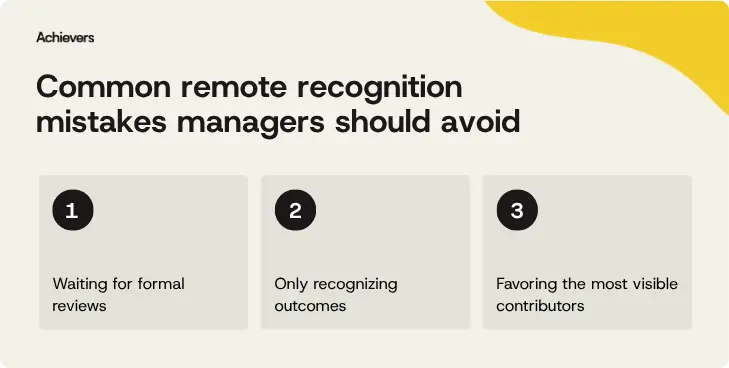
- Waiting for formal reviews: When recognition is saved for performance reviews, it loses its power. Remote employees need feedback closer to the moment of impact to feel seen and supported — not months later, when the work feels like a distant memory.
- Recognizing only outcomes, not effort or collaboration: Focusing only on final results overlooks the behaviors that make those results possible. In remote teams, problem‑solving, adaptability, and collaboration often happen quietly. When they go unrecognized, motivation turns into disengagement.
- Favoring the most visible contributors: Remote work can amplify proximity bias. Employees who speak up more often or work similar hours may receive more recognition, while equally impactful work happening behind the scenes gets missed. Over time, this creates frustration and employees start to lose trust in their leaders.
- Over‑indexing on rewards instead of meaning: Rewards can reinforce recognition, but they can’t replace it. When recognition becomes transactional, points without context, rewards without explanation, it starts to feel impersonal. What employees remember most is why they were recognized, not what they received.
How to measure if remote recognition is working
To truly support remote employees, a few simple metrics can tell you if employee recognition is showing up consistently, reaching the right people, and actually strengthening engagement and retention (instead of becoming background noise).
Key recognition metrics to track
- Frequency and distribution: How often recognition happens, and how widely it’s shared, offers a clear signal of whether recognition is part of everyday work or saved for special moments. Looking at distribution helps determine whether appreciation is reaching the full team or if it’s focused around a small group.
- Manager consistency: Managers have a significant influence on whether recognition shows up at all. Tracking consistency helps highlight where recognition is a regular habit and where it may depend on individual style rather than shared expectations.
- Equity across roles, locations, and demographics: Remote work can make some accomplishments and contributions easier to see than others. Reviewing recognition across roles, locations, and time zones helps ensure appreciation reflects impact and not just visibility or proximity.
How recognition data supports better management
- It helps managers see patterns they can’t observe day to day: Recognition data shows where appreciation is happening consistently and where it isn’t. This helps managers understand whether recognition is becoming a habit or slipping into something occasional and uneven.
- It surfaces gaps before disengagement becomes visible: Recognition data helps managers spot these early warning signs and address them before they show up as disengagement or turnover.
- It supports more equitable management decisions: By looking at recognition across roles, locations, and teams, managers can identify blind spots, like work that happens behind the scenes or across time zones.
- It enables better conversations and coaching: Recognition data gives managers a starting point for coaching conversations, helping them reflect on their own habits and adjust how they recognize effort, collaboration, and progress.
How managers can leverage a recognition platform to support remote employees
As remote teams grow, recognition becomes harder to manage through memory, spreadsheets, or good intentions alone. A recognition platform gives managers the structure and visibility they need to make recognition consistent, equitable, and meaningful without losing that human touch.
Here’s how to leverage a recognition platform:
- Make recognition visible across locations and time zones: Recognition no longer depends on who’s online at the same time. Contributions can be seen and celebrated across teams, regions, and schedules — so appreciation travels as far as the work does.
- Reduce bias by broadening who gets recognized: When peers, partners, and cross‑functional teammates can recognize one another, great work is less likely to be missed.
- Reinforce values consistently: Recognition tied to a company’s core values helps employees understand what matters most, and not just what gets done. Over time, those moments reinforce culture in a way policies and posters never could.
- Support equity, consistency, and scale: As teams grow and scale, platforms help ensure recognition remains fair, frequent, and accessible — not dependent on who’s most visible or who happens to speak up.
How managers use recognition platforms to strengthen remote recognition
- Recognize contributions in real time: Instead of waiting for reviews or recaps, managers can acknowledge effort when it happens.
- Share recognition publicly to build connection: Public recognition helps remote employees see how their work fits into the bigger picture and learn from one another’s contributions.
- Reinforce priorities and values consistently: Platforms make it easier for managers to tie recognition back to the behaviors and outcomes the team is working toward.
- Use data to understand recognition gaps and patterns: Recognition activity highlights where appreciation is and isn’t showing up, giving managers a clearer picture of team dynamics they might not otherwise see.
How Achievers helps managers bring remote recognition to life
Achievers is built to help organizations move from ad hoc appreciation to frequent, meaningful recognition that actually shapes behavior — especially for remote teams.
Here’s how Achievers’ recognition software helps managers recognize remote employees on a global scale:
- Recognition in the flow of work: Achievers integrates directly into tools managers and employees already use every day, including integrations with Workday, Outlook, Slack, and Microsoft — making it easy to recognize contributions in real time, not weeks later. For offline or frontline employees, options like mobile-first access, QR codes, kiosks, and physical recognition cards ensure no one is left out.
- Higher recognition frequency by design: Achievers drives more than 2x the recognition frequency of other providers by making recognition simple, visible, and habitual. For remote teams, that frequency is critical. It keeps appreciation present in day‑to‑day work instead of being confined to milestones or reviews.
- Global, equitable rewards and celebrations: With a global rewards marketplace spanning nearly 190 countries and millions of locally relevant options, Achievers makes it easy to recognize and reward remote teams. Automated celebrations ensure key moments, like onboarding, service milestones, and promotions — are never missed, no matter where your people are in the world.
- Actionable insights for managers and leaders: Achievers captures the richest recognition data in the industry, offering customizable reporting and near real‑time insights into recognition patterns. Managers can see where recognition is working, where the gaps are, and how recognition connects to engagement and retention — allowing leaders to become better coaches and make more informed decisions.
Recognition is how managers create connection across distance
When managers recognize remote employees with consistency and intention, people feel connected, valued, and motivated to stay engaged. The strategies in this guide are meant to help recognition show up in everyday moments, not just milestone ones.
And they work. Organizations around the world are already using these remote work tips to strengthen connection and engagement across their global, dispersed teams.

Key insights
- Remote employee recognition works best when it’s intentional, frequent, and designed to replace the visibility and connection lost in distributed work.
- Managers play a critical role in shaping recognition by making it timely, specific, visible, and aligned with the behaviors that matter most.
- With the right strategies and tools in place, recognition becomes a powerful way to build connection, engagement, and trust across remote teams.