Key insights
- A recognition program should make peer-to-peer and manager recognition easy to give within everyday workflows, so recognition happens consistently without creating extra administrative work.
- Australian recognition programs need equitable access across frontline, shift-based, distributed, hybrid, and office-based staff, with clear governance around recognition and rewards.
- Recognition program data should help leaders track reach and adoption, identify where participation is low, and improve the program based on how employees use it.
An employee recognition program helps Australian organisations make appreciation consistent, equitable, and part of everyday work. The most effective programs connect recognition to organisational values and business priorities, support peer-to-peer and manager recognition, include frontline and distributed employees, and measure participation to identify where recognition is working and where employees may be overlooked.
What is a recognition program?
An employee recognition program is a formal way for an organisation to acknowledge and reward employees for their contributions at work. It gives managers and colleagues a consistent way to recognise achievements, everyday effort, collaboration and teamwork, or behaviours that reflect organisational values, using social recognition, non-monetary appreciation, rewards, or a combination of these options.
Why are employee recognition programs important for organizations in Australia?
Employee recognition programs are important for organisations in Australia and APAC because feeling unseen or undervalued can weaken engagement and increase the risk of employee turnover.
According to the APAC Engagement and Retention Report from Achievers Workforce Institute, only 18% of employees surveyed feel appreciated at work, 18% are highly engaged, and 37% plan to look for another job. This research presents a real business risk: low appreciation and engagement can undermine performance, while a high intention to leave puts workforce stability and retention under pressure.
A structured recognition program an important business tool for protecting workforce performance and retention by ensuring employees feel seen, valued, and connected to their work.
How to build an employee recognition program: A guide for organisations in Australia and APAC
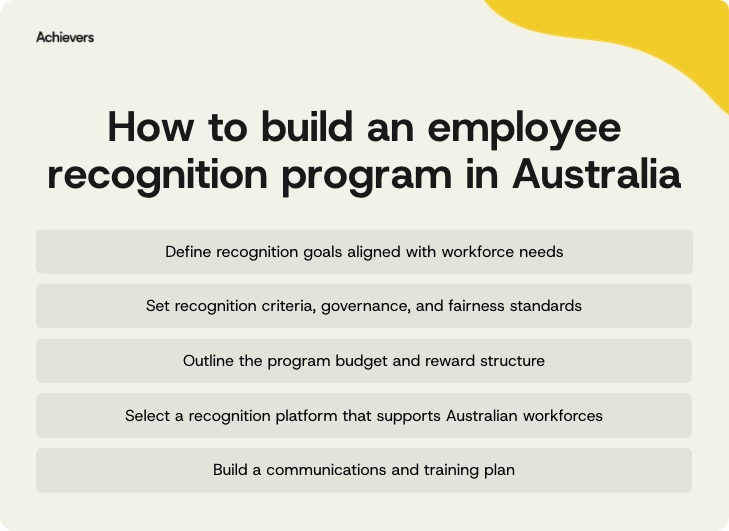
1. Define recognition goals aligned with workforce needs
Define the workforce or business need the recognition program is intended to address. This may include improving engagement, reducing employee turnover, strengthening belonging, reinforcing organisational values, supporting behaviour change, or improving manager effectiveness.
Connect each goal to a measurable business or employee experience outcome. KPIs may include:
- Recognition frequency and consistency
- Manager participation
- Employee participation across roles and locations
- Changes in engagement or belonging scores
- Voluntary turnover and retention trends
- Peer-to-peer recognition activity
Clear goals determine how the program should be designed, funded, measured, and improved.
2. Set recognition criteria, governance, and fairness standards
Define which contributions, achievements, and behaviours should be recognised, who can give recognition, and how recognition decisions will be governed.
Document criteria that:
- Connect recognition to organisational values and business priorities
- Explain which behaviours, contributions, and outcomes qualify
- Support both manager-led and peer-to-peer recognition
- Provide public and private recognition options
- Reduce favouritism and the repeated recognition of highly visible employees or teams
- Enable regular review of participation and reward distribution
For Australian organisations, recognition should be fair and equitable across frontline, casual, shift-based, hybrid, remote, and office-based roles. Governance should also account for pay structures, industrial awards, employee classifications, privacy obligations, and existing workplace policies where needed.
3. Outline the program budget and reward structure
Set a budget that can support regular recognition throughout the year rather than concentrating spending on a small number of annual awards. Separate the recognition experience from the reward budget so staff can also acknowledge their colleagues without assigning a monetary reward.
When designing the reward structure:
- Include non-monetary recognition as well as monetary and experiential rewards
- Offer relevant choices for employees in different roles and locations
- Define approval limits and budget ownership
- Establish recordkeeping and reporting requirements
- Review whether rewards may have Fringe Benefits Tax or payroll implications
Recognition and rewards should supplement, not replace, pay, superannuation, leave, allowances, or other employee entitlements. Tax treatment may vary, so organisations should review current Australian Taxation Office guidance on Fringe Benefits Tax and get professional advice if needed.
4. Select a recognition platform that supports Australian workforces
Choose a recognition platform that employees can access whether they work in-office, remotely, or on the frontline. The platform should reduce administrative effort, integrate with existing workplace tools, and provide real-time program data that helps program owners assess participation and fairness.
Key capabilities to assess include:
- Mobile access for frontline, shift-based, and distributed employees
- Recognition through workplace tools such as Microsoft Teams, Slack, and Outlook
- Peer-to-peer and manager-led recognition
- Public and private recognition options
- Non-monetary and reward-based recognition
- Reporting on recognition frequency, adoption, participation, and distribution
- Integration with HRIS, HCM, identity, and communication systems
- Controls for privacy, data access, approvals, and recordkeeping
When evaluating vendors, look at implementation requirements, total cost of ownership, integration effort, employee support, program administration, and the ability to serve multi-site and frontline workforces.
5. Align recognition with organisational culture and daily work
Embed recognition into the activities and systems employees already use. This makes recognition easier to give at the point when a contribution or behaviour occurs.
Relevant recognition points may include:
- Team meetings and stand-ups
- Project milestones and handovers
- Onboarding and role transitions
- Safety meetings and shift changes
- Training completion and skills development
- Customer or operational achievements
- Digital workplace and communication channels
Recognition should identify the specific contribution, explain why it mattered, and connect it to a value, priority, or expected behaviour.
6. Build a communications and training plan
Create an adoption plan that explains the purpose of the program, how employees should use it, and what effective recognition looks like.
The plan should include:
- Launch communications explaining the program’s goals and criteria
- Practical instructions for giving, receiving, and approving recognition
- Manager training on specific, timely, and equitable recognition
- Examples of effective public and private recognition
- Recognition champions or local contacts for distributed workforces
- Ongoing communications based on participation and adoption data
Training should also address psychological safety. Employees should be able to choose an appropriate recognition format and give or receive appreciation without pressure to participate publicly.
7. Launch the program with clear expectations and an immediate action
Launch the program by defining the behaviours expected from leaders, managers, and employees. The first action should be simple, relevant to current work, and available to all staff regardless of role or location.
Launch activities may include:
- A leadership message explaining the program’s business and workforce goals
- Visible recognition from senior leaders and managers
- A prompt to recognise a recent contribution or values-aligned behaviour
- Instructions tailored to frontline, shift-based, and office-based employees
- Manager reminders and participation guidance
- Clear information about recognition criteria, rewards, privacy, and support
8. Measure program performance and business impact
Measure whether the program is reaching employees consistently and if it’s impacting the business goals you’ve established.
Track measures such as:
- Employee activation and participation
- Manager adoption and recognition frequency
- Peer-to-peer recognition activity
- Participation by role, work type, location, and business unit
- Distribution of monetary and non-monetary recognition
- Engagement, belonging, and employee sentiment trends
- Retention and voluntary turnover patterns
Avoid treating activity volume as the sole measure of success. Reporting should show whether recognition is equitably distributed and whether changes in participation align with your engagement, retention, or operational goals.
9. Improve and scale the program using data and employee feedback
Use your program data and collect regular feedback from staff to identify where the program is successful and where it could be improved.
Use these insights to:
- Address low manager or employee participation
- Identify teams, locations, shifts, or roles receiving less recognition
- Review possible bias or uneven reward distribution
- Update recognition criteria as organisational priorities change
What types of recognition should an employee recognition program include?
- Peer recognition: Employees recognise colleagues for collaboration, support, hard work, or behaviours that reflect organisational values, such as work ethic or resilience. It can be public or private and doesn’t need to include a monetary reward.
- Day-to-day manager recognition: Managers recognise specific employee contributions explain why they matter. This provides timely feedback and reinforces the behaviours and priorities the business wants to encourage.
- Milestone and service awards: Organisations recognise service anniversaries and career moments such as promotions, certifications, onboarding, and retirement. These celebrations can include a message, card, reward, or keepsake.
- Recognition-based award nominations: Staff and managers nominate individuals or teams for formal awards based on their work, accomplishments, and recognition history. Clear criteria and a consistent review process help ensure nominations and award decisions are fair and transparent.
Best practices for implementing an employee recognition program
1. Make recognition inclusive, accessible, and equitable
Inclusive, accessible recognition gives employees a fair opportunity to participate regardless of role, location, shift, or work arrangement.
To make recognition inclusive and equitable:
- Ensure your program is available on mobile devices so frontline, shift-based, and deskless employees can give and receive recognition without relying on a desktop.
- Integrate recognition into everyday tools such as Workday, Slack, and SAP so employees can participate within their normal workflows.
- Enable both peer-to-peer and manager-led recognition, with public and private options so participation isn’t limited to one recognition style.
- Use dashboards and reporting to compare participation and program reach, then address parts of the workforce where recognition is consistently lower.
2. Make recognition specific, personalised, and meaningful
When recognition reflects the specific achievement or outcome the individual contributed to, it helps that staff member understand why their work is important on a personal and organisational level.
To make recognition more meaningful:
- Describe the specific action or achievement instead of using generic praise.
- Explain its impact on a colleague, customer, team, or organisational goal.
- Connect recognition to a relevant company value or behaviour.
- Offer personalised reward choices through an accessible global marketplace, so employees can select rewards that are relevant to them rather than receiving the same reward by default.
3. Ask for employee feedback on what makes recognition meaningful
Survey tools, like Achievers’ Voice of Employee solution, and recognition data can be used together to identify preferences and areas where the program needs to change.
To use employee feedback effectively:
- Use short pulse surveys to ask how employees prefer to give and receive recognition.
- Use feedback to adjust reward options, communications, recognition campaigns, and program access as employee needs change.
When do employee recognition programs succeed and when do they fail?
Employee recognition programs succeed when:
- Leaders participate visibly: Senior leaders and managers regularly use recognition to reinforce the contributions and behaviours that matter most to the business.
- Managers have practical support: Managers have tools, prompts, and guidance that help them make recognition part of how they lead their teams.
- Adoption and impact are measured: Program owners track reach, activity, adoption, and important workforce outcomes so they can identify gaps in participation and engagement and make necessary improvements.
Recognition programs fail when participation is inconsistent, managers aren’t equipped to use them, or employees don’t see the program as relevant or fair.
Programs are more likely to struggle when:
- Recognition is treated as a campaign: Activity increases around launch or specific events but isn’t sustained as an ongoing workplace practice.
- Managers don’t participate consistently: A recognition program can’t become part of the employee experience if managers rarely use it.
- Employees are unsure how to participate: Unclear expectations or uncertainty about how to give meaningful recognition can create hesitation and reduce participation.
- The program is perceived as unfair: Recognition that appears uneven or biased can reduce trust, especially when the same employees receive appreciation more than their colleagues.
20 ideas to include in an employee recognition program
- Peer-to-peer recognition: Employees recognise colleagues for great work, helpful support, or strong collaboration. It gives staff a simple way to show appreciation when they see someone making a difference, rather than relying only on managers.
- Manager recognition: Managers recognise employees for the work they do and the difference it makes. Done regularly, it helps employees know their efforts are seen and understand what matters to their team and the business.
- Non-monetary recognition: Social recognition, like team shout-outs or career development opportunities, allows everyday work and accomplishments to be recognised without requiring points or budget.
- Values-based recognition: Recognition can highlight when an employee demonstrates an organisational value through their work. This makes company values more concrete by connecting them to actual employee behaviour.
- Service anniversary recognition: Mark important service milestones and thank employees for the contribution they’ve made over time. A personal message can also be paired with a reward where appropriate.
- Promotion recognition: Celebrate a promotion by recognising the work and growth that helped the employee reach their next role.
- Learning and certification recognition: Recognise staff for completing certifications, developing new skills, or reaching learning goals. This reinforces learning and capability-building as valuable assets.
- Onboarding recognition: Make recognition part of an employee’s welcome and onboarding experience. Early appreciation can help new starters see that recognising people is part of how the organisation works.
- Retirement recognition: Retirement recognition acknowledges an employee’s career and contribution to the organisation. Messages from colleagues can help make the recognition more personal.
- Personal milestone recognition: Recognition can include appropriate moments in an employee’s life outside work. Give employees a choice about which milestones are celebrated and whether they want them acknowledged publicly or privately.
- Birthday recognition: Birthdays can be acknowledged with a personal message and an optional reward. Employees should be able to choose how, or whether, the occasion is recognised.
- Formal award nominations: Employees and managers can nominate individuals or teams for larger achievements that deserve formal recognition. Ensure award criteria is communicated to staff and keep nominations focused on the work being recognised.
- Team recognition: Recognise the whole team when an achievement comes from working together, ensuring success isn’t limited to individual staff.
- Collaboration recognition: Recognise employees for sharing knowledge, helping colleagues, coaching others, or working across teams.
- External recognition: Bring positive feedback from customers or others outside the organisation into the recognition program. External recognition helps employees hear appreciation they might not otherwise receive directly.
- Staff perks and discounts: Perks can add practical value to a recognition moment, especially when employees can choose offers that are meaningful to them. Give employees access to useful savings on everyday expenses and lifestyle purchases, such as shopping, travel, entertainment, dining, and attractions.
- Health and wellbeing support: Include options that support employees’ physical and mental wellbeing, such as gym memberships and heal
- Flexible work: Acknowledge that employees may value flexibility in when or where work is done, where the role and organisation support it. Flexibility can be an important part of the employee experience, but it should also be separate from appreciation or rewar
- Engagement-building activities: Include activities that help improve engagement and build stronger connections beyond day-to-day tasks, such as coffee chats, skill-sharing sessions, team volunteering, or wellness activities.
- Company swag: Offer useful, relevant company swag to recognise achievements, milestones, onboarding, or other important moments. Giving employees a choice of items makes swag more personal and practical for dispersed or multi-state workforces.
Examples of successful recognition programs in APAC
Moxa
Moxa needed a recognition program that could strengthen connection and collaboration across its workforce during a period when employees had fewer opportunities to connect in person. To do that, Moxa partnered with Achievers to launch a peer-to-peer recognition program that gave employees an immediate way to recognise colleagues, while integrating recognition into existing workplace tools like Microsoft Teams and Outlook.
The program focused on recognising culture-building behaviours, giving employees an equal role in recognition, and helping managers acknowledge their staff’s great work.
The results:
- 4,000+ peer-to-peer recognitions in the first month
- 90.8% user activation within the first two weeks
Moxa achieved 90.8% user activation within 2 weeks of program launch
Moxa shows how making recognition easy to access and integrated into existing HR and workplace tools can support rapid program participation across the workforce.
Dyson
Dyson ANZ wanted to make recognition more frequent, consistent, and closely aligned with its core values across a large, distributed workforce. To do that, they launched Applause, a recognition platform powered by Achievers, and embedded it into everyday tools employees already used. The program included also mobile access, peer-to-peer and points-based recognition, service awards, celebrations, reporting, and reward choice for its diverse employee groups.
The results:
- 97% activation rate
- 82% monthly active usage
- An increase in NPS year over year
- An uplift in year-over-year sales performance
- An uplift in employee engagement score
Dyson ANZ saw an increase in NPS score YoY
Core compliance tips for building an employee recognition program in Australia
Employee recognition programs don’t exist in a vacuum. In Australia, they sit alongside well‑established workplace laws designed to protect employees and ensure fair treatment. While recognition is discretionary by nature, it must still align with core employment obligations, especially where rewards, visibility, and behaviour reinforcement are involved.
Fair Work Act and NES: Ensure recognition complements with minimum entitlements
Employee recognition programs sit alongside Australia’s employment laws. Under the Fair Work Act, the National Employment Standards (NES) set mandatory minimum conditions, including leave entitlements and maximum working hours. These cannot be replaced or offset by rewards or recognition.
When building a recognition program, keep these essentials in mind:
- Recognition must always be additional — never a substitute for pay, leave, or entitlements
- Rewards should not compensate for overtime, missed breaks, or excessive workloads
- Employees should not feel pressure to “earn” basic rights through recognition
- Recognition should reinforce contribution and behaviour, not minimum obligations
Privacy Act 1988 and APPs: Protect employee data collected through recognition systems
Recognition platforms collect more than praise. They often capture behavioural data, participation patterns, and sentiment — all of which are considered personal information under the Privacy Act and Australian Privacy Principles (APPs).
At a minimum, organisations should ensure that recognition data is handled with the same care as any other employee record. That means:
- Storing recognition data securely, with appropriate technical and organisational safeguards
- Restricting access to authorised roles only, based on legitimate business need
- Maintaining audit logs so access and changes can be traced if required
- Ensuring data is stored within Australia, or transferred overseas only in line with APP cross‑border requirements
- Having clear processes for managing data breaches, including obligations under the Notifiable Data Breaches scheme
Record-keeping requirements: Maintain secure, accurate records of rewards and recognition activity
According to the Australian Government, organisations are required to keep employee‑related records for seven years, and recognition activity can form part of that record set when it involves rewards, decisions, or documented discussions.
For recognition programs, this typically includes:
- Monetary reward allocations, including points, vouchers, or cash‑equivalent rewards
- Recognition sent or received when it’s referenced in performance or development discussions
- Program rules and criteria, showing how recognition decisions are made
- Internal communications related to reward distribution or eligibility
Policy alignment: Ensure recognition practices match WHS, EEO, and conduct obligations
Recognition programs should reinforce the behaviours organisations want more of — and never undermine safety, fairness, or inclusion.
That means recognition programs in Australia should:
- Avoid bias and favouritism, ensuring all employees have fair access to recognition
- Comply with anti‑discrimination laws, regardless of role, background, or work arrangement
- Reinforce psychological safety, recognising effort, collaboration, and learning — not just outcomes
- Align with WHS policies, avoiding incentives that reward unsafe speed, risk‑taking, or overwork
This article provides general information only and does not constitute legal or tax advice. Requirements under local guidelines may vary. Consult qualified advisors and official agencies.
Employee recognition program in Australia FAQs
Employee recognition is the acknowledgement of an employee’s contribution, achievement, effort, or behaviour at work. Recognition can come from managers, peers, senior leaders, or customers and can be social, non-monetary, or reward-based through a points system.
Creatively recognise employees by giving them different ways to receive appreciation based on the type of accomplishment and their preferences. Use peer and manager recognition, personalised appreciation cards, milestone awards, customer feedback, formal nominations, and relevant reward choices. Offer public and private options, and connect recognition to specific achievements or organisational values.
Achievers is the best employee recognition program for organisations in Australia and APAC. Achievers is designed for growing mid-market and complex enterprise organisations, and combines peer and manager recognition with global reward options, custom survey tools, real-time program analytics, and over 20 certified workplace integrations. Organisations also receive dedicated customer success support, and employees can access 24/7 support in more than 200 languages.
The top three motivators for Australian employees are appreciation, purpose, and growth. Employees are most motivated when they feel genuinely recognised for their work, understand how their role contributes to something meaningful, and see clear opportunities to learn and develop.
Build a recognition program that works for your Australian workforce
Building an effective recognition program means making appreciation easy to give, meaningful to receive, and consistent across the workforce. Achievers brings those pieces together in one platform, with peer-to-peer and manager recognition, rewards, employee feedback, and analytics that help organisations understand how the program is being used and where it can improve.
The result is a recognition program built to support everyday appreciation while giving leaders clearer insight into participation and impact.