Table of contents
Create a culture that means business™
Schedule a demo with an Achievers solution expert today.


 Copy URL
Employee recognition software for mid-sized companies has officially grown up. In North America, fast‑scaling organizations are juggling hybrid work, tighter labor markets, and employees who expect more than an annual “great job” email. Recognition still matters, but informal, inconsistent programs don’t scale, and spreadsheets definitely don’t.
And the stakes are high. Achievers Workforce Institute (AWI) research shows that employees who are recognized meaningfully each month are 12x more likely to find their work meaningful and 17x more likely to feel connected to their colleagues. That makes employee recognition a powerful advantage for mid-sized companies navigating growth, change, and competition for talent.
But recognition software needs that works the way organizations do: flexible, easy to adopt, and built for real humans doing real work across teams, time zones, and tools. This guide breaks down what to look for and highlights the best employee recognition software for mid-sized companies with a clear focus on platforms that help organizations build connection, reinforce values, and drive measurable results as they grow.
What really matters in recognition software for mid-sized companies
For mid-sized companies in North America, employee recognition software has one job: make recognition easier, more consistent, and more meaningful as the organization grows. Not someday. Right now.
At this stage, culture can still be shaped, but it can also slip fast. Teams expand, managers get stretched, and suddenly recognition depends on who remembers to do it (spoiler: not everyone). The right software steps in quietly, supports good habits, and scales connection without turning recognition into a “program” people forget about.
Here’s what actually matters.
Understand essential recognition features
Consider this your practical checklist, with real‑life situations to understand the impact of each feature.
Peer‑to‑peer recognition
Why it matters: Mid-sized organizations tend to be flatter, faster, and more collaborative. The people who see great work first are usually peers, not managers.
Scenario: A cross‑functional team pulls off a big client launch. Marketing, sales, and product all played a role. Peer recognition lets appreciation happen instantly, publicly, and without a formal approval chain.
What to look for:
- Simple, visible recognition anyone can give
- Clear alignment to company values (not just emojis and applause)
- No artificial limits that make recognition feel rationed
Manager‑led recognition
Why it matters: Managers still set the tone. But they’re juggling performance, priorities, and people — and recognition often falls to the bottom of the list unless it’s easy.
Scenario: A manager leads a hybrid team spread across locations and schedules. Recognition software helps them reinforce progress and priorities consistently, without adding admin work or reminders.
What to look for:
- Tools managers can use in seconds, not minutes
- Recognition tied to goals and behaviors, not just outcomes
- Enough structure to create fairness without micromanagement
Rewards catalog flexibility
Why it matters: Nowadays, employees expect choice. What motivates one person may completely miss the mark for another.
Scenario: A frontline employee might prefer a digital gift card they can use today. A remote employee may value experiences. Someone else just wants meaningful public recognition tied to their impact. One catalog should cover all of that.
What to look for:
- Digital gift cards and experiential rewards
- Strong non‑monetary recognition options (because not everything needs a price tag)
- Coverage that works seamlessly across North America
Real‑time, in‑the‑flow recognition
Why it matters: Recognition only works if people actually use it. And if it lives outside daily tools, participation drops fast.
Scenario: Teams collaborate in Slack or Microsoft Teams all day. Recognition that shows up right there feels natural, not like another system to log into later.
What to look for:
- Native integrations with Slack and Microsoft Teams
- Recognition that happens in real time, not retroactively
- Zero friction for everyday use
Values‑based recognition
Why it matters: Recognition shouldn’t just reward what gets done, it should reinforce how work gets done.
Scenario: As the company grows, leaders worry culture will dilute. Values‑based recognition keeps expectations clear and visible, even as new teams and managers come onboard.
What to look for:
- Recognition explicitly tied to company values
- Reporting that shows which values are actually being reinforced
- Consistency across departments, not pockets of good culture
What are the best employee engagement tools for mid-sized companies
The most effective employee engagement platforms combine several core capabilities in one solution. For mid-sized companies, the best tools help employees feel recognized, heard, and connected while giving leaders the insights they need to improve culture and performance at scale. Rather than relying on separate systems for recognition, feedback, and communication, many organizations are prioritizing integrated platforms that support engagement across the entire employee experience.
Key capabilities to look for include:
- Employee recognition and rewards: Frequent recognition reinforces company values, strengthens belonging, and helps employees feel appreciated for their contributions
- Employee feedback and listening tools: Pulse surveys and real-time feedback help organizations understand employee sentiment and take action before engagement declines
- Analytics and reporting: Engagement insights help leaders measure participation, track trends, and connect engagement efforts to business outcomes
- Workflow integrations: The best tools fit into employees’ daily routines through integrations with platforms like Microsoft Teams, Slack, HRIS systems, and email
For many mid-sized organizations, recognition-led engagement platforms deliver the greatest impact because they influence multiple engagement drivers at once. When employees receive meaningful recognition, they’re more likely to feel connected to their work, aligned with company values, and motivated to contribute. That’s why leading employee engagement tools increasingly combine recognition, rewards, employee voice, and analytics in a single platform that can scale as the organization grows.
Mapping recognition software features to common mid-sized company challenges
This is where the right capabilities really earn their keep. When teams grow, work gets more distributed, and managers get busier, recognition either scales smoothly, or starts to crack. Mapping features to real, mid‑sized challenges helps separate software that sounds good in a demo from platforms that actually support culture as your company grows.
Growing from 300 to 800 employees
What worked through hallway conversations doesn’t scale. Recognition software brings structure without stripping out authenticity, so culture grows with the company instead of getting lost in it.
Supporting remote, frontline, and hybrid employees equally
Recognition should reach everyone, not just people at desks or headquarters. Look for platforms designed to create visibility and inclusion across roles, locations, and schedules.
Keeping recognition consistent across departments and managers
Without shared tools, recognition becomes uneven fast. Software sets clear guardrails so recognition feels fair, frequent, and aligned, no matter who someone reports to.
Assess flexibility and scalability
Mid-sized companies don’t stand still, and recognition software shouldn’t either.
Configurable programs beat rigid platforms
Avoid tools that lock you into yesterday’s structure. Look for configurable rules, budgets, and experiences that evolve as your organization does.
Modular design > all‑or‑nothing suites
The best platforms let you start where you are and grow over time, instead of forcing you to adopt features before you’re ready.
Choosing a model that scales with you
Here’s the question mid-sized companies should always ask: Will this still work when we’re bigger, more distributed, or more complex than we are today?
Recognition software should support:
- Frequent participation across roles and locations
- Clear alignment to values and business outcomes
- Flexibility as teams, structures, and priorities evolve
Future‑proof for what’s coming next
- Mergers and acquisitions: Onboard new teams without rebuilding recognition from scratch
- North American expansion: Support multiple regions, currencies, and compliance needs
- Reporting and compliance: Strong data and audit trails as expectations rise
Recognition software should make work feel more human, not more complicated. For mid-sized companies, the right capabilities don’t just support recognition today; they help culture, connection, and performance scale tomorrow.
A smart way to evaluate recognition software for growing mid-size companies
By now, you’ve probably realized something important: most recognition platforms sound good on the surface. The difference shows up when you look at how well the software matches the realities of a mid‑sized organization.
Let’s narrow the field before you start direct comparisons:
Start with usability and adoption (because shelfware helps no one)
If employees don’t use the platform, it doesn’t matter how many features it has.
For mid-sized companies, adoption hinges on:
- Intuitive employee experience (no training manuals required)
- Manager ease‑of‑use (recognition should take seconds, not meetings)
- Low admin lift for HR teams already wearing multiple hats
If recognition feels like “one more system,” participation drops fast. The best platforms disappear into daily work.
Look for integrations that support real work
Recognition shouldn’t live in a silo.
Strong mid‑market platforms integrate with:
- Microsoft Teams and Slack for in‑the‑flow recognition
- Core HRIS systems for employee data and reporting consistency
Bonus points if insights roll up automatically, instead of requiring manual exports and spreadsheet gymnastics.
Prioritize insight, not just activity
Recognition data is only valuable if it tells you something useful.
Mid-sized HR teams should look for reporting that helps answer questions like:
- Are recognition habits consistent across teams and managers?
- Which values are being reinforced and which are being ignored?
- Is recognition reaching remote and frontline employees equally?
If the platform only shows how many points were sent last month, you’re missing the bigger picture.
A quick gut check before you move on
Before diving into the vendor list, ask:
- Can this platform grow with us for the next 3–5 years?
- Will it still work if our structure, size, or footprint changes?
- Does it feel built for mid‑market reality or retrofitted from enterprise or small business needs?
If the answers are fuzzy, keep looking.
How to streamline the selection process (and keep it sane)
Choosing recognition software doesn’t need to turn into a six‑month saga. A little structure goes a long way.
Shortlist with purpose
Limit your shortlist to platforms that clearly meet your non‑negotiables:
- Supports both peer and manager recognition
- Works for hybrid, remote, and frontline employees
- Fits your current size and your next phase of growth
More options don’t mean better decisions. They just mean more demos.
Go into demos with a plan
Demos are where good platforms stand out — and where shiny ones fall apart.
Ask vendors to show:
- How recognition happens in real time
- What managers actually do day‑to‑day
- How HR accesses insights without extra work
And don’t be shy about asking what isn’t included. Transparency matters.
Align stakeholders early
Recognition touches more than HR. Loop in:
- People leaders who’ll use it
- IT for integrations and security
- Finance for budget clarity
Alignment upfront prevents rework later and makes buy‑in much easier.
Compare with confidence
Once you’ve done the groundwork, comparison gets simpler. You’re no longer asking, “Is this good?”
You’re asking, “Is this right for us?” That’s exactly where the next section comes in.
Next up: a side‑by‑side look at the best employee recognition software for mid‑sized companies with strengths, best‑fit scenarios, and honest limitations, so you can shortlist smarter and move forward faster.
The 5 best employee recognition software for mid-size companies
1. Achievers
G2 rating: 4.6/5
Strengths:
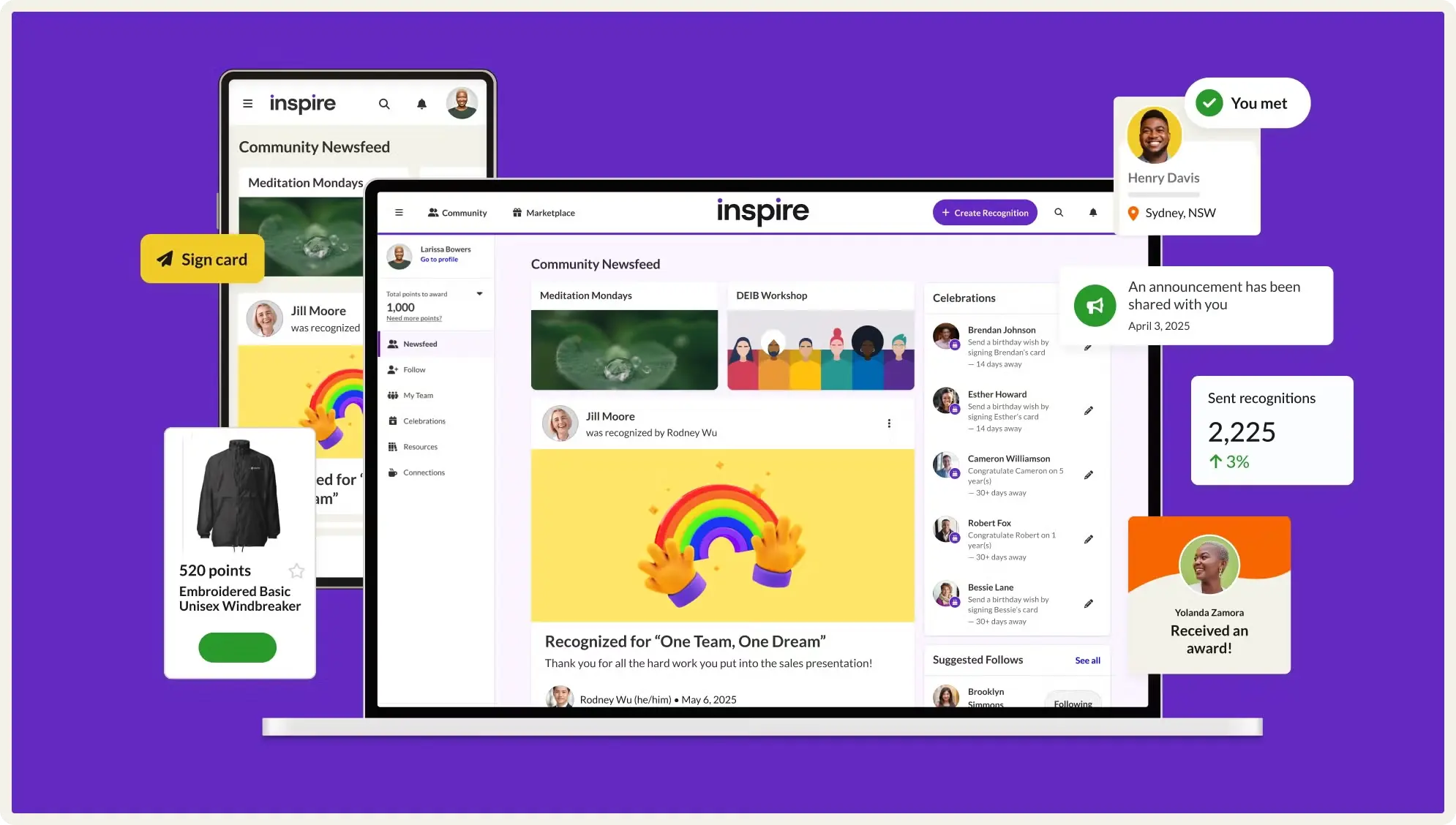
Achievers is an employee recognition and rewards platform built to help mid-sized and enterprise organizations create genuinely connected workplaces — the kind where people know what matters, feel appreciated often, and understand how their work contributes to something bigger. The platform supports both peer‑to‑peer and manager‑led recognition, backed by a global rewards marketplace and seamless integrations with the tools employees already use every day.
What sets Achievers apart is how recognition is treated not as a moment, but as a system. Recognition happens frequently, in the flow of work, and is tied directly to company values and behaviors. Over time, that activity generates rich, real‑world data that HR teams can actually use, showing what’s driving engagement, alignment, and performance across the organization.
In short: less guesswork, more insight, and far fewer one‑off “feel‑good” programs that never stick.
Best for:
Mid-sized companies that want recognition to scale with their workforce. Great for those looking to support hybrid teams, reinforce culture, and deliver insight without adding complexity.
Key features:
- Peer‑to‑peer and manager‑led recognition aligned to company values
- Unlimited non‑monetary recognition to encourage frequent participation
- Global rewards marketplace with gift cards, merchandise, and experiences
- Native integrations with Microsoft Teams, Slack, and leading HRIS platforms
- Real‑time analytics on recognition activity, engagement, and participation
- Dedicated implementation and customer success support for growing organizations
Limitations:
Achievers is purpose‑built for organizations that are serious about scale and impact; very small teams or early‑stage startups may not initially need this level of depth or insight.
Review:
“I have worked with many vendors and I have never received the level of service that I have from everyone at Achievers, especially our Client Success Manager. I have worked with many other vendors — Taleo, Oracle, as well as Jive — and I have never had such a responsive internal team.”
— Heather Markle, Manager Rewards & Recognition, AutoTrader Group
2. Guusto
G2 rating: 4.9/5
Strengths:
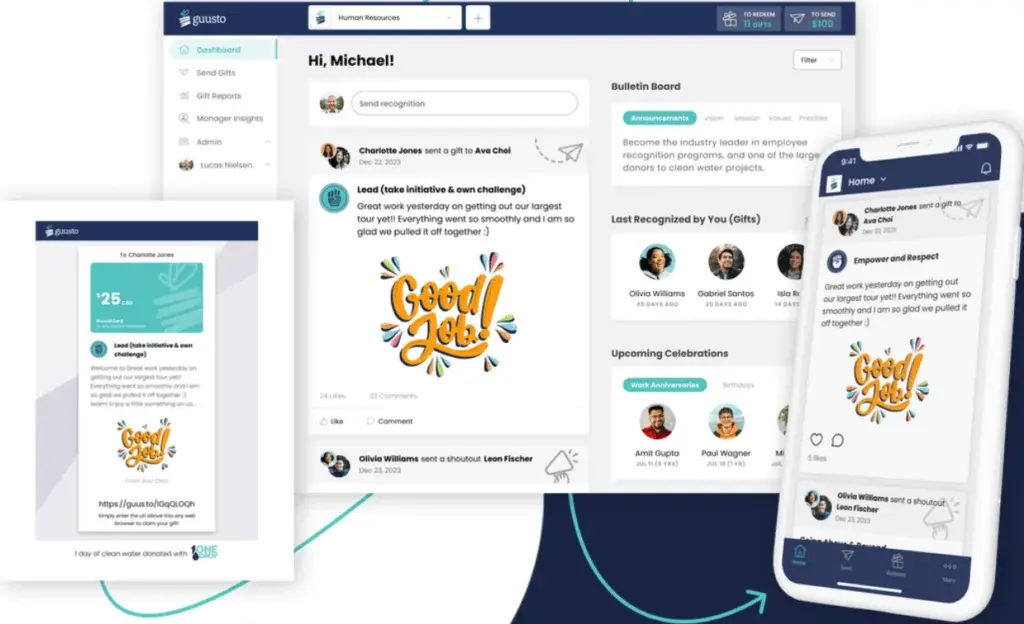
Guusto is an employee recognition and rewards platform known for its simplicity and focus on reaching frontline and deskless employees. The platform centers on easy reward delivery, allowing organizations to send digital gift cards and recognition through multiple channels such as SMS, QR codes, email, and printed rewards. This approach makes Guusto accessible for teams without consistent access to email or workplace collaboration tools.
Best for:
Mid-sized organizations with large frontline or hourly workforces that want a simple, low‑friction way to distribute rewards and recognition without requiring every employee to log into a platform.
Key features:
- Multi‑channel reward delivery via SMS, QR codes, email, and printable rewards
- Digital gift card marketplace with flexible redemption options
- Manager‑led and peer‑to‑peer recognition with basic program controls
Limitations:
- Guusto offers limited depth in analytics, values‑based recognition, and behavioral insight, which can make it harder for growing organizations to connect recognition activity to culture, performance, and long‑term engagement outcomes.
Review:
“What I like most about Guusto is how easy it makes recognizing people in a genuine way. Instead of dealing with complicated points or systems, you can just send a real gift right away, which feels a lot more personal.”
— Pooja G., Insurance Advisor, Small business, via G2
3. Nectar
G2 Rating: 4.7/5
Strengths
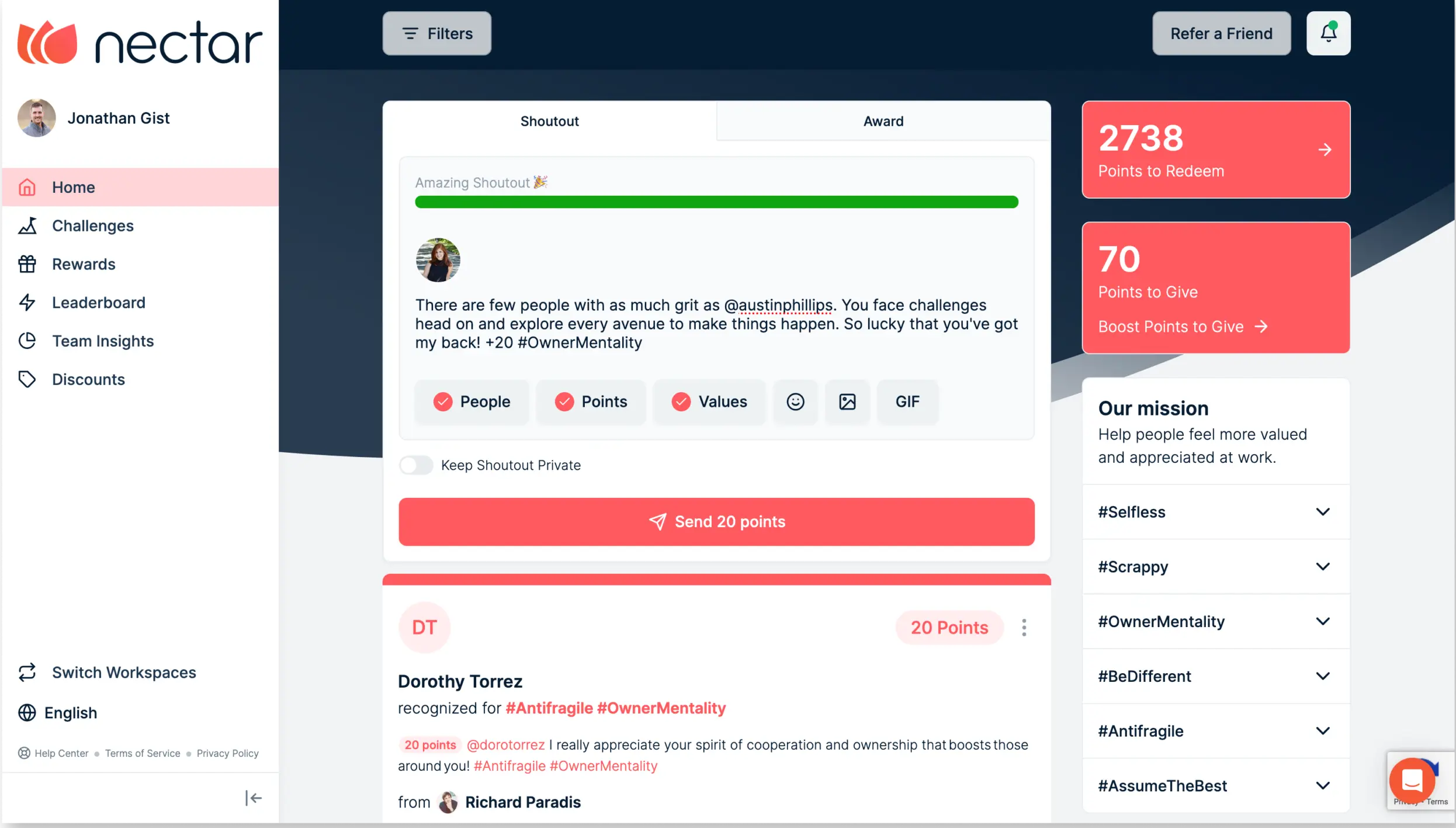
Nectar is an employee recognition and rewards platform focused on making everyday appreciation visible, social, and easy to sustain. It combines peer‑to‑peer recognition, points‑based rewards, milestones, and challenges into a single, user‑friendly experience. The platform integrates with common workplace tools like Slack and Microsoft Teams, allowing recognition to happen within existing workflows rather than in a separate system.
Best for:
Mid‑sized companies that want a simple, budget‑friendly recognition platform to encourage peer recognition and visible appreciation across teams.
Key features:
- Peer‑to‑peer recognition with a social feed tied to company values
- Points‑based rewards catalog with gift cards, swag, and charitable options
- Automated milestones, anniversaries, and recognition challenges
Limitations:
Nectar’s reporting, behavioral insight, and program configurability are more limited than enterprise‑grade platforms, which can make it harder for growing organizations to connect recognition activity to long‑term culture, performance, and retention outcomes.
Review:
“When we first started using Nectar, it was so intuitive, that we were able to jump right in to using it. Nectar is very easy to use. I can navigate smoothly between redeeming my own rewards and giving out rewards to others.”
— Jennifer R., Curriculum and Instruction Specialist, Mid-market, via G2
4. Motivosity
G2 Rating: 4.7/5
Strengths:
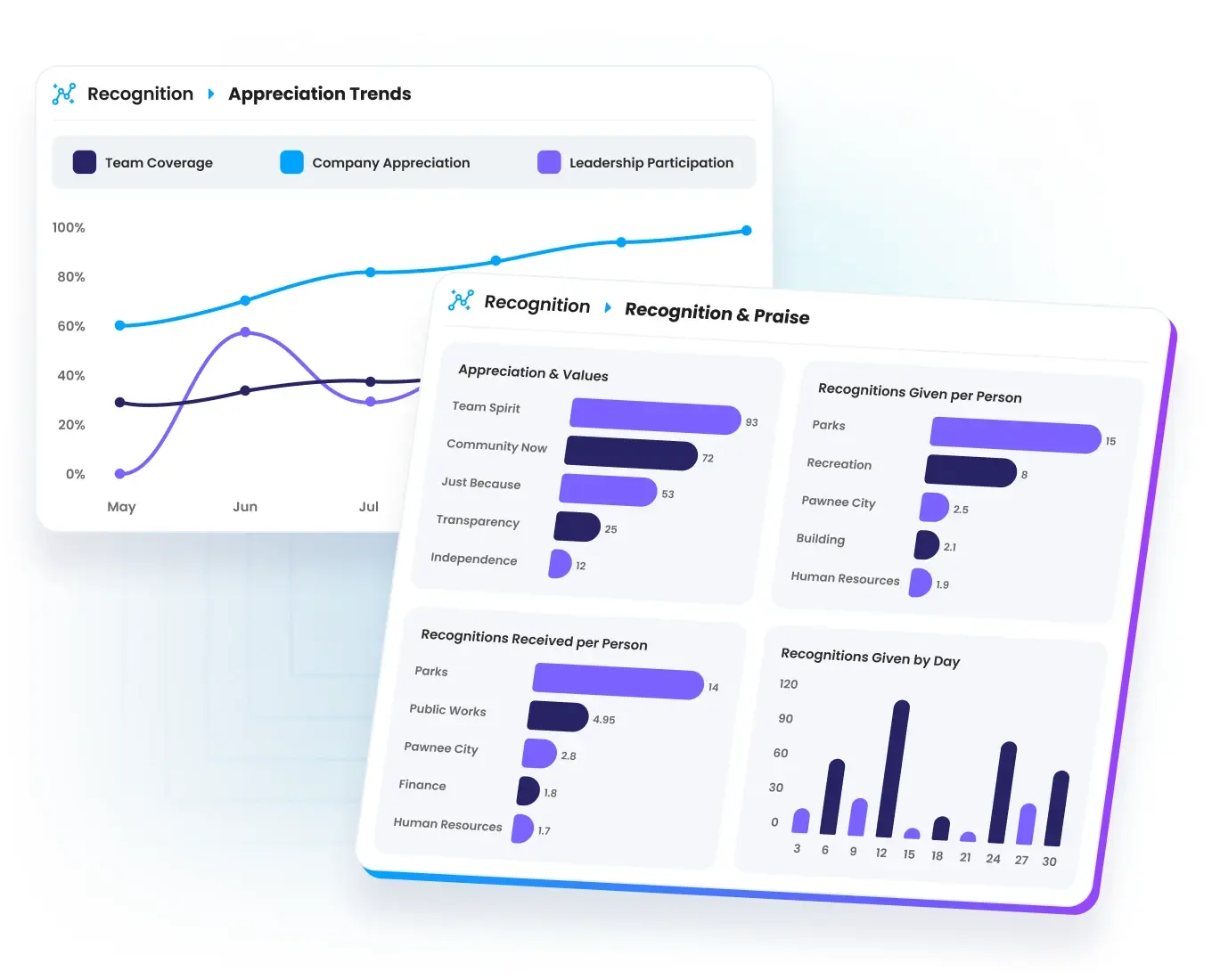
Motivosity is an employee recognition and rewards platform designed to foster connection, appreciation, and community across mid‑market and enterprise organizations. It combines peer‑to‑peer recognition, manager‑driven awards, milestones, and spot bonuses within a social, feed‑based experience that keeps recognition visible and frequent. The platform places a strong emphasis on social connection, with features like employee profiles, org charts, and community spaces that encourage interaction beyond formal recognition moments.
Best for:
Mid‑sized organizations that want a socially driven recognition platform to boost visibility, connection, and participation across teams.
Key features:
- Peer‑to‑peer and manager‑led recognition with a centralized social feed
- Automated milestones, challenges, badges, and nomination‑based awards
- Global rewards marketplace with digital gift cards, cash‑equivalent options, and charitable giving
Limitations:
Motivosity’s recognition data and reporting are more focused on participation and activity than on deeper behavioral or performance insight, which may limit strategic analysis as organizations scale and seek clearer links between recognition, outcomes, and retention.
Review:
“I loved using Motivosity. Being a new employee it was such a fun way to get to know my coworkers. It always performed well and the user experience was easy to get into. Also loved the personality quiz. I don’t know what the price is for our team to use, but to me money wel l spent and great for employee retention.”
— Jenna B., Account Manager, Small-Business, via G2
5. Terryberry
G2 rating: 4.6/5
Strengths:
Terryberry is an employee recognition and engagement platform with a long history in service awards and milestone recognition. The platform brings together peer‑to‑peer and manager‑led recognition, service anniversaries, symbolic awards, and a global rewards marketplace that includes both digital and physical rewards.
Best for:
Mid‑sized organizations that prioritize service awards, milestone celebrations, and traditional recognition programs alongside basic engagement tools.
Key features:
- Service awards and milestone recognition with symbolic and physical rewards
- Peer‑to‑peer and manager‑led recognition programs
- Global rewards marketplace with digital and physical options
Limitations:
Terryberry’s recognition experience and analytics are more oriented toward milestone and program administration than real‑time, behavior‑driven insight, which can limit visibility into everyday recognition patterns as organizations grow and modernize their approach.
Review:
“I like how easy the Terryberry platform is to use. I also value the new birthdays collection, the reporting features, and the rewards platform a lot. These features are important to me and I use all of them frequently. Switching to Terryberry from our homegrown platform was a positive change because Terryberry is user-friendly.”
— Elizabeth C., Mid-market, via G2
The best employee recognition software delivers results, and grows with you
At the end of the day, recognition only works if it actually changes behavior. That’s where Achievers comes in. Built to drive frequent, meaningful recognition in the flow of work, Achievers helps mid-sized companies strengthen connection, reinforce values, and turn everyday moments into measurable gains in engagement, productivity, and retention.
It’s recognition that feels human and performs like a system, shaping culture while moving the business forward.
Still comparing employee recognition software? See why more growing organizations choose Achievers to turn appreciation into lasting momentum.
*Information and pricing in this blog post was sourced from each vendors website
Employee recognition software FAQs
Key insights
- The best employee recognition software for mid-sized companies scales connection and culture without adding complexity.
- Recognition works best when it’s frequent, values‑based, and built into the flow of everyday work.
- Mid‑market organizations need recognition platforms they won’t outgrow as teams, structures, and expectations evolve.
| Platform | G2 rating | Best for | Core strength | Key limitation |
|---|---|---|---|---|
| Achievers | 4.6/5 | Mid-size companies scaling culture and performance | Purpose-built recognition system that drives frequent, values-based recognition with deep real-time insights | May be more robust than needed for very small or early-stage teams |
| Guusto | 4.9/5 | Frontline and deskless-heavy workforces | Simple, flexible reward delivery across SMS, QR, email, and print | Limited analytics and insight into behavior, culture, and performance |
| Nectar | 4.7/5 | Budget-conscious teams prioritizing ease of use | Social, peer-to-peer recognition with points-based rewards and simple setup | Less depth in reporting and long-term program customization |
| Motivosity | 4.7/5 | Organizations focused on social connection and engagement | Strong social feed and community-building features to boost visibility and participation | Limited strategic insight into behavior and performance outcomes |
| TerryBerry | 4.6/5 | Mid‑sized organizations that prioritize service awards | Service awards and milestone recognition with symbolic and physical rewards | Limited visibility into everyday recognition patterns |