Table of contents
Create a culture that means business™
Schedule a demo with an Achievers solution expert today.


 Copy URL
Here’s what CHROs need to know about recognition: it’s a business performance system in 2026, directly shaping the kind of employee behaviors that lead to successful outcomes across the organization. In a 2026 study from Harvard Business Review Analytic Services, 66% of the 566 surveyed respondents say recognition is very important to business performance, yet only 33% say their programs are very effective. CHROs have an opportunity to make recognition a clearer signal of what the organization values, prioritizes, and rewards.
Why should CHROs treat recognition as a business strategy in 2026?
CHROs should treat recognition as a business strategy because it gives employees a clear signal about which behaviors, priorities, and values are most important to the business.
New research from HBR’s report, Improving business performance through appreciation, found that 88% of recognition leaders design their programs to drive specific employee behaviors, compared with only 28% of organizations that were slower to adopt a program. Recognition works best when it’s built around the behaviors and efforts the business needs, instead of generic and infrequent appreciation moments.
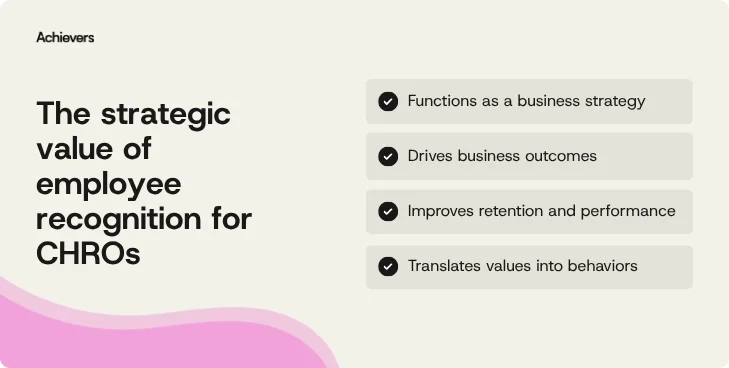
Recognition functions as a business strategy
For CHROs, recognition operates as a business strategy; a way to guide behavior, reinforce priorities, and make expectations clear without adding another layer of process. When recognition is treated strategically, it supports your people agenda instead of competing with it.
Recognition drives business outcomes
Recognition helps drive the organizational outcomes that HR feels the most pressure to meet: engagement, retention, and performance. Organizations that recognize employees consistently see lower voluntary turnover within reported ranges, stronger engagement, and better productivity and performance. Just as important, recognition helps employees understand what hard work looks like and repeat it.
Recognition delivers a cost‑effective approach to retention and performance
Replacing employees who’ve disengaged or decided to leave is expensive, time‑consuming, and disruptive. Recognition helps prevent that slide in the first place by strengthening connection early. For CHROs balancing budgets and expectations, it’s one of the few levers that delivers meaningful impact without requiring constant reinvention or major change.
Recognition translates organizational values into daily behaviors
Recognition turns values into daily behavior by showing employees which actions are worth repeating. Robert Dur, Professor of Economics at Erasmus University Rotterdam, describes recognition in the latest HBR report as “a compass that directs people’s attention, time, and energy.” For CHROs, that makes recognition one of the clearest tools for translating values from policies into everyday work.
What modern employee recognition means for CHROs in 2026
Why legacy recognition models fall short
Traditional recognition models were built for a very different workplace. Today, they struggle to keep up with how work actually happens.
- Annual awards arrive too late to influence behavior and often reward outcomes without reinforcing how they were achieved.
- Manager‑only recognition creates bottlenecks and blind spots, especially in hybrid and frontline environments where managers can’t see everything.
- Tenure‑based rewards recognize time served, not value created — and do little to guide performance or culture in the present.
For CHROs, these models limit reach, reduce relevance, and miss the moments that matter most.
The shift from episodic recognition to frequent, embedded recognition
Modern recognition works because it’s consistent and close to the work itself.
- Recognition happens weekly or in real time, not once or twice a year.
- It’s embedded into everyday workflows, rather than treated as a separate HR initiative.
- Employees don’t have to wait for permission or perfect timing to recognize meaningful contributions.
This shift makes recognition more credible, more inclusive, and far more effective at shaping day‑to‑day behavior.
The role recognition plays in building change‑ready, connected organizations
In periods of constant change, recognition does more than motivate — it stabilizes.
- It helps employees stay connected to purpose, values, managers, and peers, even as roles and priorities shift.
- It reinforces desired behaviors during transformation, not just business‑as‑usual moments.
- It creates shared signals that help team members adapt together, rather than in silos.
This is the foundation of a connected company. One where recognition is the steady force that keeps people aligned, engaged, and ready for what’s next.
That stability matters because every major business change ultimately succeeds or fails based on whether people change how they work. In a recent edition of The Recognition Effect, David Bator, Managing Director of Achievers Workforce Institute, reflects on the findings in Harvard Business Review Analytic Services’ research report. In it, he argues that recognition plays a critical role in helping organizations turn change initiatives into lasting behaviors.
How CHROs can use recognition to drive engagement, retention, and culture
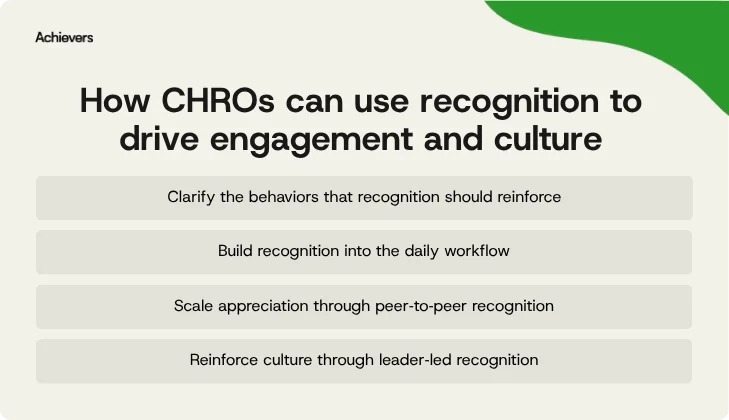
Clarify the behaviors that recognition should reinforce
Recognition drives results when it’s connected to clear expectations. CHROs need to define which behaviors most directly support engagement, morale, retention, and performance — and ensure recognition consistently reinforces them. When recognition is vague, it weakens impact. When it’s specific and tied to priorities and values, it becomes a practical signal employees can act on every day.
Build recognition into the daily workflow
Recognition is most effective when it happens in the flow of work, not around it. Instead of living in annual programs, recognition should show up in the moments where work actually happens — during team check‑ins, project milestones, customer wins, and everyday collaboration.
Scale appreciation through peer‑to‑peer recognition
Manager recognition matters — but it can’t do all the work. Peer‑to‑peer recognition expands visibility, strengthens belonging, and captures contributions leaders may never see. When recognition becomes a shared responsibility, culture scales with it. CHROs play a critical role by setting the expectation that recognition is shared work — something employees actively give, not something leaders alone are responsible for.
Reinforce culture through leader‑led recognition
Recognition from senior leaders lands differently because it shows people what truly matters right now. A CEO calling out a team for navigating change well, or an executive recognizing collaboration during a tough quarter, does more to clarify priorities than another slide or email ever could. CHROs make this stick by helping leaders recognize visibly, consistently, and in ways employees can learn from.
Design recognition that works across roles and work models
Recognition should reach people wherever work happens — on the frontline, across time zones, or behind a screen. That means designing moments that fit different realities, from quick peer shout‑outs on the floor to digital recognition shared across teams. When recognition focuses on real contribution, people feel seen for the impact they make, not how close they sit to leadership.
Positioning recognition as a system for shaping culture
Recognition creates the most value when it becomes a leadership habit, not a one‑time rollout. Used consistently, it helps people understand what the organization stands for and how they fit into it. This is where recognition turns into a system — one CHROs can track, improve, and use to strengthen culture over time.
How to measure recognition ROI and fix what’s not working
Measuring recognition ROI starts with understanding usage, consistency, and impact. These metrics show what’s working — and what isn’t.
What CHROs should measure to prove business impact
- Participation and adoption rates: Look at how many employees are actively using recognition — and how quickly they engage after joining. Strong adoption signals that recognition is part of the culture, not just a tool that exists.
- Recognition frequency and distribution: Track how often recognition happens and where it’s focused. Healthy programs show consistent recognition across teams, roles, and locations — not pockets of activity driven by a few enthusiastic users.
- Engagement and retention trends: Compare engagement scores, attrition risk, and retention outcomes for employees who are recognized regularly versus those who aren’t. These comparisons help show where recognition is strengthening commitment, and where there are still gaps.
- Sentiment and connection indicators: Measure whether employees feel valued, connected to their manager and peers, and aligned to company values. These signals reveal whether recognition is building connection, not just generating activity.
How to link recognition data to people and business outcomes
- Anchor recognition metrics to priority outcomes: Start with what leadership cares about — engagement, retention, productivity — then track how recognition activity aligns to movement in those areas.
- Use before‑and‑after and segment comparisons: Compare trends over time or across groups (by role, location, tenure, or manager effectiveness and participation) to identify where recognition is working and where it isn’t reaching people.
- Pair quantitative data with employee voice: Recognition data shows what is happening. Pulse surveys and feedback explain why and point to the changes needed to improve impact.
Common recognition challenges CHROs face — and how to overcome them
- Low participation: When participation is low, it usually means recognition feels unclear or disconnected from daily work — not that employees don’t care. HR can drive usage by making recognition easier, showing examples of what “good” looks like, and nudging recognition at moments people already care about, like onboarding or team wins.
- Manager bottlenecks: When recognition depends only on managers, it slows down and important contributions get missed. Peer recognition helps fill those gaps by capturing everyday effort and collaboration that managers don’t always see.
- Perceived unfairness: Recognition can feel unfair when employees don’t understand why certain people are recognized. Clarity and visibility take the guesswork out of recognition. When people can see the “why,” recognition feels more credible, and trust grows.
- “Set it and forget it” programs: Recognition doesn’t work on autopilot. As teams, priorities, and work models change, programs need small adjustments to stay relevant. CHROs keep recognition working by regularly checking participation and reach — and making tweaks before engagement starts to dip.
- Over‑indexing on rewards: When rewards become the main event, recognition can start to feel transactional. The most effective rewards and recognition programs lead with meaningful, specific recognition that calls out the right behaviors. Because rewards work best when they support the message — not when they replace it.
How recognition turns into results: What CHROs should do next
The question for CHROs isn’t whether recognition matters — it’s whether it’s working in the moments that matter most. When people feel disconnected, uncertain, or stretched thin, recognition is often the first signal they look for to understand whether their work still counts. When it’s done well, it becomes the thread that connects people to purpose, to one another, and to what the organization truly values.
The CHROs getting this right aren’t chasing shiny programs or one‑time wins. They’re paying attention to where recognition shows up, who it reaches, and how it reinforces the kind of culture that drives results. And they’re willing to look honestly at what’s working — and what needs to evolve.
If that sounds like where you want to be, Achievers can help you see what’s possible with recognition.
Employee recognition for CHROs FAQs
Key insights
- Recognition gives CHROs a scalable way to influence culture without relying on policy changes, training programs, or organizational redesign.
- Frequent, visible, and values‑aligned recognition is one of the most cost‑effective ways for CHROs to drive engagement and retention at scale.
- Organizations that treat recognition as a business performance system report better results than those that treat it as an engagement initiative.
“Well-designed reward and recognition programs provide a structured, consistent approach to recognizing and rewarding employee performance, underpinned by a clear strategy and performance standards. They provide a “compass for performance."”
Robert Dur
Professor of Economics, Erasmus University Rotterdam
“People repeat what gets reinforced. That’s true in moments of growth. It’s true in moments of uncertainty. It’s especially true in periods of transformation. The organizations leading in this report seem to understand that recognition is not just a reaction to performance. It's part of how performance is shaped. ”
David Bator
Managing Director, Achievers Workforce Institute