Table of contents
Create a culture that means business™
Schedule a demo with an Achievers solution expert today.


 Copy URL
Partnerships don’t usually start with fireworks.
They start with questions. Tough ones. Things like: Will this scale? Will employees actually use it? Will it hold up inside complex, global organizations? And maybe the most important one of all: Will this make work better, not just more complicated?
And right now, many of those questions trace back to the same uncomfortable truth: most employees don’t feel appreciated at work.
According to the Achievers Workforce Institute (AWI) 2026 Engagement and Retention Report, just 25% of employees say they feel genuinely appreciated, and only 26% describe themselves as engaged. Even more telling? Nearly two thirds would consider returning to a former employer if it meant feeling valued again.
In other words, the problem isn’t that organizations don’t care about recognition. It’s that appreciation isn’t consistently reaching its destination.
When Workday set out to choose a recognition partner, the goal wasn’t to add another feature. It was to find a solution that could fit naturally into how work happens, support enterprise complexity, and still feel human.
That search led to Achievers.
Workday Recognition provided by Achievers is the result of that choice — a partnership shaped by trust, shared design principles, and a belief that recognition should be more than a moment. It should be a habit.
What Workday really wanted: Adoption, not a program
Recognition has a reputation problem.
Everyone agrees it matters. Few organizations struggle with belief. The real struggle is follow-through. Too many recognition programs live on the sidelines of work, separate logins, separate tools, separate intentions that quietly fade when calendars fill up.
Workday wasn’t looking for another program.
It was looking for recognition that people would actually use, without being asked, reminded, or nudged every five minutes. That’s where Achievers stood out.
Social recognition sits at the core of the Achievers platform. Not as an add-on, but as the engine. Peer-to-peer, frequent, visible recognition is what turns appreciation into behavior and behavior into culture. When recognition is easy and social, it doesn’t feel like a task. It feels like work acknowledging work.
That distinction mattered. Because adoption isn’t driven by mandates. It’s driven by moments that feel natural enough to repeat.
Designed for how work really happens (not how org charts say it should)
Modern organizations are complex by design.
Hybrid teams. Global workforces. Matrixed roles. Frontline, deskless, distributed employees, often all within the same company. Recognition has to move just as fluidly as work does.
That’s why this partnership goes deeper than a surface-level integration.
Workday Recognition provided by Achievers is co-developed and certified to live inside the Workday experience, not alongside it. Recognition doesn’t sit in a separate system waiting to be remembered. It shows up where employees already are, when work is happening, and when appreciation actually matters.
The result isn’t just convenience. It’s consistency. Recognition becomes part of everyday workflows instead of another thing competing for attention.
The enterprise reality check: Recognition has to work for HR and IT
There’s a version of recognition software that looks great in demos, but quietly creates headaches behind the scenes.
Enterprise organizations don’t have the luxury of experimentation without guardrails. Security, scalability, compliance, and system integrity aren’t “nice to have.” They’re table stakes.
Workday’s partner ecosystem is intentionally selective. Achievers’ role as Workday’s recognition partner reflects rigorous evaluation across product, security, and customer impact, not just surface features.
For HR teams, that means fewer surprises and less vendor sprawl. For IT teams, it means certified integrations that won’t unravel at scale. For organizations, it means recognition that fits cleanly into existing systems instead of becoming another exception to manage.
When recognition data stops living in a silo, things get interesting
Recognition is powerful on its own. But when it connects to the rest of the HR ecosystem, it becomes something more.
Inside Workday, recognition doesn’t just sit as a feel-good moment. It becomes signal.
- Signals that help leaders see where collaboration is happening
- Signals that surface strengths, skills, and contributions that don’t always show up in formal reviews
- Signals that bring more context into feedback, development, and performance conversations
This is where recognition shifts from “culture initiative” to organizational intelligence grounded in real behavior, not assumptions.
And because recognition flows through the same system leaders already use, insight doesn’t require extra work. It’s already there, waiting to be used.
Three moments where integrated recognition changes the experience
Sometimes the value of integration is easiest to see in the small moments.
1. Performance conversations that feel more human
Instead of relying on memory or last-quarter highlights, employees can bring real recognition moments into feedback and performance discussions. Specific examples. Real impact, less guesswork.
2. Skills and strengths made visible
Recognition often captures work that job descriptions miss: mentoring, collaboration, problem-solving. When those moments connect to skills data, leaders gain a richer picture of how work actually gets done.
3. Global recognition without global complexity
Recognition should feel equitable everywhere, not just at headquarters. With global rewards and payroll alignment handled behind the scenes, organizations can focus on meaning, not administration.
None of these moments are flashy. But that’s the point. They’re simply better.
What smart buyers look for and why Workday’s choice matters
Workday’s decision offers a useful lens for HR and business leaders evaluating recognition today.
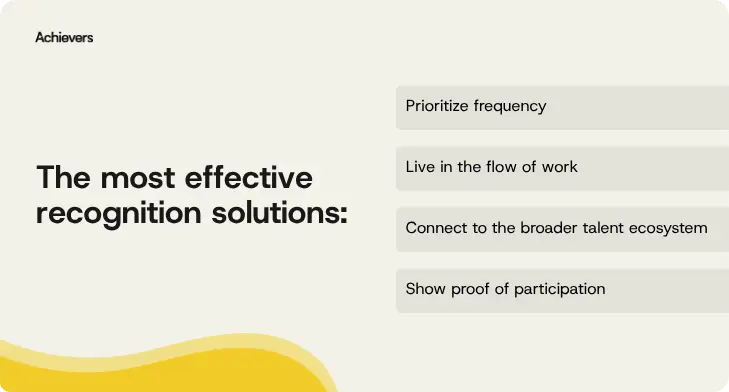
The most effective solutions share a few traits:
- They prioritize frequency, not just formality
- They live in the flow of work, not outside it
- They connect to the broader talent ecosystem, instead of operating alone
- They show proof of participation, not just intent
Recognition that meets those criteria doesn’t need constant selling. It earns its place by being useful.
A quick leader playbook: Making recognition stick
Recognition cultures don’t happen by accident. They’re built through small, repeatable behaviors.
- Here’s what leaders can do to keep recognition working:
- Recognize close to the moment (ideally within 48 hours)
- Be specific about what mattered and why
- Tie recognition back to values or outcomes
- Make it visible so others can learn from it
- Pay attention to gaps and rebalance when needed
Big picture: Why this partnership exists and why it matters to you
At its core, the Achievers–Workday partnership is about respect, for people’s time, for organizational complexity, and for the reality of modern work.
Most leaders don’t need another system to manage. They need fewer obstacles between intention and action. Recognition works best when it fits into the way work already happens, not when it asks employees and managers to remember one more thing, log into one more place, or follow one more process.
That’s why recognition works best when it’s:
- Easy enough to happen often: Because consistency, not grand gestures, is what builds trust and connection.
- Meaningful enough to matter: Because vague praise fades fast, but specific recognition reinforces the behaviors that move teams forward.
- Integrated enough to last: Because anything that lives outside core workflows struggles to survive long-term.
That’s why Workday chose Achievers. Not to add another feature, but to support recognition that can scale connection, insight, and performance, without losing its humanity.
For HR and business leaders, this means recognition becomes less about running a program and more about shaping how work feels day to day. It becomes a signal employees can rely on, managers can use naturally, and organizations can learn from without making things complicated or cumbersome.
Because when recognition lives where work happens, culture stops being abstract. It becomes something people feel every day.
Workday x Achievers FAQs
Key insights
- Recognition drives the greatest impact when it’s frequent, meaningful, and built into the flow of everyday work.
- Workday chose Achievers to turn recognition from a standalone program into a shared habit that scales across the organization.
- When recognition lives where work happens, culture becomes something employees experience, not something leaders explain.
Recognition shifts from “culture initiative” to organizational intelligence