Table of contents
Create a culture that means business™
Schedule a demo with an Achievers solution expert today.


 Copy URL
Employee engagement in 2026 isn’t quietly declining — it’s becoming an expensive liability.
According to Achievers Workforce Institute’s 2026 Engagement and Retention Report, current job‑seeking behavior alone puts U.S. employers on track to absorb over $1 trillion in turnover costs next year if nothing changes. That risk isn’t hypothetical. It’s already baked into how disconnected today’s workforce feels and how ready many employees are to act on it. Disengagement isn’t just a culture problem anymore. It’s a balance‑sheet problem.
This is what the numbers are really telling us: when employees don’t feel appreciated, connected, or supported, they don’t just disengage — they plan their exit. And those decisions ripple outward, affecting productivity, retention, and long‑term performance.
That’s why employee engagement has never been about free snacks or once‑a‑year team events. It’s about whether people feel seen, valued, and motivated to give their best — not because they’re obligated to, but because the experience of work gives them a reason to care.
The jaw-dropping stats we’ll dive into in this blog come directly from Engagement and Retention Report, built on global research conducted by Achievers Workforce Institute. This isn’t an aggregation of third‑party benchmarks. It’s original data drawn from employees and HR leaders across industries and regions, designed to surface where engagement is breaking down and where organizations still have leverage to act.
Below, we break down the employee engagement statistics that matter most in 2026 and what they reveal about building a workplace where employees aren’t just showing up, but genuinely bought in.
What are employee engagement statistics?
Employee engagement statistics are data points that measure how employees feel about their work, their leaders, and their organization and how those feelings show up in behavior. They quantify levels of commitment, motivation, connection, and intent to stay, turning what can feel like a “culture problem” into something leaders can actually see, track, and act on.
These statistics typically come from employee surveys and workforce research, like the 2026 Engagement and Retention Report from Achievers Workforce Institute, which captures how employees experience appreciation, growth, connection, purpose, and leadership at work.
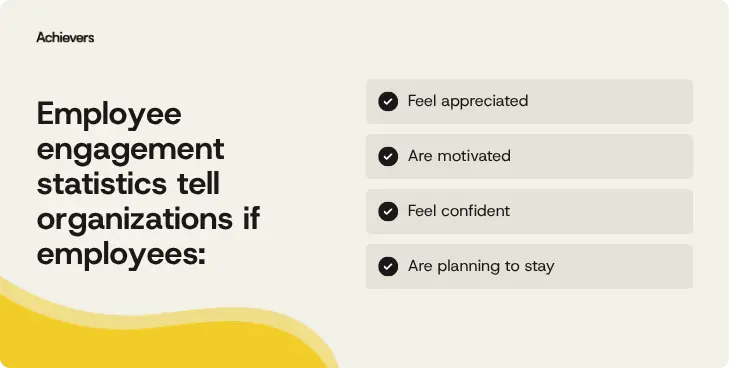
At their best, employee engagement statistics help organizations answer questions like:
- Do employees feel appreciated for their contributions?
- Are they motivated to go above and beyond in their roles?
- Do they feel connected to their manager, team, and company values?
- Are they planning to stay or quietly preparing to leave?
Employee engagement statistics reveal more than you think
Perhaps most importantly, employee engagement statistics reveal patterns. When you look beyond individual data points, a clear picture emerges of where the employee experience is working and where it’s falling short. These patterns highlight the gaps between what employees expect from work and what many organizations are actually delivering.
Used well, employee engagement statistics aren’t just metrics — they’re signals. They show where culture is thriving, where it’s breaking down, and where recognition, connection, or growth can make the biggest impact. In short, they give leaders the clarity they need to stop guessing about engagement and start shaping it — intentionally and consistently.
15 employee engagement statistics you need to know
When employees feel connected to their work, their teams, and their organization’s purpose, everything changes. Performance improves. Retention strengthens. Culture stops feeling like a buzzword and starts feeling real.
But if you want to understand what’s driving — or draining — engagement, you have to start with the data.
Here are 15 employee engagement statistics from the 2026 Engagement and Retention Report that reveal what’s working, what’s missing, and where organizations need to pay closer attention.
1. Only 26% of employees are engaged at work
Just over one in four employees say they’re engaged in their work. That means the majority of the workforce is either disengaged or emotionally disconnected. When engagement is this low, productivity, innovation, and retention all take a hit. The message is clear: engagement can’t be assumed — it has to be intentionally built.
2. Just 25% of employees feel appreciated at work
Recognition remains one of the most overlooked engagement drivers. Only a quarter of employees feel genuinely appreciated and that gap has real consequences. Employees who feel appreciated are 12x more likely to find their work meaningful and 17x more likely to see a long‑term career with their organization. Appreciation isn’t a perk. It’s a predictor of engagement and loyalty.
3. 34% of employees plan to look for a new job
More than one‑third of employees are actively job hunting this year, and another 22% are undecided about staying. That puts over half the workforce at risk of turnover. These employee engagement statistics point to a fragile commitment problem and a massive opportunity for organizations that get engagement right.
4. Only 25% of employees envision a long‑term career with their employer
Just one in four employees can picture a future with their current organization. This isn’t just about who’s leaving now — it’s about who can’t see a reason to stay. When employees don’t see growth, appreciation, or connection ahead, engagement stalls and loyalty fades long before a resignation letter appears.
5. Employees who feel appreciated are 17x more likely to envision a long‑term career
This is one of the most powerful employee engagement statistics in the report. Feeling appreciated dramatically shifts how employees think about their future. Recognition doesn’t just motivate performance — it shapes career commitment.
6. Only 22% of employees feel they have access to growth opportunities
Career growth is a major engagement driver, yet fewer than a quarter of employees believe their organization is providing the tools, resources, or opportunities they need to grow. When growth feels blocked, engagement stalls and job hunting accelerates.
7. Employees with development opportunities are 2.5x more engaged
When employees see a clear path forward, engagement rises. The data shows that access to learning and development makes employees 2.5x more likely to be engaged and 2.5x less likely to be job hunting. Growth isn’t optional. It’s foundational to engagement.
8. Only 19% of employees feel connected to their manager
Managers play a critical role in engagement, yet fewer than one in five employees feel truly connected to their direct leader. This disconnect limits trust, feedback, and recognition — all essential ingredients for engagement.
9. Recognition from managers makes employees 2.8x more likely to feel connected
When managers recognize employees consistently, connection improves fast. Employees who receive regular recognition from their manager are 2.8x more likely to feel connected to their organization and 2.7x more likely to feel supported in their growth. Recognition is leadership in action.
10. Only 25% of employees feel their work is meaningful
Purpose and engagement are deeply linked. Yet only one in four employees say their work feels meaningful. Employees who feel appreciated are 12x more likely to find meaning in their work, reinforcing how recognition fuels purpose.
11. Only 23% of employees feel they have the resources they need to do their best work
Engagement doesn’t stall only because of motivation — it stalls because of friction. Fewer than one in four employees feel properly enabled to succeed in their role. When employees are asked to perform without the right tools, clarity, or support, effort turns into frustration. Over time, that friction quietly erodes engagement, performance, and trust. Enablement isn’t separate from engagement, it’s a prerequisite for it.
12. Disengagement could cost employers up to $1.3 trillion in attrition
If current job‑hunting trends continue, U.S. employers could lose at least $1.3 trillion to turnover in 2026. Disengagement isn’t just a culture issue, it’s a massive financial risk.
13. 75% of employees feel overlooked at work
Three‑quarters of the workforce feels overlooked and that sense of invisibility directly undermines engagement, trust, and motivation. When people don’t feel seen, they don’t stay engaged for long.
14. Employees who feel appreciated are 56x more likely to feel connected to their organization
Connection is one of the strongest predictors of engagement, and recognition is the fastest way to build it. Employees who feel appreciated are dramatically more connected and far more likely to stay.
15. Recognition, connection, and growth are the top engagement drivers
Across all regions, the data points to three consistent levers behind strong employee engagement statistics: recognition, connection, and growth. Organizations that invest in all three create cultures where people don’t just work, they thrive.
What these employee engagement statistics are really telling us
When only 26% of employees are engaged and just 25% feel appreciated, the problem isn’t effort — it’s visibility. Most employees aren’t disengaged because they don’t care. They’re disengaged because their work goes unnoticed, their growth feels uncertain, and their connection to the organization fades over time.
That’s where the opportunity lives. The same data shows that employees who feel appreciated are 17x more likely to envision a long‑term career. Recognition doesn’t just improve morale — it reshapes how people think about their future at work. Engagement isn’t built through grand gestures or annual programs. It’s built in everyday moments: a manager noticing effort, a team celebrating progress, a workplace that makes people feel seen, supported, and valued.
That’s exactly what Achievers is designed to enable. We turn employee engagement statistics into action, enabling frequent recognition, stronger manager connection, and cultures where people don’t just show up, but choose to stay, grow, and contribute.
Seen. Heard. Appreciated. That’s how engagement becomes results.
Employee engagement statistics FAQs
Key insights
- Engagement drops when employees don’t feel appreciated or supported
- Recognition is the fastest way to boost engagement and commitment.
- Recognition, connection, and growth are the foundation of strong cultures.