Table of contents
Create a culture that means business™
Schedule a demo with an Achievers solution expert today.


 Copy URL
When recognition works, you can feel the shift. People are engaged. Teams are aligned. Work doesn’t just get done — it gets done with purpose. And according to the State of Employee Recognition Report, 91% of employees say they’d put in more effort if they felt truly valued. That’s the power of meaningful recognition.
But too many recognition programs rely on vague intentions and hope for the best. (“We have a program… people probably use it… right?”)
If you want recognition to make a real impact, you need to know what’s working. That means using measurable criteria for employee recognition. Not just feel-good moments, but clear signs of performance, values, and engagement.
Let’s break down five criteria that go beyond the basics, and show you how to build a recognition program that’s not just appreciated, but accountable.
5 measurable criteria for employee recognition
If your recognition program doesn’t have a measurement strategy, it’s just a feel-good initiative with a short shelf life. To build a culture that sticks and scales, you need to define what good looks like. The right criteria can help you recognize the moments that matter, reinforce desired behaviors, and show your impact on the business.
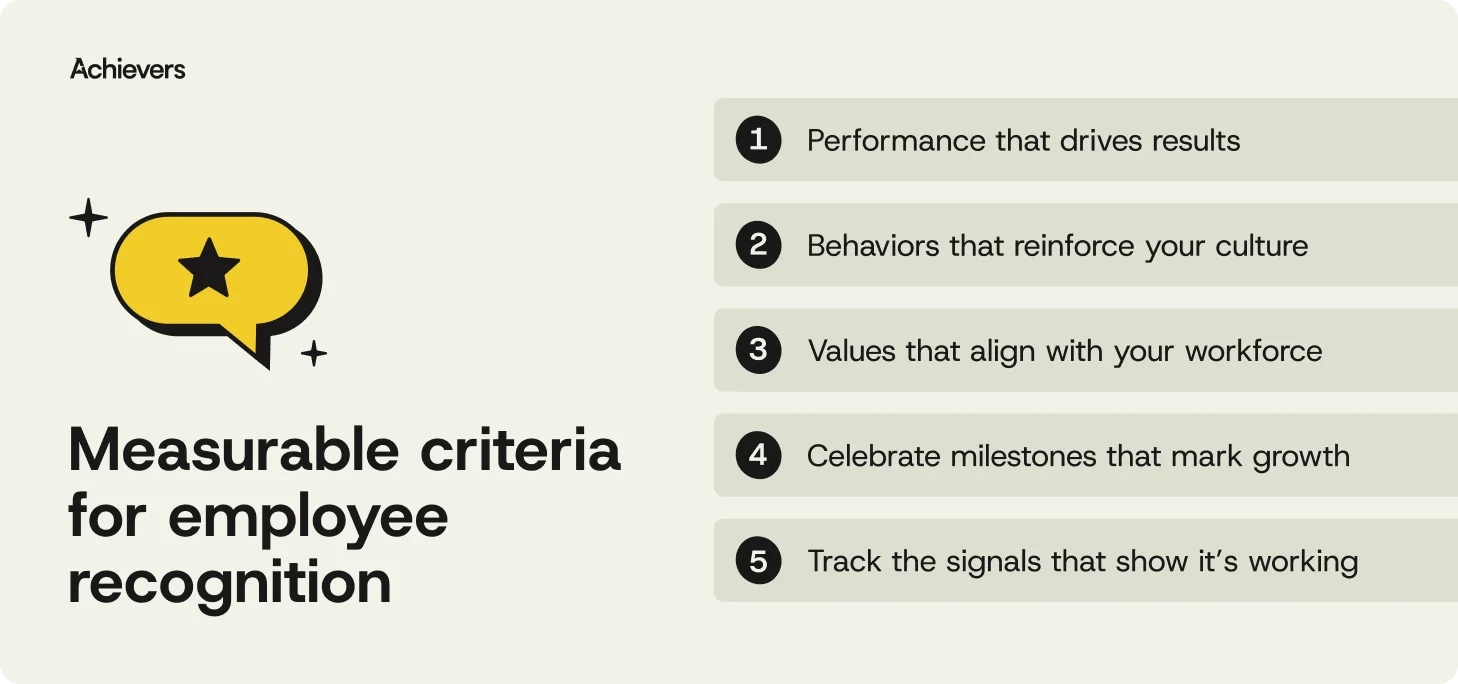
Here are five measurable criteria for recognition programs that make recognition not just meaningful, but actionable:
1. Performance that drives results
Not all wins show up in a trophy case, but when they’re tied to performance metrics, they should show up in your recognition program. Performance-based recognition helps reinforce the day-to-day actions that move your business forward.
When you spotlight the people consistently hitting targets, meeting deadlines, or delivering standout work, you’re not just rewarding output — you’re setting the bar for what success looks like.
What to measure:
- KPI achievement: Recognize employees who consistently hit or exceed their goals — whether it’s a sales quota, service-level agreement, or operational target.
- Project completions and delivery: Celebrate individuals or teams who finish key initiatives on time (or ahead of schedule), especially when they include cross-functional collaboration.
- Quality of work: Highlight employees who go beyond the basics, delivering accurate, thoughtful, high-standard work that reflects care and attention to detail.
- Productivity: Acknowledge employees who consistently complete a high volume of work without sacrificing quality — or who improve processes to boost team efficiency.
- Sales or customer success outcomes: Recognize team members who exceed revenue targets, retain clients, or drive up customer satisfaction scores.
2. Behaviors that reinforce your culture
Recognition isn’t just about the outcome. It’s about how people show up along the way. Behavioral recognition highlights the everyday actions that quietly shape your culture — like stepping up to help a teammate, leading with curiosity, or staying calm under pressure. These are the moments that deserve to be seen.
What to measure:
- Collaboration: Recognize employees who break down silos, support their peers, or lead inclusive, cross-functional projects.
- Innovation: Call out those who introduce new ideas, improve processes, or find creative ways to solve problems.
- Problem-solving: Celebrate employees who navigate challenges by showing resilience in the workplace, making data-driven decisions, or resolving issues before they escalate.
- Leadership at any level: Don’t just wait for manager nominations. Recognize anyone who motivates others, models accountability, or takes initiative — title or no title.
- Adaptability: Acknowledge those who embrace change with a positive mindset and help others do the same.
3. Values that align with your workforce
Recognition hits differently when it’s tied to something deeper. Values-based recognition connects appreciation to your company’s core principles — showing employees not just what matters, but why it matters.
Whether someone models integrity in a tough decision or advocates for inclusion during a team debate, these are moments that strengthen your culture from the inside out.
What to measure:
- Living company values: Recognize employees who actively embody your core values — not just in theory, but through their everyday actions and decisions.
- Culture-building behaviors: Celebrate moments where employees foster trust, inclusion, or belonging across teams.
- Ethical decision-making: Call out integrity, fairness, and transparency — especially in moments where doing the right thing required effort or courage.
- Positive influence: Highlight employees who act as cultural ambassadors — from welcoming new hires during the onboarding process to modeling empathy and respect in tough moments.
4. Celebrate milestones that mark growth
Milestones are the recognition equivalent of cake — expected but always appreciated. And when done right, they’re more than just calendar events. They’re a chance to say, “We see you. We’re glad you’re here. And we’re better because of it.”
From career achievements to life moments, these milestones help employees feel valued for the full picture of who they are, not just their output.
What to measure:
- Tenure and anniversaries: Go beyond the generic email. Recognize meaningful moments — whether it’s a years of service anniversary or a decade of contributions — and make it personal.
- Team achievements: Spotlight the collective wins that move the business forward, like finishing a big project or hitting a stretch goal. Bonus points for calling out the unsung heroes.
- Professional development milestones: Celebrate certifications earned, skills built, and roles expanded. Learning is growth, and growth deserves recognition.
- Personal moments: Acknowledge birthdays, growing families, or major life changes. Employees don’t stop being people when they log in — so make space for the whole person.
5. Track the signals that show it’s working
Recognition is powerful — but only if it’s reaching the right people, happening often enough, and actually making an impact. That’s where measurement comes in. Not the kind that lives in a dusty spreadsheet, but real-time signals that tell you whether your program is sticking or just… existing.
These metrics help you see what’s working, where to course-correct, and how recognition is influencing behavior across your organization.
What to measure:
- Activation rate: How many employees have joined the platform? If people aren’t signing up, they’re definitely not recognizing.
- Frequency of recognition: How often are recognitions being sent — and by whom? Look for a balance between leader-driven and peer-to-peer recognition.
- Redemption activity: Are employees using their points? Low redemption might mean the reward experience needs work.
- Recognition equity: Who’s being recognized (and who’s not)? Break it down by team, role, tenure, or demographics to spot gaps.
- Engagement signals: Track likes, comments, boosts — the social cues that show whether recognition is creating employee connection.
- Budget utilization: Are you pacing well throughout the year? If you’re under-spending, recognition might not be happening often enough.
- Sentiment and feedback: What are employees saying in surveys or comments? Their words might reveal more than the numbers.
How to track recognition effectiveness
Tracking the effectiveness of employee recognition starts with measuring both participation and impact over time. The goal isn’t just to count recognition moments, but to understand how they influence engagement and performance.
Organizations can focus on a few key indicators:
-
Participation and frequency
How often employees and managers are giving and receiving recognition
-
Reach and inclusivity
Whether recognition is distributed across teams, roles, and locations
-
Engagement trends
Changes in engagement survey scores or sentiment alongside recognition activity
-
Retention and performance signals
Shifts in turnover rates or performance outcomes tied to recognized employees or teams
The most effective approach is to track these metrics consistently and look for patterns over time. When recognition is frequent, aligned to values, and widely adopted, it becomes easier to connect recognition activity to meaningful business results.
How to measure the success of employee rewards initiatives
To measure the success of an employee rewards initiative, by tracking whether those rewards lead to changes in employee behavior and measurable outcomes like engagement, retention, and performance. Don’t measure how many rewards are distributed without looking at the results behind it. Here’s how organizations can get started measuring initiative success:
Reward distribution and usage
Reward distribution measures how often rewards are issued across the organization, including points, awards, or incentives tied to performance or recognition.
This helps answer a basic question: are rewards being used consistently, or concentrated in specific teams or roles? Uneven distribution can signal gaps in program design or manager adoption. Reward usage also includes redemption behavior (i.e. how often employees use their rewards) which gives visibility into whether rewards are meaningful and relevant.
Reward participation and adoption
Participation measures how many employees are actively earning and redeeming rewards. Adoption patterns show whether rewards are integrated into everyday workflows or if they’re used only occasionally.
Consistent usage across teams indicates that rewards are accessible and aligned with how employees work. Low participation or uneven adoption may mean there’s friction, lack of awareness, or rewards don’t fit with staff preferences or interests.
Alignment between rewards and behaviors
An important measure of success is whether rewards are tied to the behaviors the organization is trying to reinforce.
This includes tracking:
- What actions or achievements are being rewarded
- Whether rewards align with company values or priorities
- How often rewards are linked to specific behaviors versus generic recognition
When rewards are clearly connected to actions, they help showcase the actions and efforts that employers value. In fact, 2026 data from the State of Recognition Report found 41% of 3,000 surveyed employees said say small monetary rewards motivate them the most. Smaller, more frequent rewards that are tied to specific recognition moments reinforce behaviors better than large rewards without context. When employees see a clear link between what they did and the reward they received, it becomes easier to understand what to repeat. That’s what turns rewards into reinforcement.
Impact on engagement and experience
Rewards contribute to engagement when they reinforce that employees’ efforts are recognized and valued. To measure this, compare reward activity with engagement data. For example, assess whether employees who receive rewards more frequently report stronger connection, motivation, or satisfaction. This helps establish whether rewards are influencing how employees experience their work.
Program-level ROI
At a program level, success is defined by whether rewards contribute to broader business outcomes, including increased engagement, improved eNPS, and better performance and productivity.
The Achievers Manager Toolkit: A better way to measure recognition
It’s one thing to define measurable criteria for employee recognition. It’s another to help your managers actually track and act on them.
The Achievers Manager Toolkit bridges that gap. It puts real-time insights, reminders, and recognition prompts right where managers need them — helping them connect the dots between goals, behavior, and appreciation.
With the toolkit, managers can:
- Track team recognition activity in real time: See who’s recognizing, who’s being recognized, and how often — helping identify participation gaps and promote consistent recognition across teams.
- Get personalized nudges and prompts: Receive timely suggestions to recognize based on performance milestones, values-aligned behaviors, and real-time engagement signals.
- Monitor recognition frequency and equity: Use visual dashboards to assess how recognition is distributed — by role, tenure, department, or demographic — so no one gets overlooked.
- Celebrate key milestones and behaviors consistently: Acknowledge service anniversaries, project completions, collaboration, innovation, and customer impact — all within the natural flow of work.
The result? More intentional recognition. More consistent habits. And a clearer line between everyday actions and business impact.
Build recognition that’s measurable, meaningful, and built to last
Recognition should never feel like an afterthought. It’s how you show people they matter, remind them what good looks like, and build a culture where the right behaviors stick. But here’s the thing: the best recognition isn’t just heartfelt — it’s trackable.
When you define what matters and give people the tools to celebrate it, recognition becomes more than a moment. It becomes a habit. A strategy. A culture-shaping force.
That’s what Achievers is here for. We help you take the guesswork out of appreciation — with smart insights, nudges for busy managers, and tools that make recognition easy, personal, and measurable from day one.
When recognition is clear and consistent, great work stops being the exception and starts becoming the norm.