Table of contents
Create a culture that means business™
Schedule a demo with an Achievers solution expert today.


 Copy URL
Building an employee recognition program means creating a clear, consistent way to reinforce the behaviors and contributions that matter most to your organization. The strongest programs help employees understand what good work looks like and ensure that meaningful efforts don’t go unnoticed.
Employee recognition has also increasingly become a business performance strategy. In a Harvard Business Review Analytic Services survey, 66% of respondents said their organization’s recognition program is very important for influencing business performance, yet only 33% described their program as very effective. The gap highlights an important reality: most organizations believe recognition matters, but many have not yet built programs that consistently influence the behaviors that drive results.
What is an employee recognition program?
An employee recognition program is a structured system organizations use to acknowledge employees for their work, contributions, achievements, and behaviors on an ongoing basis. It provides a consistent way for managers, leaders, and peers to recognize efforts that support company goals and values. Most recognition programs are delivered through an online recognition platform, where employees can give and receive recognition, celebrate milestones, and access rewards in one place.
Why does an employee recognition program matter now?
Employee recognition programs matter now because many employees still don’t receive recognition often enough for it to shape performance, engagement, or culture. Research from the 2026 State of Recognition Report, which surveyed 3,000 employees globally, found that 35% of employees are recognized only a few times a year, while 92% say they would put in additional effort if they were recognized. Without a structured program, valuable work often goes unnoticed and organizations lose the ability to reinforce the kind of behaviors and contributions that help businesses succeed.
Who is impacted the most by an employee recognition program?
Employees and managers are impacted the most by an employee recognition program because they participate in recognition every day. Employees receive feedback, appreciation, and visibility for their contributions, while managers use recognition to reinforce expectations, celebrate progress, and support performance.
When does an employee recognition program succeed and fail?
An employee recognition program succeeds when employees see recognition as a genuine reflection of their contributions. For example, a manager regularly acknowledges team contributions, peers celebrate each other’s successes, and milestones are recognized in a timely and personal way.
A recognition program often fails when recognition feels forced, inconsistent, overly dependent on managers, or disconnected from employees’ day-to-day work. For example, recognition that only happens at annual events or only reaches the same small group of employees.
Where does an employee recognition program show up in an organization?
An employee recognition program shows up across the entire employee lifecycle, from onboarding and everyday work to promotions, project milestones, work anniversaries, and career achievements. It appears in manager-to-employee feedback, peer-to-peer recognition, team celebrations, and company-wide initiatives, and is never confined to a single event or department.
How does an employee recognition program work in practice?
An employee recognition program works in practice by establishing clear criteria for what should be recognized, providing employees and managers with ways to recognize those contributions, and making recognition visible across the organization. When an employee demonstrates a company value, reaches a milestone, supports a teammate, or delivers meaningful results, that contribution is recognized and shared through the program.
How to build and launch an employee recognition program
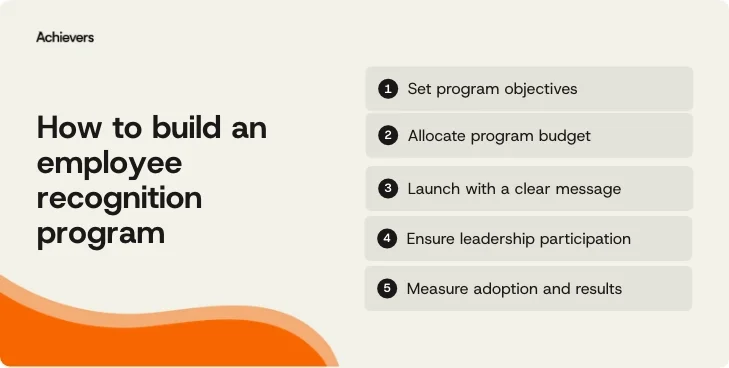
1. Design the recognition program
Designing an employee recognition program means defining what will be recognized, how recognition will be given, who will participate, and how success will be measured. A well-designed program creates clear expectations from the start and ensures recognition supports organizational goals, values, and employee needs.
Set objectives
Set objectives before launching the program so recognition has a clear purpose. Common goals include increasing participation, improving employee engagement, reinforcing company values, strengthening retention, or encouraging specific behaviors. These objectives should also determine which KPIs you track and how you measure success over time.
Align recognition to company values
Align recognition to the behaviors and actions your organization wants to encourage. Connecting recognition to company values helps employees understand what contributions matter most and creates consistency across teams. Recognition becomes more meaningful when employees can see a direct connection between their actions and organizational priorities.
Allocate budget
Allocate budget based on how the program will operate and scale. Budget considerations typically include recognition software, rewards, communications, training, and program administration. A sustainable budget supports ongoing participation and adoption, instead of focusing only on launch activities.
Define program guidelines
Define program guidelines to create consistency and transparency. Employees should understand what qualifies for recognition, who can send recognition, how rewards are distributed, and any rules that impact participation. Clear guidelines reduce confusion and help create a fair experience across the business.
Plan for scale
Plan for scale early, especially if employees work across multiple locations, countries, or work environments. Recognition programs should support different languages, rewards preferences, accessibility needs, and time zones so the experience remains consistent for all employees.
2. Introduce and launch the program
Introducing an employee recognition program means employees need to understand why the program exists, what it recognizes, how to participate, and why their involvement matters.
Launch your recognition program with a clear message
Launch the program and explain its purpose before asking employees to participate. Employees should understand what behaviors, values, and contributions the program is designed to recognize, how recognition will be given, and how it supports larger organizational goals. The clearer the connection, the easier it is for employees to adopt recognition as part of their daily work.
Train employees and managers
Train employees and leaders on examples of effective recognition, explain when and how recognition should be given, and help managers understand their role in encouraging participation. Recognition is more likely to become a habit when expectations are clear from the beginning.
Ensure leadership participation
Ensuring leadership is participating in your recognition program helps establish recognition as an expected part of the employee experience. When leaders are involved, it signals to employees that recognition is a clear priority.
3. Measure program adoption and results
Measuring the results of an employee recognition program means tracking whether recognition is influencing participation, employee experience, and business outcomes.
Measure adoption early
Measure adoption early by tracking program adoption from launch so you can identify participation gaps and opportunities for improvement. Common KPIs include:
- Recognitions sent and received
- Monthly active users
- Activation rates
- Recognition index
- Leadership participation
- Employee engagement trends over time
Monitoring these metrics helps determine whether employees are participating regularly and whether the program is becoming part of regular work.
Gather employee feedback
Gather feedback through employee survey tools, focus groups, and manager conversations to understand how employees experience the program. Feedback can highlight participation challenges, identify opportunities for improvement, and show areas where recognition is resonating most strongly.
Refine the program over time
Refine the program based on participation data and employee feedback. Recognition programs are most successful when they develop alongside employee needs, company priorities, and workplace culture. Regular review helps ensure the program remains relevant, accessible, and impactful over time.
Why recognition programs miss the mark
Recognition programs are most effective when they do more than celebrate good work. They should actively reinforce the behaviors that help organizations achieve their goals.
The research from HBR found a significant difference between organizations that see strong business results from recognition and those that do not. Among organizations with highly effective programs, 88% intentionally design recognition to drive specific employee behaviors. In contrast, only 28% of organizations with less effective programs take the same approach.
That distinction matters because recognition influences where employees focus their time and energy. As economist Robert Dur explains in the research report, “A reward and recognition system is a bit like a compass that directs people’s attention, time, and energy.” When recognition is tied to strategic priorities, employees gain a clearer understanding of what success looks like and which contributions the organization values most.
Effective recognition is also timely, meaningful, and specific. Generic praise may create a positive moment, but meaningful recognition helps employees understand why their actions mattered and encourages those behaviors to be repeated. As Dur notes, “Recognition is powerful but tends to be underestimated by people in practice. For recognition to be powerful, it needs to be meaningful.”
Organizations that close the execution gap treat recognition as an ongoing business practice rather than an occasional people initiative. They align recognition with company values, strategic objectives, and the behaviors they want to see more often across the workforce.
The business impact of an employee recognition program
Recognition is often associated with engagement, morale, and culture. While these outcomes are important, the strongest programs also create measurable business results.
The Harvard Business Review research found that organizations with highly effective recognition programs are significantly more likely to report improvements across key performance indicators. Compared to laggard organizations, leaders are more likely to report:
- Improved productivity (49% vs. 18%)
- Better customer experience (44% vs. 20%)
- Increased revenue or profit margins (36% vs. 8%)
- Faster execution of goals and strategy (30% vs. 9%)
The impact extends beyond financial and operational metrics. Organizations with effective recognition programs are also more likely to see gains in innovation, collaboration, problem-solving, and talent development. Meanwhile, nearly one-third (31%) of laggard organizations report that their recognition programs have produced no business improvements at all, compared to just 2% of leader organizations.
These findings reinforce an important idea: recognition works best when it’s designed to support business priorities, not simply improve engagement scores. For HR leaders, the takeaway is clear: the most effective recognition programs aren’t measured solely by participation rates or reward redemptions. They’re measured by their ability to reinforce the behaviors that improve performance, strengthen culture, and help the business execute on its strategy.
Best practices guide for employee recognition programs

Recognize employees in real time
Recognize employees as close to the moment of contribution as possible. Immediate recognition creates a stronger connection between an employee’s actions and the appreciation they receive, helping showcase what great work looks like in real-time.
Encourage participation through campaigns
Encourage participation through recognition campaigns that create recurring opportunities for employees to recognize one another. Campaigns tied to company milestones, awareness days, team achievements, or seasonal events can increase visibility and help recognition become a habit. The simplest way? Create your own monthly recognition calendar playbook. It helps teams plan ahead, stay consistent, and turn good intentions into regular moments of appreciation.
Make recognition frequent and impactful
Make recognition frequent enough to become part of the employee experience and meaningful enough to reinforce important contributions. Employees should receive recognition regularly, but recognition should also be relevant, specific, and connected to the value they create for their team or business.
Tie recognition to specific behaviors
Tie recognition to specific behaviors so employees understand exactly what they are being recognized for. Instead of generic praise, identify the behavior, contribution, or outcome being acknowledged and explain why it mattered. This helps create clear examples of the actions and values the organization wants to encourage.
How do you build a budget for an employee recognition program?
Building a budget for employee recognition starts with aligning investment to business goals — whether that’s improving engagement, reducing turnover, or reinforcing company values. The most effective programs treat recognition not as a cost, but as a driver of performance and retention.
A practical way to approach budgeting is to plan for both program structure and participation:
- Per-employee investment: Many organizations allocate a set annual budget per employee to support frequent, meaningful recognition
- Rewards funding: Budget for points, incentives, or experiences that reinforce desired behaviors
- Technology costs: Include platform fees for recognition software that enables scale, reporting, and ease of use
- Program support: Account for communications, training, and ongoing campaign management
To maximize impact, organizations should focus on frequency and accessibility — ensuring employees can recognize each other regularly, not just during milestones. Platforms like the Achievers employee experience platform help optimize budget by increasing participation and tying recognition activity to measurable business outcomes.
Types of employee recognition
Social recognition
Social recognition is public acknowledgment of an employee’s contributions, achievements, or behaviors. It is typically shared through recognition platforms, team meetings, company communications, or social feeds where other employees can see and engage with the recognition.
Monetary recognition
Monetary recognition combines appreciation with a tangible reward. This can include points, gift cards, bonuses, company merchandise, or rewards from a global marketplace.
Peer-to-peer recognition
Peer-to-peer recognition is appreciation given directly between coworkers. Unlike manager-led recognition, peer recognition highlights contributions that colleagues observe through everyday collaboration. It helps employees acknowledge support, teamwork, problem-solving, and other contributions that may not always be visible to leaders.
Where should a recognition program live?
A recognition program should live where work already happens. For many organizations, that starts with one or two core tools employees already use every day, integrated with tools like Slack, Teams, or Outlook. But don’t stop there. Your program should also live in your workplace culture, woven into team meetings and town halls. Because when appreciation is visible in the moments that matter, it feels natural, meaningful, and impossible to ignore. The goal isn’t complexity — it’s making recognition easy enough that it actually happens.
When does an employee recognition program have the most impact?
Recognition programs deliver the greatest impact when they’re woven into the everyday flow of work. When recognition is weekly, our research shows employees are 2.6x more likely to be productive and 9x more likely to feel a strong sense of belonging. Catch people in the moment, and recognition feels powerful. Wait too long, and it starts to sound more like a footnote than genuine appreciation.
What are the challenges with existing employee recognition programs?
The challenges with existing employee recognition programs are:
1. Recognition happens too infrequently
Recognition happens too infrequently when it’s reserved for annual service awards, performance reviews, or major milestones. Employees need regular feedback to understand what they’re doing well and what behaviors the organization values most. When recognition is delayed, it loses relevance and impact.
2. Participation is limited
Participation is limited when recognition comes mostly from managers. Employees see valuable contributions from their peers every day, but many traditional programs don’t make it easy for coworkers to recognize one another. As a result, important moments go unnoticed.
3. Recognition feels like extra work
Recognition feels like extra work when employees have to leave their normal workflow to participate. If giving recognition requires too many steps, adoption drops. The most effective programs make recognition easy to give in the tools employees already use.
4. Recognition isn’t visible enough
Recognition isn’t visible enough when appreciation happens privately or within small teams. Public recognition helps employees see what success looks like across the organization and reinforces behaviors others can learn from and repeat.
5. Rewards miss the mark
Rewards miss the mark when they don’t reflect what employees actually value. A reward that feels meaningful to one employee may feel irrelevant to another, which is why flexibility and choice matter.
6. Program success is hard to measure
The success of a recognition program is hard to measure when organizations don’t track participation, recognition frequency, or program outcomes. Without data, it’s difficult to understand whether recognition is improving engagement, retention, or performance, or where the program needs to improve.
How to prevent bias in employee recognition programs
1. Make recognition everyone’s responsibility
Making recognition everyone’s responsibility helps prevent bias by reducing dependence on a single person’s perspective. When recognition comes only from managers, employees are limited to what those managers see. Recognition from peers creates more opportunities for contributions across teams, departments, and work styles to be noticed.
2. Tie recognition to clear behaviors
Tying recognition to clear behaviors helps prevent bias by giving employees consistent criteria for recognition. Recognition should explain what someone did and why it mattered, not rely on subjective opinions. The more specific the recognition, the less room there is for personal preferences to influence who gets recognized.
3. Train employees on what meaningful recognition looks like
Training employees on what meaningful recognition looks like helps prevent bias by creating a shared standard. Employees should understand how to write specific recognition, connect recognition to company values, and recognize contributions outside of their immediate circle of colleagues.
4. Use technology to support equitable recognition
Using technology to support equitable recognition helps prevent bias by providing visibility into recognition patterns at scale. Recognition platforms can help organizations identify gaps in participation and encourage more balanced recognition across the workforce, making it easier to create a program that recognizes fairly instead of subjectively.
The business case for an employee recognition program
Enhance business results
Employee recognition can improve business results by increasing employee engagement, productivity, and commitment. Recognition helps employees understand which contributions matter most, creating stronger alignment between individual actions and organizational goals. The employee recognition statistics compiled by Achievers make it clear: recognition is directly tied to business performance. Here’s what the research shows:
- Increasing recognition from quarterly to monthly boosts the likelihood of engagement and productivity by 40% and job commitment by 25%.
- Employees who are recognized monthly are 36% more likely to say they are productive and engaged, and 22% more likely to be highly committed to their roles.
Improve organizational culture
Employee recognition can strengthen organizational culture by reinforcing shared values, encouraging positive workplace behaviors, and helping employees feel connected to the organization. Research from Gallup on organizational culture shows:
- Employees who strongly agree with the statement “I feel connected to my organization’s culture” are 62% less likely to feel burned out at work very often or always, according to research from Gallup.
- Those same employees are 47% less likely to be watching for job opportunities or actively looking for another job.
Get executive buy-in
Executive buy-in is easier to achieve when recognition is positioned as a business driver instead of an employee engagement initiative. Leaders are more likely to support recognition programs when they can see a clear connection between recognition, employee outcomes, and business performance.
Research from the Achievers Workforce Institute (AWI) found:
- 60% of HR leaders with an online recognition program say it’s driving business results, compared to 30% with an offline or in-house platform.
- Programs that measure specific outcomes like employee well-being, belonging, and engagement are 68% more likely to drive business results.
Selecting the right recognition platform is one of the most important decisions when building a scalable employee recognition program. For an independent analysis of the market, review the 2026 PEAK Matrix® report, which evaluates leading rewards and recognition providers based on market impact, innovation, customer adoption, and vision.
How do you develop an employee recognition strategy?
To develop an employee recognition strategy, decide what deserves more attention in your organization and recognize it consistently. The best strategies start with a simpler question: What do we want employees to do more often? Once that’s clear, recognition becomes a tool for shaping culture instead of simply celebrating it.
A strong employee recognition strategy should:
- Connect recognition to the actions and outcomes that matter most
- Make recognition easy, visible, and frequent
- Allow peers, managers, and leaders to participate
- Combine meaningful recognition with rewards when appropriate
- Use data to identify participation gaps and opportunities for improvement
- Fit naturally into the workplace tools employees already use every day
Best practices for international and global recognition programs
1. Build a shared global foundation
Building a shared global foundation means establishing consistent values, recognition criteria, and program standards that apply across every region. Employees should understand what behaviors are recognized, why they matter, and how recognition connects to the organization’s culture regardless of location.
Shared values that translate everywhere
Shared values act as the connective tissue of your global culture. They give every region a clear understanding of what “good” looks like while still allowing teams to express those values in ways that feel natural locally.
Clear expectations across cultures
Clear criteria remove guesswork. When people know exactly which behaviors are recognized, and why, it creates consistency across time zones, reduces misunderstandings, and builds trust in the program.
One consistent system, several local expressions
A centralized platform keeps the program aligned and measurable, while regional teams shape the tone, rewards, and communication style. This balance protects consistency without losing the cultural nuance that makes recognition meaningful.
2. Shared values that translate everywhere
Define a set of shared values that can be recognized consistently across the organization. Shared values help create a common understanding of what success looks like while allowing regional teams to express those values in ways that reflect local culture and workplace norms.
Clear expectations across cultures
Create clear recognition criteria so employees understand which behaviors, contributions, and achievements are eligible for recognition. Consistent standards help reduce ambiguity, improve fairness, and build trust in the program across regions and time zones.
One consistent system with local flexibility
Use a centralized recognition platform to create consistency in reporting, participation, and measurement while allowing regional flexibility in rewards, communications, and program delivery. This helps organizations ensure global alignment without overlooking local preferences and cultural differences.
3. Make recognition culturally relevant and locally meaningful
Include regional voices in program design and execution
Include local HR teams and people leaders in the design and rollout of the program. Their insight can help ensure recognition practices, communications, and rewards fit cultural expectations and feel personal and relevant to employees in each region.
Adapt messaging and recognition styles
Adapt messaging and recognition styles to reflect regional preferences. Some cultures may respond well to public recognition, while others prefer private or team-based acknowledgment.
Offer locally relevant rewards
Offer rewards that reflect local preferences and purchasing habits. Rewards are more meaningful when employees can choose options that feel relevant, accessible, and valuable in their region.
4. Ensure equity and access across the globe
Accessible tools and channels
Recognition should be accessible for everyone, whether they’re on mobile, working in-office, or supporting customers on the frontline. When recognition meets people where they are, it becomes a natural part of the day instead of another task to remember.
In-time-zone, in-language support
Offering in-time-zone and in-language help makes the experience feel local, approachable, and built with their reality in mind.
Fairness through transparency
Fair, transparent recognition programs earn trust. Reviewing recognition patterns across regions helps ensure everyone has equal opportunity to be seen and celebrated and allows you to quickly spot and correct gaps or unintentional bias.
4. Empower leaders and local champions
Train global managers to recognize intentionally
Training global leaders to recognize their international workforce creates a stronger sense of connection and unity at every level of the business. According to data from the 2026 State of Recognition Report, employees recognized by their managers are 11.5x more likely to trust them and 7.7x more likely to feel like they belong. This makes leadership behavior one of your strongest levers in every region.
Simple, in-the-flow recognition tools
When recognition is simple and is part of the tools teams use every day, leaders are more likely to do it consistently. Integrations with tools like Workday, Microsoft Teams, Outlook, Slack, and mobile help leaders embed recognition naturally into their day, no matter where they work.
5. Launch globally with local activation
Start with a pilot that reflects your global workforce
Start your recognition program pilot by choosing a region or team that captures a mix of roles, cultures, and workflows. Use the pilot to test real‑world scenarios, uncover friction, and gather the insights that will strengthen your global rollout.
Create one clear global plan and let regions localize it
Give teams a shared message and toolkit, then encourage them to adapt the delivery, tone, and timing so the launch feels natural in their market. This keeps your strategy aligned while allowing for meaningful regional nuance.
Make the launch visible and easy to engage with
Pair crisp messaging with leadership presence, and give employees a simple first action, like sending a recognition or joining a kickoff moment, so participation feels effortless from day one.
Give managers what they need to lead the way
Equip leaders with ready‑to‑use prompts, examples, and in‑the‑flow tools (Workday, Microsoft Teams, Outlook, Slack, mobile). When recognition is easy and modeled consistently, it spreads quickly.
Support employees where they are
Provide in‑language, in‑time‑zone support so questions get answered quickly. Local support builds confidence and shows employees the program is designed with their reality in mind.
Use insights to refine and scale
Use program insights to track participation, recognition frequency, and reward trends across regions. Pair the data with regional feedback to keep the experience fair and culturally relevant as you grow.
Modern employee recognition programs should be designed to generate both employee engagement and organizational insight. The Brandon Hall Group report explores how strategic recognition programs can help organizations identify trends in collaboration, performance, culture, and retention.
How to increase employee recognition program participation
1. Make recognition easy to give
Making recognition easy to give is one of the fastest ways to increase program participation. If employees have to learn a new system, switch between multiple tools, or follow a lengthy process, many simply won’t participate. The most successful programs remove friction and make recognition feel effortless.
2. Enable peer-to-peer recognition
Enabling peer-to-peer recognition increases participation by creating more opportunities for employees to recognize great work. Managers can’t see every contribution, but coworkers interact with each other every day. Opening recognition to everyone helps appreciation happen more often and reach more people.
3. Recognize employees more frequently
Recognizing employees more frequently keeps participation from becoming stagnant. Programs that focus only on annual awards or milestones give employees fewer reasons to engage. Frequent recognition builds momentum and turns participation into a habit instead of a one-time event.
4. Tie recognition to company values
Tying recognition to company values makes participation more meaningful. Employees will use a recognition program more frequently when they understand exactly what behaviors deserve recognition and how those behaviors contribute to business success.
5. Make recognition visible
Making recognition visible encourages more employees to participate. When employees regularly see coworkers being recognized, the program stays top of mind and demonstrates what meaningful recognition looks like in practice.
6. Train leaders to recognize employees consistently
Training leaders to recognize employees consistently helps set the tone for the entire organization. Employees take cues from their managers, and participation tends to increase when leaders actively model the behaviors they want others to follow.
7. Use recognition campaigns
Using recognition campaigns can give participation a noticeable boost. Campaigns tied to company milestones, cultural initiatives, or awareness events give employees a timely reason to engage and can help reactivate people who rarely participate.
Create a lasting impact with Achievers’ employee recognition program
Achievers helps global companies build recognition programs that employees understand, participate in, and use consistently by combining recognition technology with implementation support, customer success guidance, program strategy, and 24/7 multilingual support.
From launch through long-term program management, Achievers helps organizations increase participation, measure impact, and adapt recognition programs as employee and business needs evolve. We help organizations create recognition experiences that scale globally while remaining meaningful at the local level.

Employee recognition program FAQs
Key insights
- Recognition programs help organizations turn company values into observable, repeatable behaviors by making employee contributions visible across the workforce.
- Programs that rely on annual events or manager-only recognition often miss meaningful contributions that happen every day.
- Global recognition programs are most successful when employees share a common understanding of what deserves recognition, regardless of location, language, or role.