Table of contents
Create a culture that means business™
Schedule a demo with an Achievers solution expert today.


 Copy URL
Impactful employee recognition programs do more than celebrate wins. They help people understand why their work matters. When recognition shows up consistently and feels genuine, it creates clarity. Employees can see how what they do day to day connects to something bigger, not just their to‑do list.
That connection doesn’t happen by accident. According to research from Achievers Workforce Institute (AWI), employees who are recognized at least monthly are 3.9x more likely to see how their work connects to the bigger picture. Recognition helps people connect effort to impact, and that’s where engagement, motivation, and performance start to build. In other words, recognition helps connect the dots between people and performance.
We’re breaking down seven impactful employee recognition programs from Achievers customers. Each one offers clear, practical takeaways you can put to work right away.
What impactful employee recognition programs get right
The best recognition programs don’t just create more moments of appreciation. They make those moments count.
Research from Harvard Business Review Analytic Services found that organizations with the most effective recognition programs are far more intentional about what they recognize. In fact, 88% of leader organizations design recognition programs to reinforce specific employee behaviors, compared to just 28% of laggards.
That’s because impactful recognition does more than acknowledge great work. It helps employees understand what success looks like and where to focus their time and energy. As the research shows, leading organizations use recognition to reinforce the behaviors that support business goals, strengthen culture, and move strategy forward.
The most impactful programs tend to have a few things in common, they:
- Connect recognition to the behaviors that drive business success
- Make recognition part of everyday work, not just major milestones
- Equip managers to recognize meaningful contributions consistently
- Empower employees to recognize one another
- Make great work visible across the organization
- Use recognition to reinforce company values and strategic priorities
7 examples of impactful employee recognition programs across today’s workforce
1. Cineplex uses recognition to drive frontline performance
Cineplex’s story shows how employee recognition can move from a feel‑good initiative to a true performance driver. Operating thousands of frontline roles across theaters and experiential venues, Cineplex needed a way to keep teams motivated, aligned, and focused on guest experience — without slowing down fast‑paced, shift‑based work.
By making recognition part of everyday leadership, Cineplex worked it into daily routines, incentives, and ongoing campaigns. Recognition wasn’t just encouraged — it was tied directly to the behaviors that matter most on the floor. The result: higher employee motivation, significant gains in NPS across locations, and nearly $400,000 in incremental revenue driven by recognition‑powered campaigns.
Takeaway for HR leaders:
Make recognition part of how leaders lead and not something extra. When recognition is frequent, visible, and tied to the behaviors that drive results, it becomes a scalable way to improve performance, not just morale.
2. Sobeys improves operations through feedback, learning, and rewards
As one of Canada’s largest grocery retailers with more than 131,000 employees, Sobeys needed a scalable approach that reached hourly workers and support teams, while staying focused on business priorities. Through its recognition program, Bring It!, Sobeys created a shared system where recognition, feedback, and learning work together to reinforce performance.
A standout example from Sobeys’ story comes from its retail support centers, where the team used feedback surveys and gamified learning to improve cube truck utilization — one of the company’s key logistics metrics. Employees completed quizzes tied to real operational goals, earned points for strong performance, and shared feedback on where processes could improve. The result: cube utilization increased from 77.3% to 86.2%, helping teams stay focused, work better together, and deliver where it counts.
Takeaway for HR leaders:
Recognition becomes more powerful when it’s paired with feedback and learning. By rewarding employees for building knowledge and contributing ideas (not just hitting outcomes), you can drive improvements across your operations while keeping teams engaged and focused on what matters most.
3. General Motors aligns a global workforce through values‑based recognition
General Motors needed a recognition approach that could unite more than 160,000 employees across six continents during a major cultural and business transformation. To support its vision of zero crashes, zero emissions, and zero congestion, GM aligned recognition to seven core behaviors that define how work gets done, ensuring employees everywhere were recognized for the same values, not just results.
GM’s story shows how the shift to one global recognition program created clarity, consistency, and momentum. Employees could recognize peers in real time, celebrate milestones, and see recognition publicly shared across the organization. Within months of launch, participation soared, recognition became one of the most improved areas in engagement surveys, and employees reported feeling more appreciated and aligned with the company’s vision and behaviors.
Takeaway for HR leaders:
When recognition is grounded in shared values and delivered regularly across teams and locations, it becomes a powerful way to break down silos and drive culture change, even in the most complex, global organizations.
4. Seattle Children’s strengthens engagement through patient‑led recognition
Seattle Children’s Hospital wanted a more inclusive way to recognize the full care team — not just clinicians, but everyone who plays a role in a patient’s experience. While families were eager to share gratitude, that feedback was often informal, delayed, or directed at only a few visible roles. The organization saw an opportunity to turn patient appreciation into something more timely, visible, and meaningful for staff across all functions.
Recognition was taken a step further by integrating patient kudos directly into the hospital’s recognition platform using the Achievers API. Patients and families could submit recognition in real time, ensuring contributions from custodial, administrative, and support staff were celebrated alongside clinical care. During the pilot, patient‑submitted recognitions drove a 10% increase in employee engagement and helped spark a “pay it forward” culture where recognition from patients led to more recognition between peers.
Takeaway for HR leaders:
Seattle Children’s story proves recognition doesn’t have to come only from inside the organization. When you create space for customers or patients to say thank you through external recognition tools, you can elevate engagement, inclusion, and belonging across roles that are often overlooked.
5. Scotiabank scales recognition across a global workforce
With nearly 90,000 employees across 30 countries, Scotiabank needed a recognition program that could scale globally without losing consistency or relevance. Its legacy platform couldn’t support cross‑team recognition, mobile access, or meaningful insights, making it hard to build momentum or visibility at scale. The goal was clear: create one enterprise‑wide recognition experience that reinforced values, engaged leaders, and worked seamlessly across regions.
Scotiabank’s story shows recognition became a daily habit, not a one‑time event. Leaders were mobilized as recognition champions, peer‑to‑peer recognition was encouraged through campaigns like Pay It Forward, and recognition was embedded directly into the flow of work through Microsoft Teams. The results speak for themselves: 93% of employees actively use the platform, recognitions sent per employee have increased by nearly 60%, and one campaign alone drove a 40% month‑over‑month increase in active users.
Takeaway for HR leaders:
Global recognition works best when it’s simple, visible, and built into everyday tools. When leaders model the behavior and employees can recognize each other wherever they work, recognition becomes a shared language and not a siloed program.
6. Kellanova increases recognition frequency to strengthen pride and connection
Kellanova knew recognition needed to change when a global survey revealed that only about half of employees felt regularly appreciated for their work. With more than 30,000 employees across four regions — many in manufacturing and frontline roles — recognition was inconsistent, siloed, and largely top‑down. The company needed a simpler, more inclusive way to help people feel seen for both everyday contributions and big wins.
In Kellanova’s story, recognition became a daily, peer‑driven habit. By launching a mobile‑first, global recognition platform, Kellanova made it easy for employees to recognize one another across teams, regions, and roles. Recognition was tied to company values, supported by meaningful rewards, and expanded into a broader engagement hub, helping boost pride, connection, and participation worldwide.
Takeaway for HR leaders:
If recognition feels rare or uneven, focus on frequency and accessibility first. When recognition is easy, inclusive, and part of everyday work, it strengthens pride, connection, and loyalty at scale.
7. Rogers doubled sales by rethinking frontline rewards
In Rogers’ story, the company was looking for a better way to motivate fulfillment reps to upsell and cross‑sell during customer activations after commission‑based approaches repeatedly missed the mark. What they needed was something simpler, more engaging, and easier to sustain, while still delivering clear ROI.
Rogers introduced a non‑cash, points‑based rewards program that recognized reps instantly for additional services sold. Within six months, participation reached nearly 70%, quickly exceeding industry norms. More importantly, the program delivered a 93% increase in sales of additional services, showing that recognition‑powered rewards can directly influence frontline performance.
Takeaway for HR leaders:
Immediate, visible recognition tied to specific behaviors can motivate participation, spark healthy competition, and deliver measurable business results.
Elements of an impactful recognition program
The most impactful recognition programs combine a few core elements that work together to create clarity, consistency, and momentum, including:
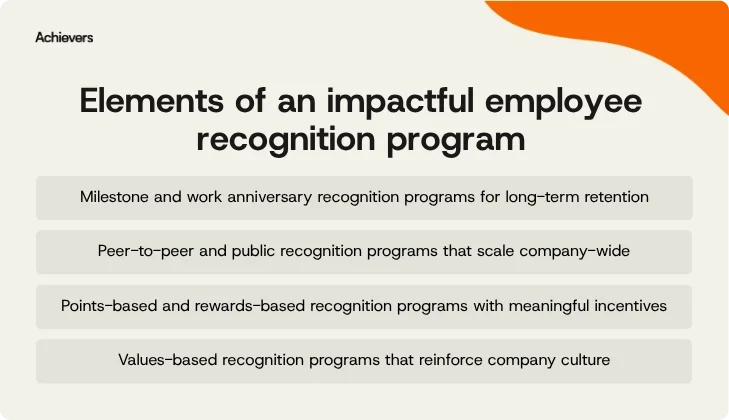
Milestone and work anniversary recognition programs for long-term retention
Strong milestone programs remove the risk of being forgotten while avoiding the trap of sounding generic. Automation makes sure moments aren’t missed, but meaning comes from context: what the person has learned, contributed, and helped move forward. When it’s done well and with intention, milestone recognition quietly reinforces loyalty without a long speech or a fancy watch.
Peer-to-peer and public recognition programs that scale company-wide
Peer‑to‑peer recognition programs give employees a simple way to recognize one another for good work, collaboration, and everyday contributions, not just major wins. By opening recognition up beyond managers, these programs make appreciation more frequent and more reflective of how work gets done.
Visibility is what gives peer recognition its power. Research from the State of Recognition Report shows that 33% of employees recognized by their peers feel more productive at work and have a stronger sense of belonging — a reminder that recognition doesn’t just acknowledge effort, it helps people feel part of something bigger.
Points-based and rewards-based recognition programs with meaningful incentives
Points‑based and rewards‑based recognition programs pair appreciation with tangible incentives employees can choose and use. These programs allow organizations to recognize contributions in a way that feels concrete, consistent, and scalable without using rewards as compensation.
When rewards are used thoughtfully, they reinforce recognition rather than overshadow it. Clear guidelines, fair budgets, and the ability to let employees choose the type of reward they want helps keep participation high and building trust.
Values-based recognition programs that reinforce company culture
Values‑based recognition programs focus on recognizing employees for how work gets done, not just what gets delivered. They tie recognition directly to an organization’s stated values, so employees can clearly see which behaviors are expected, encouraged, and rewarded.
Clear categories, shared language, and visibility into how and why people are being recognized help leaders spot what’s working and where there’s room for improvement. Over time, values move out of slide decks and into everyday decisions.
Why impactful recognition programs deliver stronger business results
The examples in this article come from different industries, workforce models, and business challenges, but they share a common philosophy: recognition is used to reinforce behaviors that matter.
Harvard Business Review Analytic Services research found that organizations with the most effective recognition programs consistently outperform their peers across a range of business outcomes. Compared to laggard organizations, they are more likely to report:
- Improved productivity (49% vs. 18%)
- Better customer experience (44% vs. 20%)
- Faster execution of goals and strategy (30% vs. 9%)
- Increased revenue or profit margins (36% vs. 8%)
The research also found that nearly one-third (31%) of organizations with ineffective recognition programs report seeing no business improvements from their efforts, compared to just 2% of organizations with highly effective programs.
What’s the difference? Leaders are more intentional. They understand that recognition isn’t simply about making employees feel appreciated. It’s about helping people understand which actions, behaviors, and contributions create success for the organization.
As explained in the research report, a recognition program acts like “a compass that directs people’s attention, time, and energy.” When recognition consistently points employees toward the behaviors that support customers, teams, and business goals, performance improvements often follow.
The organizations featured in this article demonstrate that there is no single formula for recognition success. What matters is creating a recognition strategy that aligns appreciation with purpose, making it easy for employees to understand how their work contributes to something bigger.
Achievers’ recognition program connects people and performance
Across these examples, one thing becomes clear: the most impactful employee recognition programs aren’t about checking a box or handing out rewards. They’re about helping people see that what they do matters and that it matters to someone else, too.
That’s exactly how Achievers approaches recognition. Achievers’ employee recognition platform connects people and performance by making appreciation frequent, visible, and part of everyday work. When recognition shows up in the moments that matter — tied to real behaviors and real impact — it stops being a nice gesture and starts shaping how work gets done.
Recognition isn’t just about celebrating success. It’s about shaping it.
Impactful employee recognition programs FAQs
Key insights
- The most impactful employee recognition programs connect people to purpose by making everyday contributions visible and meaningful.
- Recognition works best when it reinforces behaviors, not just outcomes, and shows up consistently across teams, roles, and regions.
- When recognition is frequent, visible, and tied to what matters most, it doesn’t just boost morale — it drives performance.