Table of contents
Create a culture that means business™
Schedule a demo with an Achievers solution expert today.


 Copy URL
Employee turnover is a message employees send to their managers, because when people leave, they’re telling you something. The real challenge is figuring out what that something is, and how to fix it before your best people walk out the door. When you understand what’s driving turnover, you can start shaping a culture where employees feel seen, supported, and motivated to stick around.
How to calculate employee turnover rates
Turnover rates might not be the most thrilling numbers on your dashboard — but they speak volumes about the health of your company culture. The good news? You don’t need a finance degree or a crystal ball to make sense of them. Just a simple formula, a bit of patience, and maybe a strong coffee.
Here’s the basic formula:
For example, if the average number of employees is 90 and 6 employees left during the year, your turnover rate would be:
This tells you what is happening. The next step is understanding why. That’s where recognition becomes a critical driver of retention. Data from the Achievers Workforce Institute (AWI) 2026 Engagement and Retention Report tells us that:
Only 25% of employees feel appreciated at work
When appreciation is this low, it signals a major gap in the employee experience and a clear opportunity to improve engagement before it turns into turnover.
Employees who feel appreciated are 2.5x more likely to stay
This is the shift from insight to action: increasing recognition directly improves retention outcomes.
75% of employees say removing rewards would influence their decision to leave
Recognition paired with meaningful rewards reinforces value in a way employees can feel, helping turn short-term engagement into long-term loyalty.
Turnover data shows where you’re losing people. Recognition helps you understand how to keep them. That’s why leading organizations don’t just measure turnover, they invest in recognition and rewards programs that make employees feel seen, supported, and confident in their future.
5 steps to calculate employee turnover rate
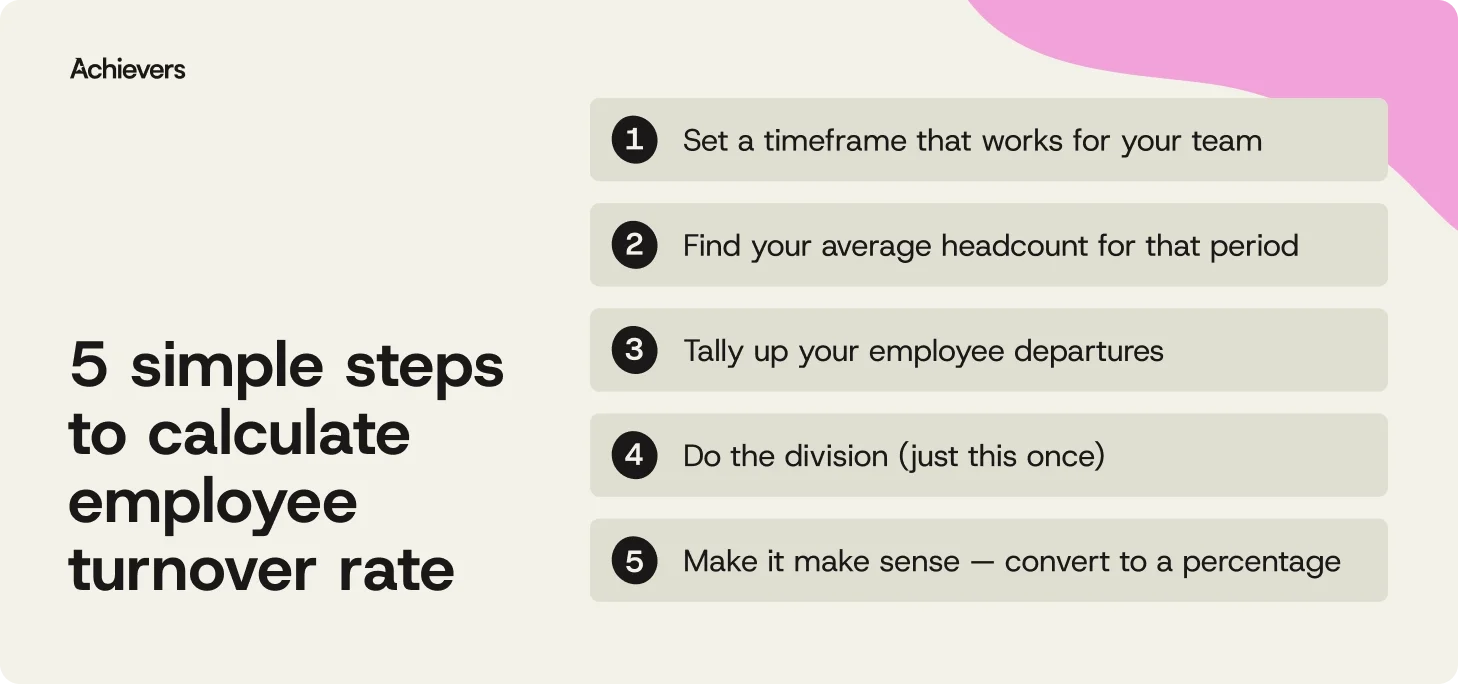
1. Set a timeframe that works for your team
Before you do anything else, pick a timeframe to measure, whether it’s monthly, quarterly, or annually. Each view tells a different story: shorter windows help spot quick shifts, while annual numbers reveal long-term patterns (and whether your retention strategy is actually, well, working).
2. Find your average headcount for that period
Start by recording how many employees you had at the beginning and end of your chosen timeframe. Add those two numbers together and divide by two, and that’s your average headcount.
3. Tally up your employee departures
Count how many people left during that period. That includes resignations, retirements, terminations, and layoffs. Voluntary or not, they all contribute to your turnover story.
4. Calculate the division
Take the number of employees who left and divide it by your average number of employees. This gives you the turnover rate as a decimal.
5. Make it make sense by converting to a percentage
Multiply that decimal by 100 to turn it into a percentage, something you can actually use in presentations, dashboards, and awkward boardroom chats.
That’s your turnover rate. And once you’ve got it, you can start digging into what’s really behind it and how to keep your top talent right where they belong.
Reading between the lines of your turnover rate
So, you’ve crunched the numbers and calculated your turnover rate. Next is figuring out what it’s trying to tell you.
A high turnover rate is a signal that something isn’t working in your organization. Maybe it’s compensation. Maybe it’s culture. On the other hand, a low turnover rate often points to a stable, disengaged workforce that’s feeling seen, heard and staying for a reason.
Here’s a quick look at what your turnover rate might be communicating:
High turnover might be saying:
- “I’m not getting paid enough for this.”
- “Where’s my future here?”
- “My manager doesn’t get me.”
- “This culture isn’t it.”
Low turnover could be telling you:
- “People are happy and it shows.”
- “Roles are aligned with expectations.”
- “Employees feel engaged and valued.”
- “Compensation is competitive enough to stick around for.”
No two companies are the same, which means turnover will always have a few unique layers. But whatever the rate, it’s a powerful launch point to explore what’s really driving employees out the door — or keeping them in their seats.
Common causes of high turnover
Let’s take a closer look at some of the usual contributors to turnover. None of them are new — but if they’re lingering in your workplace, your people probably won’t be for long:
- Poor management: When employees feel unsupported, unheard, or undervalued, they look for greener (and better managed) pastures.
- Stalled career growth: A dead-end job rarely inspires loyalty. If growth feels out of reach, so does long-term commitment.
- Inadequate compensation: If pay doesn’t meet market expectations, you’ll find yourself training replacements on repeat.
- Toxic culture: If inclusion is lacking and bad behavior is swept under the rug, even the most dedicated team members will eventually look for an exit.
The real cost of high turnover
Turnover isn’t just a line on a spreadsheet — it’s a ripple effect. When employees leave, it costs money, time, energy, and often a few too many “who’s covering that now?” meetings. Let’s break down what high employee turnover really means for your business, beyond the obvious.
Turnover is expensive
Replacing a single employee can cost anywhere from 40% to 200% of their salary, depending on the role. That’s budget-reforecasting, strategy-delaying, CFO-cringing kind of money.
But it’s not just the recruiting, onboarding, and training costs. There’s also the productivity hit, because new hires need time to ramp up. And don’t forget the toll on those who stay behind. Watching colleagues leave can take a toll on employee morale and engagement. Eventually, people start to wonder if they’re next.
Turnover negatively impacts culture
Every time someone walks out the door, they take more than a badge and a branded mug. They take relationships, know-how, and institutional memory, and sometimes leave a hefty workload behind.
That workload doesn’t disappear. It lands on someone else’s desk. And when that starts to pile up, so does the frustration. High performers might succumb to burnout at work. Others may begin to question if the culture is as healthy as it claims to be.
Turnover quietly slows company growth
High turnover can slowly impact how your business is able to grow and scale. Frequent departures can stall long-term projects, weaken customer relationships, and fragment strategic momentum.
When institutional knowledge is constantly walking out the door, it’s harder to maintain consistency across operations, leadership, and culture. Eventually, this can dent your employer brand and make it harder to attract and retain talent you desperately need to turn things around.
Strategies to reduce employee turnover rates
Let’s be honest: great employees don’t usually leave because they feel too appreciated, too supported, or too fulfilled. Reducing turnover isn’t about magic — it’s about being intentional. That means building an organizational culture where employees feel recognized, rewarded, and empowered to grow.
Below are a few strategies that do more than just retain employees — they help them thrive:
Build a culture that actually feels good to work in
Start by building a workplace culture that feels good to be a part of. That means recognizing achievements often (and meaningfully), building a culture of appreciation, and making it clear that their contributions matter.
Engagement and retention initiatives like employee recognition programs aren’t just nice to have — they’re essential. Done right, they boost morale, reinforce the behaviors you want to see more of, and make employees think twice before polishing up their résumés.
And let’s not forget wellness. Offering support for physical, mental, and emotional health like gym memberships, mental health days, or resources to help with work-life balance sends a clear message that the company cares about its employees as people, aside from solely their professional efforts.
Invest in growth and watch loyalty grow with it
Here’s a thought: If employees can grow their careers at your company, they won’t need to go elsewhere to do it. Providing clear opportunities for learning, upskilling and reskilling, and advancement shows people that their future is here — not out there.
Professional development isn’t just a perk — it’s a proven retention tool. It prepares your team for leadership roles, reduces your dependency on external hires, and saves on recruiting costs. Plus, it reinforces trust: when people know their company is investing in their success, they’re more likely to return the favor with long-term commitment.
Cultivate a committed, engaged workforce with Achievers
Building a workplace where people want to stay and grow starts with culture. When employees feel recognized, supported, and heard, they show up engaged and committed to your business long-term. That’s where Achievers makes the difference.
Achievers helps organizations create lasting cultures of appreciation by turning everyday moments into meaningful recognition. And by making it easy to listen and respond to employee feedback, Achievers empowers leaders to act on what matters most.
The result is a workforce that feels valued, energized, and ready to stick around for the long haul.
FAQs about employee turnover rates
Annual turnover = [(# of employees who left / average # of employees) × 100]
(6 ÷ 90) × 100 = 6.67%
If you had 85 employees at the start of Q1 and 95 at the end, your average is (85 + 95) ÷ 2 = 90
If 5 employees resigned and 1 was let go, your total is 6
6 departures ÷ 90 average employees = 0.067
0.067 × 100 = 6.7%
High turnover is a signal, not fate — with purpose, recognition, and people-first culture, you can boost retention and shift the tide.
To keep your best people, give them more than a reason to stay — give them a reason to be excited they did.