Table of contents
Create a culture that means business™
Schedule a demo with an Achievers solution expert today.


 Copy URL
Employee engagement programs improve connection, retention, performance, and employee experience when included in regular employee interactions instead of occasional campaigns. In 2026, the most effective programs focus on recognition, rewards, employee feedback, career development, well-being, flexibility, and belonging, helping employees feel valued, supported, and connected to organizational goals.
What is an employee engagement program?
An employee engagement program is a structured effort to improve how employees experience work by increasing their connection to their organization, manager, team, and role. These programs help HR and management create the conditions that support engagement by encouraging employees to feel valued, involved, supported, and able to contribute their best work, through features like social and monetary recognition, surveys and feedback tools, and employee connection opportunities.
Why do employee engagement programs matter now?
Employee engagement programs matter because many organizations are facing challenges with employee connection, trust, belonging, and long-term commitment. Research from the 2026 State of Recognition Report, including answers from 3,000 employees globally, finds that less than 33% of those surveyed feel a strong sense of connection or purpose.
As workforces become more distributed and employee expectations continue to change and evolve, organizations need consistent ways to help employees feel valued, supported, and connected to their work. Well-designed engagement programs strengthen relationships between leaders and peers and help build more resilient, adaptable workforces.
Who is impacted most by employee engagement programs?
Employee engagement programs impact the employees who feel disconnected from their work, managers, colleagues, or organizations. This includes new hires, frontline employees, remote and hybrid workers, and employees who lack regular recognition, growth opportunities, or meaningful manager support.
Engagement programs help address these experience gaps by creating more opportunities for employees to be recognized for their contributions, share honest feedback, connect with their colleagues, and find growth and development opportunities.
Employee engagement programs are most effective when they provide actionable insight alongside employee feedback. Discover the connection between recognition and business results in Brandon Hall Group’s analysis of how recognition influences retention, performance, and workforce alignment.
When do employee engagement programs work and when do they fail?
Employee engagement programs work when they help employees feel appreciated, connected to their colleagues and managers, supported in their growth, and aligned with organizational values. They also work best when managers and leadership act on employee feedback and regularly recognize when employees are active and participating in the program.
Engagement programs often fail if they collect feedback but don’t result in meaningful action, recognize employees infrequently, or fail to meet the needs of different employee groups, and can struggle to build trust, connection, or lasting engagement.
Where do employee engagement programs show up in an organization?
Employee engagement programs show up in onboarding experiences, manager 1:1s, employee recognition programs, team meetings, employee surveys, career development conversations, mentorship programs, milestone celebrations, wellness initiatives, and employee resource groups (ERGs).
Accessible engagement plans are integrated into the software and tools employees use every day, whether that’s Slack, Zoom, or Microsoft tools like Copilot and Teams. This creates a consistent program experience and allows employees working globally or on dispersed teams to stay connected to one another and the business.
How do employee engagement programs work in practice?
Employee engagement programs work by creating consistent opportunities for employees to participate in the culture of an organization. In practice, that means recognizing employee contributions, regularly collecting and acting on feedback, supporting career growth and development, celebrating personal and professional milestones, encouraging peer connections, and reinforcing great work with monetary and points-based rewards.
14 employee engagement program examples for 2026
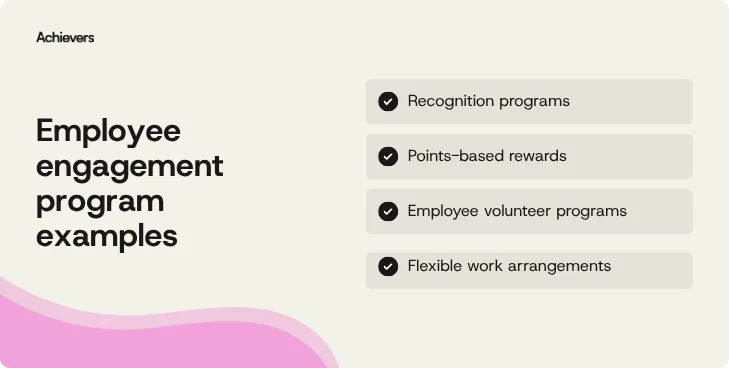
1. Recognition programs
Recognition programs are one of the most effective ways to shape culture and performance. When employees are recognized in real time for living company values and delivering results, engagement rises, because people understand what matters and feel appreciated for contributing to it.
Whether it’s peer-to-peer recognition, leadership awards, or social moments of appreciation in the flow of work, recognition reinforces the behaviors organizations want more of.
How to implement:
- Define the values and behaviors recognition should reinforce
- Enable peer‑to‑peer and manager recognition in daily workflows
- Make recognition visible across teams and locations
How to measure success:
- Recognition frequency and participation rates
- Engagement and sentiment scores tied to recognition
- Retention rates among frequently recognized employees
2. Points-based rewards
Points-based rewards are most effective when they’re meaningful to the person receiving them. A points-based rewards system makes that possible by giving employees choice so they can redeem rewards that actually fit their lives, whether that’s a gift card to their preferred store, a travel experience, a piece of company swag, or a donation to their favorite charity.
By putting flexibility and personalization at the center, points-based rewards are easy to scale and simple to manage, while still feeling thoughtful and human.
How to implement:
- Offer a flexible rewards catalog with meaningful choices
- Align points to specific behaviors and contributions
- Review reward usage regularly to ensure relevance
How to measure success:
- Reward redemption and participation rates
- Usage across roles, regions, and demographics
- Correlation between rewards activity and retention
3. Employee volunteer programs
Employee volunteer programs help employees feel more connected to their purpose both personally and at work. By giving employees opportunities to give back, through volunteer days, cause-based campaigns, or donation matching, organizations help people see how their work aligns with something bigger. The result is a stronger sense of belonging, pride, and cultural alignment that naturally drives engagement.
How to implement:
- Partner with causes employees care about
- Offer paid volunteer time or company‑sponsored volunteer days
- Share impact stories to reinforce purpose
How to measure success:
- Volunteer participation rates
- Employee feedback on purpose and belonging
- Engagement scores linked to values alignment
4. Flexible work arrangements
Flexible work arrangements help employees get their best work done. Whether it’s hybrid schedules, flexible hours, or compressed workweeks, giving people more control over when and how they work supports well-being, autonomy, and trust. Organizations that lead with flexibility see higher engagement and lower burnout because they’re designing work around people, not the other way around.
How to implement:
- Define flexibility guidelines by role, not just policy
- Train managers to lead flexible teams consistently
- Communicate expectations and guardrails clearly
How to measure success:
- Engagement and burnout indicators
- Absenteeism and turnover rates
- Productivity or performance outcomes by team
5. Mentorship opportunities
Mentorship opportunities are a valuable tool to help improve engagement in the workplace. Mentorship programs pair employees with experienced guides who help them build skills, navigate challenges, and plan what’s next. These relationships boost confidence, strengthen internal networks, and reinforce a culture where learning and support are part of everyday work.
How to implement:
- Match mentors and mentees based on goals and skills
- Set clear expectations for participation and duration
- Provide structure and resources to support the relationship
How to measure success:
- Program participation and completion rates
- Employee development and internal mobility metrics
- Feedback on growth and career confidence
6. Team-building activities
Team-building activities build connection and camaraderie at work. Shared challenges, team lunches, community projects, and ERG-led activities give employees opportunities to connect as people, not just roles. Over time, these moments turn coworkers into collaborators and make culture something employees actively experience.
How to implement:
- Focus on inclusive, purpose‑driven activities
- Involve employees in planning and facilitation
- Design activities that work across locations and roles
How to measure success:
- Participation rates across teams
- Feedback on connection and collaboration
- Improvements in team engagement scores
7. Wellness programs
Wellness programs support engagement at every level. Today’s wellness programs go beyond gym discounts to support physical, mental, and emotional health through coaching, mindfulness resources, and wellness initiatives employees can actually use. When people feel genuinely supported, engagement follows naturally.
How to implement:
- Offer resources that support physical, mental, and emotional health
- Make programs easy to access and stigma‑free
- Communicate consistently and normalize participation
How to measure success:
- Program utilization rates
- Well‑being and burnout indicators
- Engagement and absenteeism trends
8. Charity work
Charity work, including campaigns, fundraising events, on-site volunteer opportunities, and social impact initiatives, gives employees a shared sense of purpose beyond day-to-day tasks. That collective impact strengthens culture, deepens connection, and shows employees that the organization lives its values.
How to implement:
- Align initiatives with company values and employee interests
- Encourage team‑based participation
- Recognize contributions and impact publicly
How to measure success:
- Participation in giving or fundraising campaigns
- Employee sentiment around pride and purpose
- Engagement scores tied to social impact
9. Onboarding programs
Onboarding programs help new hires feel welcomed, prepared, and connected from day one. When training, cultural immersion, and mentorship come together, employees gain clarity faster, and businesses build the foundation for long-term engagement and success.
How to implement:
- Combine training, culture, and connection in the first 90 days
- Assign onboarding buddies or mentors
- Standardize core experiences while allowing local flexibility
How to measure success:
- Time‑to‑productivity metrics
- New‑hire engagement and feedback scores
- First‑year retention rates
10. Employee resource groups (ERGs)
Employee resource groups create space for connection, advocacy, and shared experience across the organization. Through development opportunities and culture-building initiatives, ERGs elevate diverse voices and turn inclusion into a measurable strength.
How to implement:
- Provide clear sponsorship and executive support
- Give ERGs defined goals and resources
- Integrate ERG insights into broader culture initiatives
How to measure success:
- ERG participation and membership growth
- Feedback on belonging and inclusion
- Impact on engagement across underrepresented groups
11. Employee voice and feedback tools
Employee voice and feedback tools, like regular check-ins, pulse surveys, and always-on feedback channels give people space to share what’s working — and what’s not. When organizations act on feedback and communicate openly about next steps, trust grows. Closing the loop makes all the difference.
How to implement:
- Use pulse surveys and always‑on feedback channels
- Share results transparently and quickly
- Act on insights and communicate follow‑through
How to measure success:
- Survey response and participation rates
- Time to action on key themes
- Trust and communication sentiment scores
12. Clear career pathways
Clear career pathways create stronger workplace commitment. When employees understand how they can grow, what skills they need, and what success looks like, they’re more likely to invest in their future with your organization. Clear career pathways remove guesswork and replace it with momentum.
How to implement:
- Define roles, skills, and progression criteria clearly
- Provide development resources and manager guidance
- Communicate pathways consistently across teams
How to measure success:
- Internal mobility and promotion rates
- Employee confidence in career growth
- Retention of high‑potential talent
13. Formal award programs
Formal award programs, from service milestones to culture champion awards, celebrate meaningful contributions tied to real values. Done well, they add focus and excitement to recognition while reinforcing what the organization stands for.
How to implement:
- Tie awards to clear values and measurable impact
- Establish transparent nomination and selection criteria
- Celebrate winners publicly and consistently
How to measure success:
- Award participation and nomination rates
- Employee perception of fairness and recognition
- Engagement scores following award cycles
14. Flexible work and meaningful time off
Flexible work and meaningful time off, like strong PTO policies and paid volunteer opportunities, help employees manage work and life without burning out. When people feel trusted and supported, they stay engaged, balanced, and proud of where they work.
How to implement:
- Set clear PTO and flexibility expectations
- Encourage leaders to model healthy boundaries
- Offer options like paid volunteer time off
How to measure success:
- PTO usage and burnout indicators
- Retention and absenteeism rates
- Employee feedback on work‑life balance
How to build an employee engagement program
1. Identify engagement challenges
Identify engagement challenges by understanding where employees feel disconnected. Review employee survey data, feedback, turnover trends, participation rates, and manager insights to identify issues related to recognition, belonging, communication, career growth, or manager support.
2. Set clear goals and success metrics
Set clear goals and success metrics to define what success looks like before launching a program. Your objectives might include improving employee retention, increasing recognition participation, strengthening manager effectiveness, supporting career development, or improving employee sentiment. Choose metrics that fit those goals.
3. Choose engagement programs that address employee needs
Choose engagement programs that address employee needs based on the challenges you’ve identified for them as a group or individually where possible. For example, a rewards and recognition program increases desired behaviors and builds stronger cultures, while mentorship and career development programs help employees build skills, navigate career paths, and see future opportunities within the organization. Focus on programs that solve specific problems over launching multiple initiatives at once.
4. Train managers on best practices
Train managers on best practices by offering guidance and clear expectations around recognition, coaching, feedback, and employee development for consistent program reinforcement.
5. Measure participation and employee outcomes
Measure participation and employee outcomes to track both activity and impact. Monitor participation rates, employee feedback, recognition activity, retention trends, engagement scores, and other metrics tied to your goals to understand whether the program is creating meaningful change.
6. Adjust employee engagement programs based on employee feedback
Adjust your employee engagement plan based on employee feedback by regularly collecting it, identifying issues with participation, and making improvements based on input. Programs that listen and adapt are more successful long-term
What are some effective employee engagement programs?
The most effective employee engagement programs make employees feel seen, supported, and connected to their work. That typically shows up through a mix of recognition, rewards, feedback, growth opportunities, and clear communication.
According to the 2026 Engagement and Retention Report from Achievers Workforce Institute (AWI), only 25% of employees feel genuinely appreciated, yet when employees do feel appreciated, they are 2.5x more likely to stay with their company. That’s the pattern: when recognition is frequent and meaningful, engagement rises. And when engagement rises, turnover improves.
Here’s what that looks like in practice:
- Recognition programs make appreciation visible and consistent
- Rewards and incentive programs reinforce the behaviors you want repeated
- Feedback and listening programs turn employee voice into action
- Growth and development programs show employees a future with your organization
How can I choose the right employee engagement program?
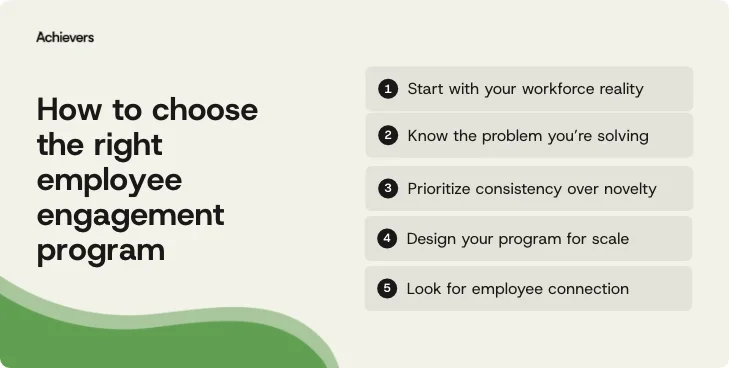
1. Start with your workforce reality
Engagement programs work best when they reflect how and where employees work. Frontline, hybrid, global, and desk‑based teams experience connection differently. Programs should be accessible and relevant across roles, locations, and schedules.
2. Be clear on the problem you’re solving
Different programs drive different outcomes. Recognition strengthens performance and retention. Feedback programs surface risk and opportunity. Career pathways support long‑term growth. Clarity on your primary goal helps prevent “initiative overload” and ensures programs reinforce one another instead of competing for attention.
3. Prioritize consistency over novelty
Prioritize consistency over novelty, because a program’s long‑term value matters more than its launch moment. Engagement improves when experiences are repeated, visible, and are integrated into the tools and programs employees use daily, not when they rely on one‑off events or annual rollouts.
4. Design your program for scale
The most effective engagement strategies don’t aim to do everything at once. They focus on programs that can scale connection consistently as the organization grows or changes. If a program only works for part of the workforce, it’s worth rethinking how it’s designed or how it’s supported.
5. Look for employee connection
High participation doesn’t always equal high engagement. The strongest programs help employees feel seen, heard, and appreciated, by their peers, their leaders, and the organization as a whole. When programs strengthen those connections, engagement follows naturally.
How to use feedback to enhance your engagement programs
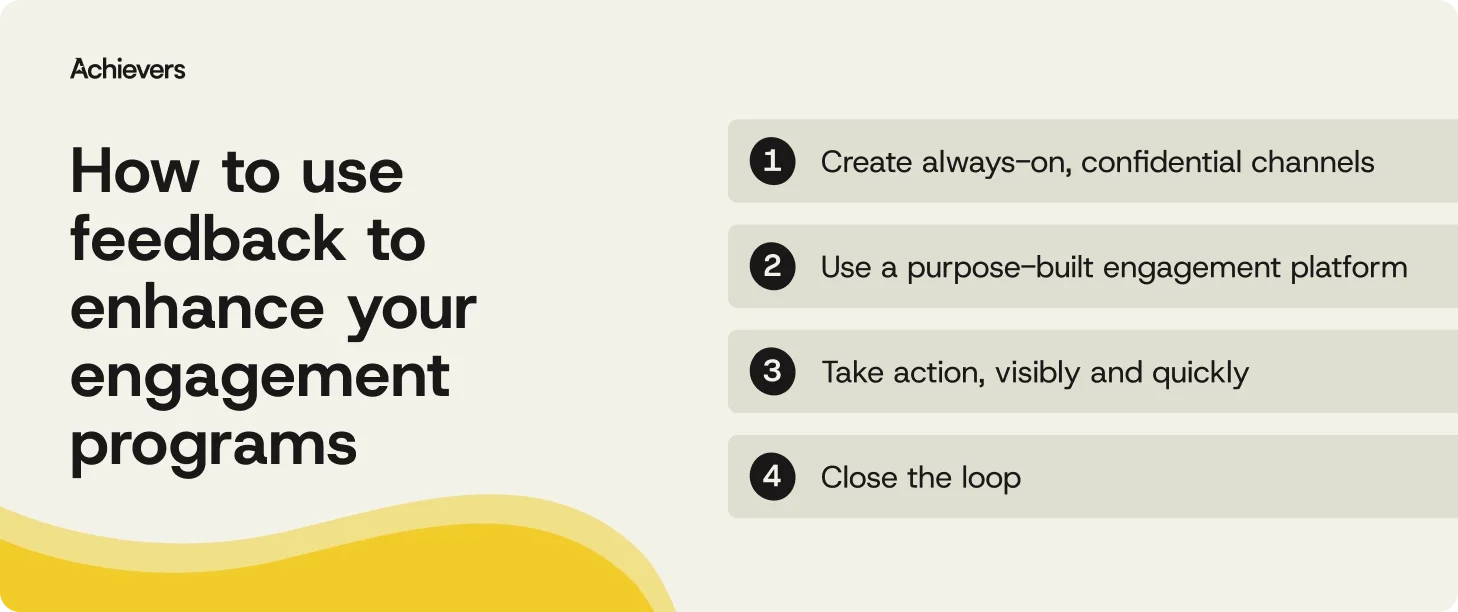
Create always-on, confidential channels
Always-on, confidential channels, from employee survey questions to digital suggestion boxes and HR chatbots, should be easy, accessible, and safe to share. Offering multiple confidential touchpoints shows employees their input is welcome anytime, not just during an annual review.
Use a purpose-built engagement platform
A purpose-built employee engagement platform brings together surveys, sentiment analytics, and feedback history to uncover what’s really driving engagement (or holding it back). That insight empowers leaders to act fast and with precision.
Take action, visibly and quickly
Take action quickly, because nothing builds an employee’s disengagement faster than ignored feedback. When employees raise concerns, whether it’s workload, team dynamics, or resource gaps, respond with clarity, empathy, and urgency. Action, not acknowledgment, drives culture change.
Close the loop
Close the loop by sharing what you heard, what you’re doing about it, and why. Whether it’s launching new training, updating a policy, or adding resources, clear communication turns feedback into a shared success story.
What makes an employee engagement program successful?
Launching engagement programs is only half the equation. Sustaining them? That takes intention, alignment, and a culture that puts people first. Because when the right environment supports the right initiatives, employees don’t just show up — they show up inspired, connected, and ready to contribute.
Here are eight must-haves that turn good programs into great outcomes:
1. Clear, human communication
Open, consistent communication keeps everyone aligned and builds trust from the inside out. Whether it’s pulse surveys, all-hands updates, or one-on-one check-ins, people want to feel informed, heard, and valued.
2. A clear purpose
A clear purpose and strong values turn everyday tasks into meaningful contributions and foster a culture of shared momentum.
3. Accountability that empowers growth
Growth-powered accountability should set clear expectations, provide regular feedback, and celebrate progress. When employees know how their work is measured, and are supported along the way, they stay motivated and focused.
4. Recognition that’s frequent and meaningful
Frequent, meaningful recognition is a behavior-shaping tool that drives productivity and performance, culture, and retention. When employees feel seen and appreciated — by peers, leaders, and teams — they engage more and stay longer.
5. Strong leadership
Strong leaders lead with empathy, recognition, and clarity. They model the behaviors they want to see and create space for others to grow. The best leaders build trust and cultures that scale it.
6. Continuous development
Continuous development, whether it’s mentorship, upskilling, or stretch assignments, opportunities to grow, signal that employees matter. That investment builds loyalty and keeps top talent engaged.
7. Culture that creates belonging
Engagement thrives in belonging-driven cultures and environments where people feel safe to speak up, take risks, and bring their whole selves to work. A strong culture is a competitive advantage.
8. Purpose-driven impact
Programs that are impact driven, support community involvement, sustainability, and ethical practices create pride and meaning that goes beyond the job description.
9. Connection that works across roles, regions, and realities
Great engagement programs connect global, hybrid, and frontline employees with equal consistency and care. That means recognition that reaches frontline teams in real time, communication that cuts across time zones, and experiences that feel inclusive, no matter someone’s role, location, or schedule.
The business impact of employee engagement
Employee engagement isn’t just about morale — it’s about momentum. When employees feel recognized, connected, and supported, they do more than show up. They lean in, speak up, and go further. That’s why the world’s best-run businesses don’t just invest in engagement — they build cultures around it.
Here’s what that looks like in action:
1. Higher productivity
Engaged employees are energized employees. When individuals feel seen, supported, and aligned with your values, they’re more focused, efficient, and motivated to go the extra mile
2. Stronger company culture
Recognition, communication, and purpose are the pillars of a strong company culture. Programs that reinforce those key elements help create environments where employees feel valued, included, and excited to be a part of your organization long-term.
3. Increased retention
Employees stay when they feel heard, recognized, and supported. A robust engagement strategy that’s grounded in feedback, growth, and appreciation, transforms talent into long-term contributors. According to People Managing People, organizations with high employee engagement see a 59% reduction in turnover in low-turnover companies and 24% in high-turnover companies.
4. Better collaboration
From Employee Resource Groups (ERGs) to volunteer initiatives and team-building events, engagement programs strengthen relationships across the organization. This equals more trust, better teamwork, and greater cross-functional impact.
5. Improved well-being
Engagement and well-being go hand in hand. Flexible work arrangements, mental health resources, and wellness support show that leaders care about their employees in and out of the office.
6. Stronger alignment with company vision
When employees understand how their work connects to the bigger picture, motivation follows. Engagement programs help make that connection clear, translating purpose into performance.
7. More innovation and growth
Engaged employees contribute new ideas, seek out opportunities, and invest in their development. These behaviors support innovation, organizational agility, and long-term growth. According to engagement statistics from Small Biz Trends, highly engaged business units are 21% more profitable.
8. Higher customer satisfaction
Happy teams create happy customers. When employees are empowered and engaged, it reflects in every interaction, building trust, loyalty, and a memorable brand experience. According to research from Gallup, engaged employees contribute to a 10% increase in customer ratings.
What should enterprise organizations consider before scaling engagement programs?
1. How the program fits within the existing tech ecosystem
Engagement works best when it fits naturally into existing workflows. Integrations with core HR and collaboration tools help recognition, feedback, and communication show up where work actually happens, especially for frontline and global teams.
2. Data privacy rules and security processes
Employees need to know their data is handled responsibly and their feedback is safe. Clear privacy standards, strong security practices, and transparency around how insights are used help people speak up without second‑guessing the consequences.
3. Consistent program standards and metrics
Clear standards, like values, recognition behaviors, and success metrics allow people leaders and program admins to bring the program to life in ways that make sense locally.
4. Real-time engagement data and insights
More data doesn’t equal a better engagement plan. Instead of collecting everything, prioritize insights that help leaders understand what’s working, where connection is breaking down, and what needs attention next. Engagement improves when employees can see that listening leads to action.
5. Program longevity and scalability
Programs should be easy to sustain, supported by clear ownership, and flexible enough to evolve as the workforce changes. If a program relies on constant manual effort or heroic champions, it’s harder to keep momentum.
How Wesley improved employee engagement
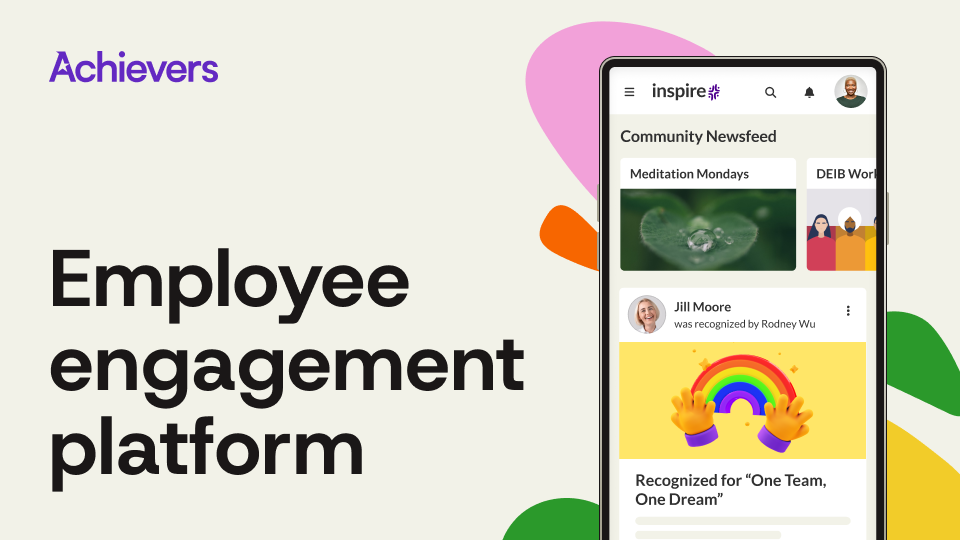
Wesley, a nonprofit healthcare and housing provider, wanted to create a stronger culture across its nursing workforce while addressing retention challenges, improving engagement, and encouraging employees to recognize one another. To support these goals, Wesley worked with Achievers to launch Inspire, a company-wide recognition and rewards program built around employee belonging and peer-to-peer recognition.
The program made recognition accessible across shifts and locations, allowing employees to celebrate achievements, nominate coworkers for awards, send e-cards, and redeem rewards. Wesley also used employee pulse surveys to gather feedback and better understand what mattered most to its workforce.
The results:
- An increase in belonging, from 57.4 to 72.2 points
- A decrease in organization-wide turnover from 67.5% to 34.5% in the first year.
Instead of relying solely on manager-driven recognition, Wesley allowed employees at all levels to contribute to creating a stronger workplace culture.
Achievers is where engagement programs drive results
Achievers helps organizations turn employee engagement from a collection of programs into a connected employee experience. Through recognition, rewards, employee feedback tools, celebration features, and real-time reporting and analytics, organizations can identify engagement challenges and take actionable steps to better support their people.
Whether the goal is improving retention, increasing recognition frequency, strengthening manager effectiveness, or creating a stronger sense of belonging, Achievers gives HR leaders the tools to make a regular part of the employee experience.
Employee engagement programs FAQs
Key insights
- Engagement drives performance, retention, and culture, especially when employees feel seen, heard, and appreciated in everyday moments.
- High‑impact engagement programs work everywhere work happens, supporting frontline, hybrid, and global teams with consistency, flexibility, and purpose.
- An engagement program succeeds when it's chosen intentionally, implemented with clear actions, measured with the right KPIs, and reinforced through ongoing feedback and recognition.